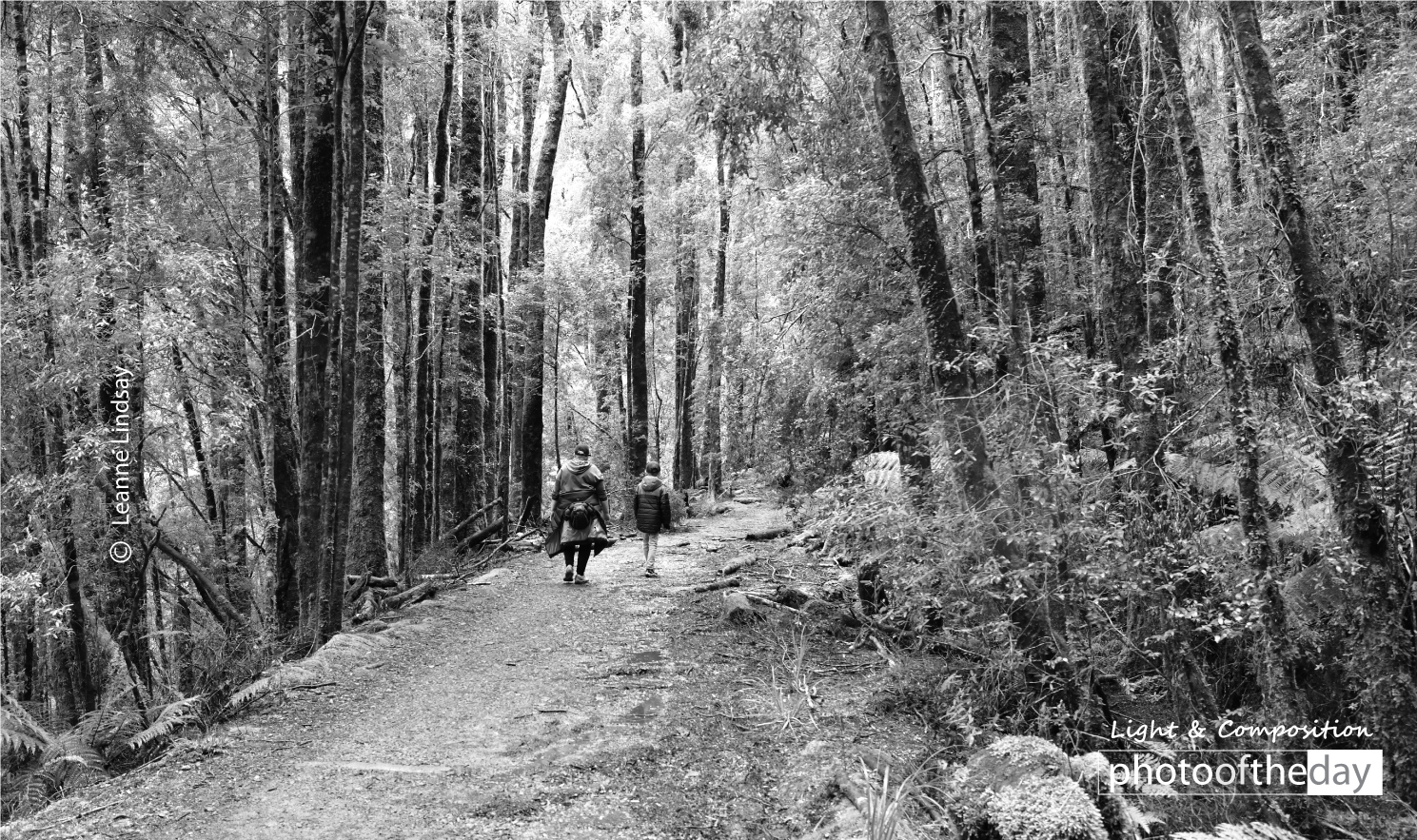
The Lesson by Leanne Lindsay
Captured during a challenging hike through the ancient rainforests of Tasmania, this image documents a poignant intersection of history and nature. As the photographer and her grandson navigated terrain marked by the remnants of abandoned gold mining equipment and decaying tram tracks, the scene served as a living classroom on environmental preservation. By mounting the camera on a tripod and utilizing a timer, the photographer captured a reflective moment of shared discovery. The image is award-worthy for its evocative juxtaposition of industrial decay being reclaimed by lush, encroaching moss and lichen, symbolizing the resilience of the natural world.
Leanne Lindsay
Born in Adelaide in 1962, Leanne Lindsay relocated to Sydney during her youth. Although she received her first camera at age 21, a theft interrupted her creative journey for several decades. Returning to photography in her late 50s, she has since cultivated a vibrant practice specializing in newborn and family portraiture, while maintaining a deep artistic appreciation for architectural and landscape photography.
Resonance Score Breakdown
Transparency Note: The resonance score (7.9/20) is calculated based on social engagement metrics collected before the award announcement.
Expert Photography Reviews · 7
The Rust of Time
There is a specific, metallic scent that lingers in the air long after the machinery has stopped its grinding. It is the smell of iron surrendering to the damp, the slow, orange bloom of oxidation that marks the exact moment a tool stops being a tool and begins to be a relic.
Read the reflection →Lessons in the Quiet
I spent this morning trying to explain to my nephew why we shouldn't pull the weeds in the garden. He wanted everything neat, everything cleared away so the flowers could stand alone.
Read the reflection →Reviews & Comments
Share your thoughts about this award-winning photograph. Your reviews contribute to the community engagement score.

You didn’t just photograph a landscape; you brought your grandson into the frame of history. I’ve spent years in the bush, and there’s a quiet weight to those rusted tracks that you’ve captured perfectly. It’s not about the gear or the moss. It’s about that shared silence between two generations. I felt a lump in my throat looking at it. You waited for the right moment, and you were actually there with him. That’s everything.
The frame’s geometry relies on the tram tracks, which slice the picture plane with necessary aggression. They force the eye toward the figures, creating a fulcrum where industrial decay meets organic chaos. It’s a rigid architecture that keeps the sentimentality in check. I’m actually relieved the moss doesn’t swallow the composition entirely. The tension between the rusted iron and the encroaching forest holds. It’s a disciplined study in spatial weight that doesn’t collapse under its own narrative.
The boy’s posture is static, lacking the kinetic tension of true discovery. He’s standing, not engaging. I’ve spent my life chasing the exact millisecond where intent meets action, and this feels like a rehearsal, not the performance. It’s a quiet scene, sure, but it misses the visceral snap of a body leaning into the unknown. I wanted to see his muscles coiled, ready to scramble over that rusted iron. It’s just too still for me.
Dragging a tripod through Tasmanian scrub isn’t for the faint of heart. One suspects the damp chill of Montezuma Falls seeped into the bones long before the shutter clicked. It’s a quiet, deliberate frame; the rusted tram tracks don’t just sit there, they’ve been earned. I’ve spent enough miserable hours in similar rainforests to appreciate the patience required here. It’s a rare thing to see a lesson taught so softly. She clearly didn’t rush this.
Tripods are for landscapes, not the street. You’ve staged a moment here, and while the moss reclaiming that rusted iron is beautiful, it’s static. It doesn’t breathe. Cartier-Bresson would’ve hunted for the grandson’s movement, the flicker of curiosity in his eyes. I’m left wanting the raw, messy truth of a real encounter. It’s a pretty scene, sure, but it’s missing the pulse. One tenth of a second later and the life is gone. You missed the heartbeat.
The moss-covered iron of these Tasmanian tracks has sat in silence while light from distant galaxies passed overhead, indifferent to our mining. At f/5.6, the depth of field holds both the decay and the forest’s slow reclamation. It’s a quiet, grounding perspective. I find myself shivering, not from the cold, but from the realization that these rusted relics are merely a blink in the timeline of the stars that watched them fall.
Most entries in this category rely on the grandeur of the Tasmanian wilderness, but Lindsay chooses the quiet rot of a rusted tram track. It’s the tension between the sharp, decaying iron and the soft, encroaching moss that makes this endure. I’ve seen thousands of nature shots, yet this one actually made me pause. It’s not just a hike; it’s a generational hand-off. That’s why it’ll still matter in thirty years. It’s a rare, honest lesson.