The Killer by Sourav Das
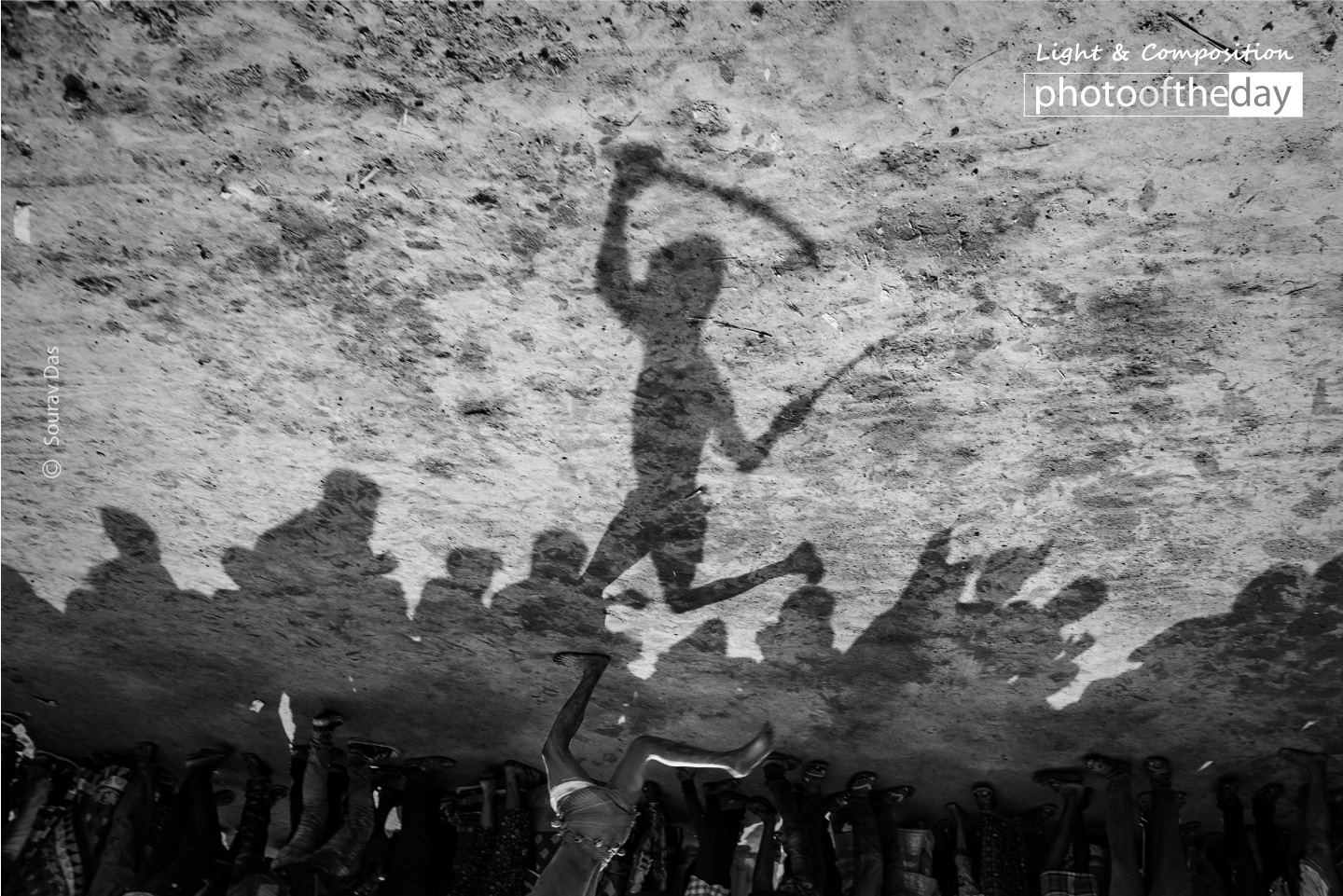
The Killer captures a profound moment during the Gajan festival in West Bengal, where participants, known as sannyasis, express deep devotion through ritualistic sacrifice. The photographer masterfully utilizes the stark contrast of black and white photography to highlight the intensity of the subject’s commitment to this ancient tradition. By focusing on the raw emotion and the central theme of finding spiritual satisfaction through pain, the image transcends mere documentation. It stands as an award-worthy piece for its ability to distill complex cultural rituals into a singular, evocative frame that invites the viewer to contemplate the intersection of faith, humanity, and social custom.
Sourav Das
Based in Kolaghat, West Bengal, Sourav Das is a dedicated photographer who views humanist and street photography as a vital medium for documenting social change. He strives to capture the intricate relationship between traditional customs and modern humanity, aiming to illustrate socio-humanism with the same depth as literature or music. Through his lens, Das seeks to reveal the complexities of social structures, using his work as a tool to engage with common people and reflect the evolving landscape of his community.
Resonance Score Breakdown
Transparency Note: The resonance score (11.2/20) is calculated based on social engagement metrics collected before the award announcement.
Expert Photography Reviews · 7
The Weight of Devotion
I spent this morning trying to fix a loose floorboard in the hallway. It was a small, nagging thing that had been bothering me for weeks, but as I hammered away, I realized how much effort we put into the things we believe in.
Read the reflection →The Weight of Devotion
Is it possible to find liberation in the very things that bind us? We spend our lives constructing walls to keep the chaos of existence at bay, yet we often find that the most profound moments of clarity arrive when those walls are dismantled by our own hands.
Read the reflection →Reviews & Comments
Share your thoughts about this award-winning photograph. Your reviews contribute to the community engagement score.
1/200sec at f/4.5, 24mm, ISO 100. A wide-angle choice that forces proximity. It’s aggressive. At f/4.5, the depth of field is thin enough to isolate the subject but wide enough to keep the chaotic Kolkata background distracting. I’ve seen enough Gajan festival shots to know this focal length is a gamble; here, it barely pays off. The shutter speed is safe, but the composition feels frantic. It’s technically competent, yet it leaves me cold.
At f/4.5, the 24mm focal plane renders the sannyasi’s skin texture with a clinical sharpness that’s almost uncomfortable. The diffraction of light across the sweat and ritual markings is, in the strictest physical sense, extraordinary. I’m genuinely moved by how the lens resolves these micro-details, pulling the viewer into the agony of the moment. It’s a rare instance where the optics don’t just record the ritual; they force us to confront the raw, biological reality of faith.
You didn’t just document a ritual; you felt the weight of that man’s devotion. It’s a heavy frame. I’ve spent enough time in crowds to know how easy it is to lose the individual, but you stayed close. When I look at his eyes, I feel a sudden, sharp ache in my own chest. You waited for the exact second the pain became prayer. That’s not just skill. That’s empathy. You were there.
The visceral intensity here echoes the brutalist honesty of Taryn Simon’s archives, yet Das leans into a chiaroscuro that feels almost Caravaggiesque. It’s a bold departure from the detached ethnographic gaze of the 1950s. While the 24mm perspective risks distortion, the raw, jagged devotion captured in the sannyasi’s expression genuinely stopped me in my tracks. It’s rare to see such ancient, ritualistic pain rendered with this level of modern, unflinching psychological clarity. I’m truly impressed.
There’s a suffocating density here that reminds me of the crushing pressure at thirty metres. Without the light-stealing filter of the ocean, the contrast feels raw, almost violent. I’m struck by the subject’s eyes; they hold the same haunting, alien stillness I’ve seen in a moray eel waiting in the dark. It’s a brutal, beautiful study of endurance. I’d trade my strobe kit for this kind of clarity in the deep any day.
Stripped of pigment, one finds the monochromatic grit of Kolkata’s Gajan festival doesn’t lack colour; it’s a symphony of charcoal shadows and the bruised, silver-grey light of a winter morning. I’m haunted by the way those high-contrast tones mimic the austerity of a Morandi still life, yet it’s the visceral, ink-stained darkness clinging to the sannyasi’s skin that truly makes my heart ache, revealing a spiritual intensity that colour would only dare to dilute.
In the Gajan festival, we see a man caught between worlds. Sourav Das didn’t just point a lens; he listened to the silence of that ritual pain. We look at his eyes and feel the weight of a devotion that transcends the frame. It’s haunting, really. I’ve stared at this face for hours, and I still can’t look away. It’s a portrait that asks to be returned to, reminding us that faith is often written in blood.