The Journey and the Destination by Faisal Khan
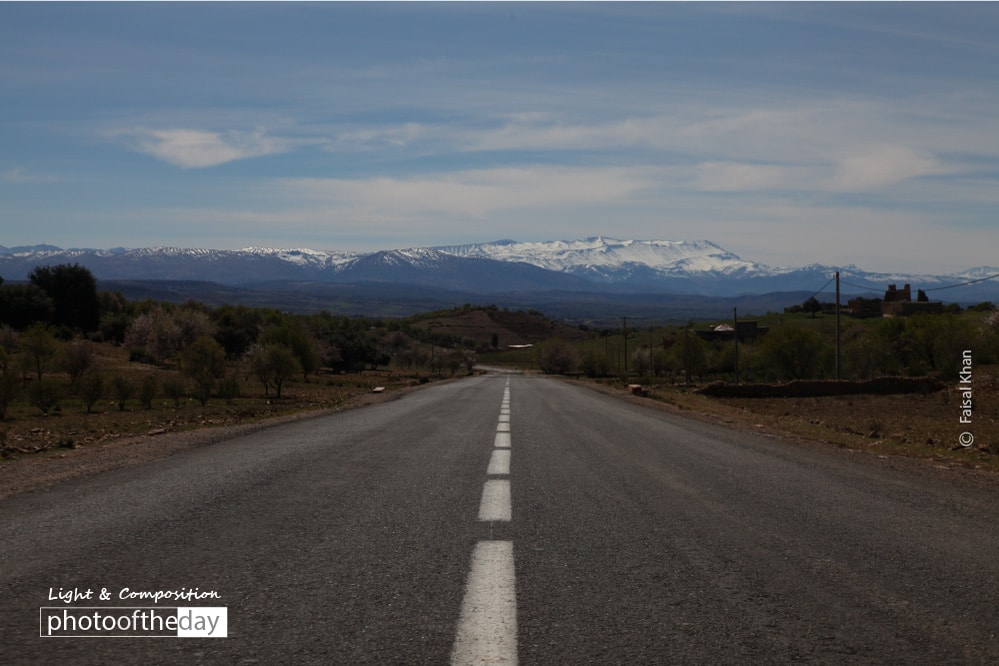
During a family road trip through the Atlas Mountains, the photographer opted for the scenic national route over the highway, seeking a more profound connection with the landscape. This image captures a fleeting moment of simplicity and grandeur amidst the rugged terrain. The composition highlights the majestic scale of the mountains, serving as a visual vessel for the cherished memories formed during the journey. The photograph is award-worthy for its ability to transform a personal travel experience into a universal meditation on nature's power, inviting viewers to pause and reflect on the quiet, awe-inspiring beauty of the natural world.
Faisal Khan
Raised in Saudi Arabia and currently based in Casablanca, Morocco, Faisal Khan is a chemical engineer turned photographer whose work is deeply rooted in his extensive global travels across 30 countries. His photographic practice serves as a meditative extension of his spiritual journey, blending a quest for self-discovery with a profound appreciation for the natural world. By capturing the majesty of creation, Khan aims to inspire viewers to find beauty and purpose in their own lives, viewing his camera as a tool for contemplation and connection.
Resonance Score Breakdown
Transparency Note: The resonance score (12.0/20) is calculated based on social engagement metrics collected before the award announcement.
Expert Photography Reviews · 7
The Geography of Belonging
We often mistake the road for a void, a mere conduit between points of interest. Yet, every path carved through a landscape is a testament to human persistence and the desire to bridge the distance between ourselves and the horizon.
Read the reflection →The Weight of the Path
I keep a small, rusted iron key in my desk drawer that no longer opens any door I know. It is heavy for its size, cold to the touch, and worn smooth by the friction of a hand that has long since stopped reaching for it.
Read the reflection →Reviews & Comments
Share your thoughts about this award-winning photograph. Your reviews contribute to the community engagement score.
The Atlas peaks here aren’t merely stone; they’re a refusal of clarity. Khan’s light hits the ridges, yet it’s the deep, bruised hollows that hold the truth. I’ve stared at these shadows until my eyes ached, feeling the crushing weight of the silence they harbor. It’s not a travelogue; it’s a confrontation with the void. When the light retreats into those crevices, it doesn’t invite us in. It demands we acknowledge our own insignificance before the mountain.
The Atlas range here echoes the stark, geological rigor of early Francis Frith, yet Khan’s 65mm perspective avoids the Victorian tendency toward mere documentation. It’s a quiet, meditative frame that avoids the trap of over-dramatizing the peaks. I’m genuinely struck by the tonal transition in the shadows; it’s handled with a restraint that feels almost like a nod to the Zone System’s discipline. It’s rare to find such honest, unforced grandeur in contemporary travel work. I’m impressed.
Before the eye identifies the Atlas peaks, something in the chest tightens. It’s the sudden, thin air of the High Atlas, a physiological response to such vast, indifferent stone. When I return to this frame, I don’t see a road trip; I feel the silence of that altitude. It’s a quiet, heavy ache. I’ve found myself breathing shallower just looking at it. It doesn’t just show a mountain; it demands your own smallness.
At f/11, the 65mm focal plane captures the High Atlas with clinical sharpness, yet I’m struck by how the diffraction limit hasn’t softened the distant ridgelines. It’s a rare, crisp rendering of geological strata. The light’s interaction with the rugged terrain creates a micro-contrast that’s almost tactile. I find myself wanting to trace those jagged peaks with my own fingers. It’s a beautiful, precise alignment of glass and mountain that truly moves me.
The Atlas peaks press against the frame. They don’t demand attention. They simply exist. I’ve spent minutes watching the shadow stretch across the stone. It’s a heavy, quiet weight. The sky occupies most of the space, yet it doesn’t feel thin. It’s a breath held. I feel a sudden, sharp loneliness looking at it. Nothing here is accidental. The empty corner is not empty. It’s the silence between the mountains. It’s enough.
The light hits the Atlas peaks and the frame snaps into focus. It’s a wide shot, breathless and still. I’ve spent hours in editing suites chasing this exact quality of light, that fleeting second where the landscape stops breathing. At f/11, Khan captures the scale without losing the grit of the road. It’s a quiet, cinematic beat. I’d have killed for this shot on my last feature. The cut would’ve been a mistake; it’s perfect.
We look at these Atlas peaks and we don’t just see stone; we see the silence of a traveler who stopped to listen. Faisal Khan didn’t just capture a landscape; he caught the breath of the mountains. It’s a portrait of the earth itself, ancient and waiting. I feel a sudden, quiet ache for the road when I see this. It’s a photograph that asks to be returned to, because it’s really a conversation with the infinite.
Super Faisal. Want to see more….cheers
Thanks Sajid, few more will be coming soon :)