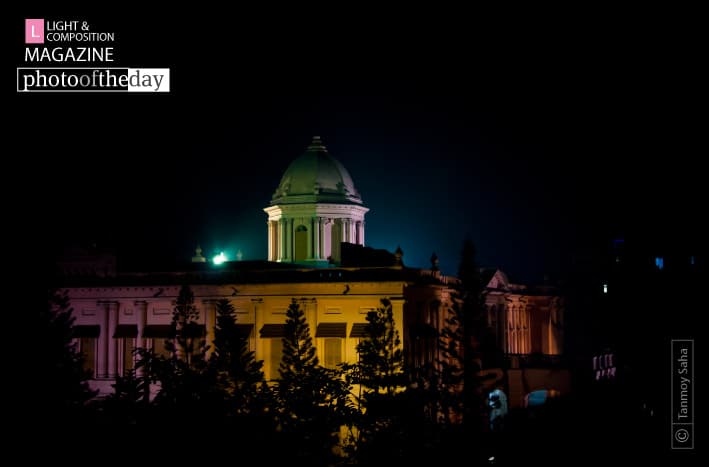
The Inner Colour of Ahsan Manjil by Tanmoy Saha
Captured at the historic Ahsan Manzil, this photograph masterfully explores the interplay between architectural grandeur and nocturnal light. The photographer focuses on the Indo-Saracenic Revival palace, situated along the banks of the Buriganga River, to reveal the structure's hidden character under the cover of night. By emphasizing the superficial glow of artificial illumination against the dark facade, the image transforms a colonial residential landmark into a vibrant, atmospheric study of color and history. This evocative composition stands out for its ability to bridge the gap between historical preservation and contemporary night photography, offering a fresh, luminous perspective on a storied Bangladeshi icon.
Tanmoy Saha
Based in Dhaka, Bangladesh, Tanmoy Saha Turja has been honing his craft since 2007. His photographic repertoire spans diverse genres, with a particular emphasis on portraiture, landscapes, and wildlife. Having refined his technical foundation through studies at the Dhaka University Photography Society and Pathshala, he continues to develop a keen eye for capturing the cultural and architectural essence of his surroundings.
Resonance Score Breakdown
Transparency Note: The resonance score (13.5/20) is calculated based on social engagement metrics collected before the award announcement.
Expert Photography Reviews · 6
The Architecture of Memory
We often mistake the past for a closed room, a place where the dust has settled and the keys have been turned in the lock. But history is not a static thing; it is a living, breathing architecture that waits for the sun to set before it begins to whisper.
Read the reflection →The Hum of Cooling Stone
The air after a long day of heat has a specific, metallic tang, like copper coins pressed against the tongue. It is the smell of stone releasing the sun it swallowed hours ago, a slow, radiating exhale that brushes against the skin like a damp silk sheet.
Read the reflection →Reviews & Comments
Share your thoughts about this award-winning photograph. Your reviews contribute to the community engagement score.
Ahsan Manzil doesn’t merely glow; it bleeds light into the void of the Buriganga. I’m unsettled by how the artificial hum clings to the stone, desperate to deny the encroaching night. It’s a colonial ghost trying to outrun its own history. When I look at these deep, suffocating shadows, I feel a genuine chill. The darkness here isn’t empty; it’s the heavy, silent judge of everything the light is too afraid to admit.
Of the thousands of architectural studies I’ve reviewed, most rely on predictable symmetry. Saha avoids that trap. By letting the artificial light bleed into the deep shadows of the Ahsan Manzil, he forces us to confront the palace’s decay rather than its postcard polish. It’s haunting. I’ve stared at this for twenty minutes, and I still feel a shiver of unease. In thirty years, this won’t just be a record; it’ll be a ghost story.
The architecture’s symmetry provides a necessary anchor, yet the frame’s edges feel loose. The artificial light creates a harsh, discordant geometry against the dark facade. It’s a struggle between historical weight and modern illumination. I’m frustrated by the lack of tighter control over the negative space; the composition doesn’t quite hold its own gravity. It’s technically competent, but the spatial tension remains unresolved. The structure demands more discipline than it’s been granted here.
The ochre glow bleeding across the facade of Ahsan Manzil recalls the bruised, heavy yellows of a Turner sunset, yet it’s the way the artificial light clings to the masonry that truly arrests one’s breath. It’s a haunting, liquid gold, shivering against the ink-black void of the Buriganga, and I’ve found myself utterly seduced by how the shadows don’t merely hide the architecture, but rather, they’ve invited the stone to dream in deep, melancholic umber.
It’s easy to snap a palace when the floodlights are humming. One wonders if Saha stood there until the humidity settled or if he simply caught the first bus. The composition is tidy, but it lacks the grit of a long, shivering vigil. I’ve spent enough nights in damp air to know when a photographer has truly committed. This feels a bit too convenient. It’s a pretty postcard, but I’m not convinced he earned it.
The Buriganga’s breath must have been heavy that night. Tanmoy didn’t just capture a palace; he waited until the artificial glow surrendered to the building’s own quiet history. It’s a rare, haunting stillness. I’ve stood in such shadows, feeling the stone pulse with the weight of centuries. When I look at these warm, amber reflections against the encroaching dark, I feel a sudden, sharp ache for the silence he found before the shutter clicked.
Hats off Tanmoy …
Great work :)