The Happiness Factor by Jabbar Jamil
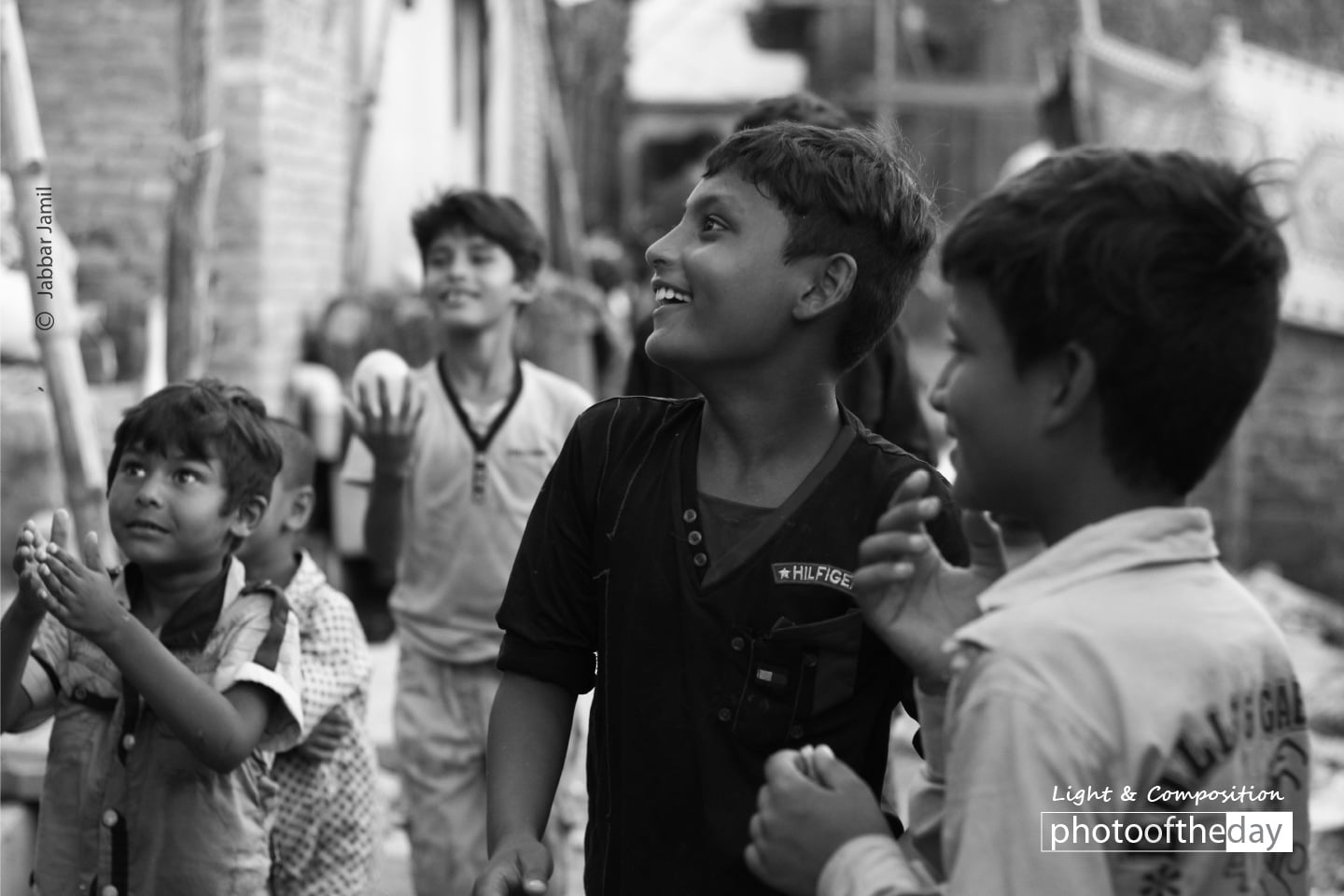
In the vibrant streets of Sialkot, Jabbar Jamil captured a fleeting, candid moment of pure childhood joy. The photograph centers on a group of children, specifically highlighting a young boy on the left who playfully clasps his hands to amuse his peers. This spontaneous interaction, born from a simple desire to create laughter, defines the essence of the image. The photographer’s ability to anticipate this genuine human connection amidst the chaos of street life is what elevates the work, transforming an ordinary afternoon into an award-worthy study of happiness and communal spirit.
Jabbar Jamil
Based in Sialkot, Pakistan, Jabbar Jamil is a dedicated street photographer who views his craft as a vital bridge between himself and the outside world. By stepping beyond his comfort zone, he captures authentic human connections that transcend the frame, using photography as both a creative outlet and a therapeutic pursuit. His work is characterized by an honest, observant approach, documenting the realities of his environment with a focus on the profound stories found in everyday life.
Resonance Score Breakdown
Transparency Note: The resonance score (11.7/20) is calculated based on social engagement metrics collected before the award announcement.
Expert Photography Reviews · 7
The Currency of Laughter
We spend our lives gathering heavy things—the iron weight of schedules, the stone walls of expectation, the dry leaves of old regrets. We carry them until our shoulders ache, forgetting that the lightest things are often the ones that hold the most gravity.
Read the reflection →The Weight of a Laugh
I keep a small, smooth river stone on my desk that I found in my grandfather’s coat pocket after he passed. It is heavy for its size, worn down by water and time until it fits perfectly into the hollow of my palm.
Read the reflection →Reviews & Comments
Share your thoughts about this award-winning photograph. Your reviews contribute to the community engagement score.

The light in Sialkot doesn’t just fall; it settles, thick and golden, against the dust of the street. I’ve spent enough hours waiting for the sun to soften to recognize that glow. It’s the hour when the world breathes. Watching that boy’s hands, I feel a sudden, sharp ache for the simplicity of his joy. He wasn’t posing for a lens; he was just listening to the rhythm of the afternoon. It’s beautiful, really.
Sialkot’s streets offer a stage, but who directed this performance? The boy’s clasped hands invite laughter, yet I find myself unsettled by the framing. Does his joy belong to him, or is it merely a prop for our consumption? It’s a sharp, clean composition, but it feels curated rather than caught. Why are we so eager to label poverty as pure happiness? I’m left wondering if we’ve mistaken a fleeting gesture for a profound truth.
Sialkot’s urban fabric isn’t just backdrop here; it’s a participant. The harsh, raking light defines the masonry’s texture, creating a datum against which these children’s movement feels kinetic. I’m struck by how the deep shadows in the threshold behind them compress the space, forcing our focus onto the boy’s gesture. It’s a rare, honest capture of how architecture shapes communal joy. I’d love to know what lies beyond that frame, but for once, I don’t mind.
The frame resolves into a series of intersecting triangles, anchored by the boy’s raised arms. His posture creates a sharp, upward-pointing vector that disrupts the horizontal chaos of the Sialkot street. I’m struck by how the negative space around his hands balances the dense, dark mass of the crowd on the right. It’s a perfect 1:2 ratio of light to shadow. Honestly, the way he anchors the entire composition’s gravity is just brilliant geometry.
The street in Sialkot is loud, but the frame isn’t. The boy’s hands hold a quiet gravity. He creates a center, yet the surrounding blur allows the air to breathe. I’ve spent minutes watching the way the light touches the dust. It’s a rare stillness. Nothing here is accidental. The empty corner is not empty. It’s where the joy settles. I feel a sudden, sharp ache for that kind of simple, unburdened space.
Of the thousands of street shots I’ve reviewed, most rely on cheap sentimentality. This one survives because of the boy’s hands. That specific, awkward gesture isn’t just play; it’s a desperate, brilliant bid for connection. It honestly makes me grin every time I look at it. While others captured the chaos of Sialkot, Jamil captured the precise millisecond where joy becomes a communal language. It’s a small, enduring truth that will still matter in thirty years.
Street photography is usually a frantic affair, but Jamil clearly didn’t just stumble upon these children. He’s waited in that Sialkot heat until the chaos settled into a rhythm. The boy’s hands are perfectly timed, a fleeting gesture caught with genuine intent. I’ve spent enough afternoons in dust and humidity to know that sort of patience isn’t cheap. It’s a rare, honest bit of joy. One suspects he returned to this corner more than once.