The Guiding Light By Ruben Alexander
The Guiding Light captures the historic Tangasseri Point Lighthouse in Kollam, Kerala, a structure dating back to 1902. The photographer chose a long exposure of two seconds at f/16 to emphasize the lighthouse's striking red and white diagonal stripes against the evening sky. By focusing on this 42-meter landmark, the image highlights the intersection of colonial maritime history and modern metal halide illumination. This photograph is award-worthy for its precise technical execution and its ability to transform a functional navigational aid into a compelling, atmospheric study of light and heritage along the Indian coastline.
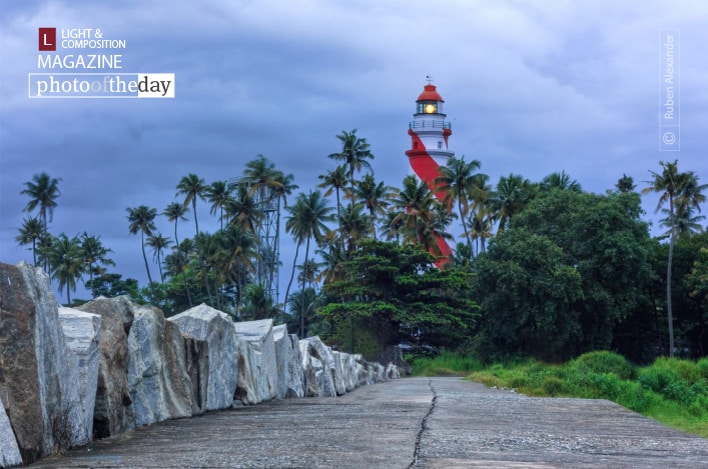
Exposure 2sec @ f/16 | ISO 200 | Focal Length 50mm
Ruben Alexander
Based in Bangalore, India, Ruben Alexander balances a professional career in the IT industry with a dedicated pursuit of photography. As a self-taught artist, he utilizes the camera as a vital creative outlet and a means of personal expression. His growing portfolio spans diverse genres, including nature, macro, landscape, and street photography, as he continues to refine his technical skills and artistic vision.
Resonance Score Breakdown
Transparency Note: The resonance score (13.1/20) is calculated based on social engagement metrics collected before the award announcement.
Expert Photography Reviews · 4
The Architecture of Warning
We have always been a species obsessed with the signal. From the primitive watchfires on a dark coastline to the rhythmic pulses of modern navigation, we build structures specifically to say: here is the edge, and here is where you must turn.
Read the reflection →Salt on the Tongue
The air near the sea has a specific weight, a dampness that clings to the skin like a second, invisible layer of clothing. I remember the taste of it—a sharp, metallic tang of salt that settles on the back of the throat, mingling with the scent of wet stone and cooling sand.
Read the reflection →Reviews & Comments
Share your thoughts about this award-winning photograph. Your reviews contribute to the community engagement score.
The air in Tangasseri must have been thick with salt that evening. He stood there, waiting for the light to soften into that two-second breath of exposure. It’s not just a lighthouse; it’s a silent conversation between stone and sky. I feel a sudden, quiet ache in my chest looking at those red stripes against the dusk. He didn’t just capture a landmark; he listened to the coast until it finally decided to reveal its soul.
The lighthouse stripes scream of colonial imposition, yet it’s the encroaching dusk that truly commands the frame. By choosing a two-second exposure, Alexander forces the light to bleed into the void, blurring the line between history and erasure. I find myself shivering at the cold, clinical precision of that metal halide beam. It doesn’t illuminate the coast; it interrogates it. Darkness here isn’t a backdrop. It’s the heavy, suffocating silence of a century left behind.
Most long exposures of lighthouses are predictable, but this one avoids the trap of mere documentation. By holding the shutter for two seconds, Alexander lets the metal halide glow bleed into the dusk, grounding the structure in its coastal reality. I’ve seen thousands of architectural shots, yet this one lingers because it captures a specific, fading silence. It’s a quiet, honest piece of history. I’d be glad to see this hanging in a gallery thirty years from now.
The lighthouse’s diagonal geometry anchors the frame, forcing a rigid verticality against the encroaching dusk. It’s a disciplined study in spatial tension. The f/16 aperture renders the stripes with clinical sharpness, yet the composition doesn’t quite resolve the heavy negative space on the left. I’ve grown weary of such predictable framing, but the sheer structural weight of that red-and-white column is undeniable. It holds the picture plane together, even if the surrounding atmosphere remains largely inert.