The Edge by Klara Marciniak
Captured at the historic Santa Barbara castle in Alicante, this photograph portrays two tourists silhouetted against the vast, endless sea. The composition masterfully juxtaposes the solid, ancient stone of the fortress with the fluid, expansive horizon, creating the illusion of figures standing at the very edge of the world. The photographer sought to capture a moment of boundless joy and a profound desire for freedom, emphasizing the elemental meeting of earth, water, and air. This image is award-worthy for its evocative storytelling and its ability to transform a simple tourist encounter into a timeless meditation on human connection and the natural world.
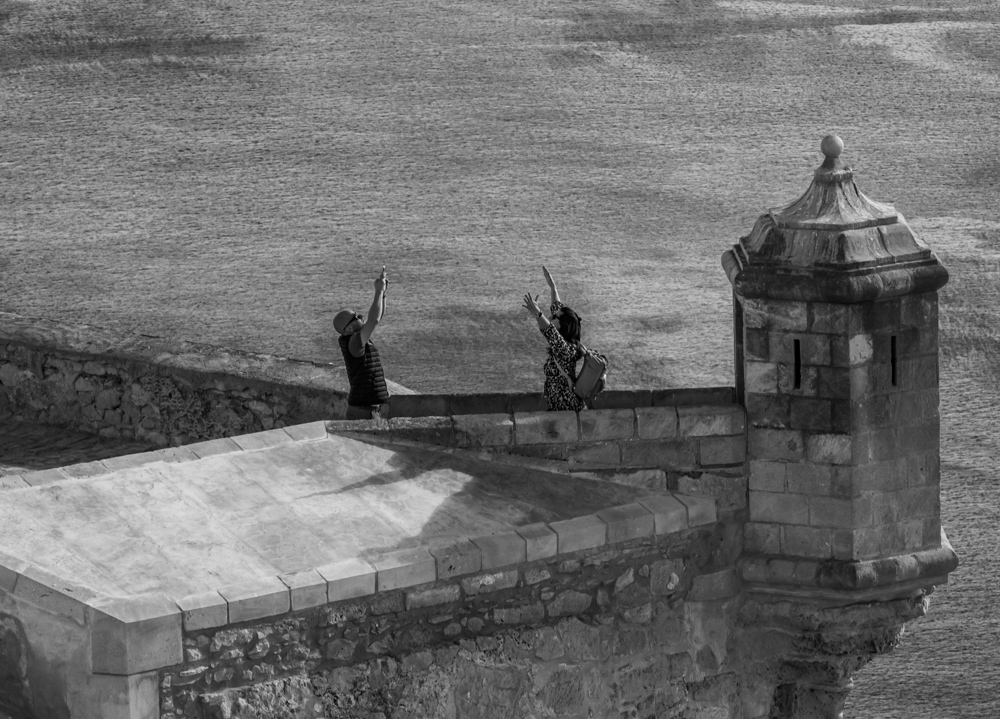
Exposure 1/250sec @ f/13 | ISO 320 | Focal Length 105mm
Klara Marciniak
Klara Marciniak is a Polish-Hungarian photographer based in Alicante, Spain, who specializes in urban photography and the documentation of everyday life. Driven by a desire to preserve fleeting moments for future generations, she captures common scenes from unique, personal perspectives. Outside of her photographic pursuits, she balances her creative work with a career in a family publishing house and time spent with her family.
Resonance Score Breakdown
Transparency Note: The resonance score (1.7/20) is calculated based on social engagement metrics collected before the award announcement.
Expert Photography Reviews · 4
Where the Tide Meets Stone
When a limpet clings to a rock face, it does so with a suction so absolute that it becomes, for all intents and purposes, a part of the geology itself.
Read the reflection →Where the Stone Meets Silence
I often find myself thinking about the places where the city finally runs out of pavement, where the iron railings and the crumbling brickwork surrender to the vast, indifferent blue.
Read the reflection →Reviews & Comments
Share your thoughts about this award-winning photograph. Your reviews contribute to the community engagement score.
1/250sec at f/13, ISO 320, 105mm. Stopping down to f/13 on a crop sensor invites diffraction, yet here it’s a calculated necessity to keep the fortress wall and distant horizon sharp. It’s a rigid, clinical choice that works. I’ve spent years staring at soft, lazy apertures, so this deliberate clarity is refreshing. The technical discipline holds the composition together. It’s not poetic, but it’s correct. The numbers don’t lie; she nailed the focus.
Looking at this horizon from the Santa Barbara castle, I’m struck by how much I miss the density of the Mediterranean. Up here, light travels through air without the brutal absorption that steals my reds and oranges at depth. It’s clean, sharp, and mercifully free of backscatter. While I usually crave the refractive index of water, there’s a strange, quiet beauty in seeing these silhouettes against a surface that isn’t trying to swallow them whole.
Two tourists silhouetted against the Mediterranean. It’s a classic trope, but does it actually capture freedom or just our obsession with consuming landscapes? I’m struck by a cold detachment here; the stone fortress feels more alive than the people. Why are we so eager to turn human presence into anonymous, decorative shapes? Does this frame erase their humanity to satisfy a romanticized aesthetic? It’s technically sharp, but it leaves me feeling completely hollow.
The stone rampart anchors the frame, providing a necessary fulcrum against the horizon’s void. It’s a rigid geometry that keeps the composition from collapsing into sentimentality. The silhouettes are placed with precision, their verticality cutting the horizontal plane. I’ve grown weary of tourist snapshots, but the tension here holds. The negative space doesn’t just exist; it demands silence. It’s a cold, calculated architecture that finally earns its weight. The frame remains disciplined, and that’s enough.