The Catch by Prasanth Chandran
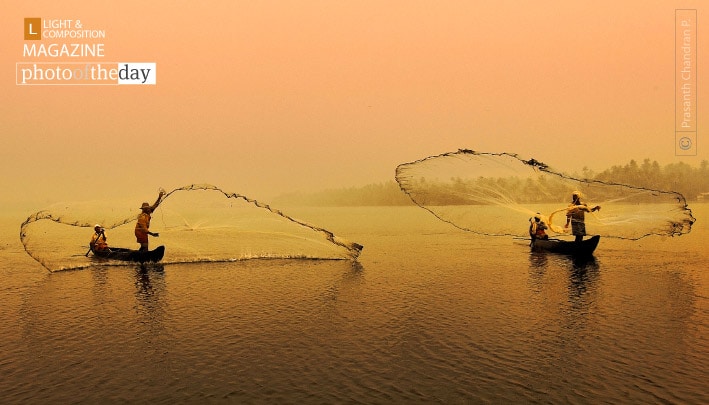
Captured in the soft, ethereal light of an early morning in Kerala, this photograph documents the rhythmic tradition of local fishermen casting their nets. The image is defined by the perfect symmetry of the fishermen’s movement, which creates a dynamic sense of motion against the tranquil waters. Prasanth Chandran’s decision to frame this moment highlights the harmony between human labor and the natural environment. The photograph is award-worthy for its immaculate composition and the way it elevates a daily routine into a timeless, evocative visual narrative of coastal life.
Prasanth Chandran
Based in Cochin, India, Prasanth Chandran began his photographic journey in 2009. His work focuses on documenting the diverse essences of Kerala, ranging from local festivities to the quiet rhythms of daily life. Driven by a desire to tell stories that move the heart and soul, he uses his camera to translate the beauty of his surroundings into inspiring visual narratives for an international audience.
Resonance Score Breakdown
Transparency Note: The resonance score (11.7/20) is calculated based on social engagement metrics collected before the award announcement.
Expert Photography Reviews · 4
The Geometry of Sustenance
In the quiet hours before the world fully wakes, there is a specific rhythm to the act of providing. We often think of labor as a heavy, linear thing—a push from point A to point B—but the oldest ways of gathering are circular.
Read the reflection →The Weaver of Tides
To cast a net is to throw a prayer into the throat of the sea. It is a gesture of faith, a wide-reaching arc that seeks to gather the invisible into the palm of the hand.
Read the reflection →Reviews & Comments
Share your thoughts about this award-winning photograph. Your reviews contribute to the community engagement score.
The net hangs in the air like a suspended question, a web of geometry defying the chaos of the tide. It’s here that the darkness matters; the deep, bruised water isn’t just a backdrop, but a hungry void waiting to reclaim the labor. I’ve stared at this arc for an hour, feeling the cold weight of the morning. It doesn’t invite us in. It demands we acknowledge the silence that swallows every human effort whole.
The symmetry here is almost too tidy, yet one can’t help but admire the patience required to time that arc of the net. It’s clear Chandran didn’t just stumble upon this; he’s stood in that damp sand until his boots leaked. I’ve spent enough mornings shivering in the salt spray to recognize the commitment. It’s an earned moment, and frankly, it makes me miss the smell of the tide. A fine, disciplined bit of work.
The ochre of the fishermen’s skin against the bruised, violet-grey of the Kerala surf creates a chromatic tension that’s truly intoxicating. It’s a palette reminiscent of Turner’s late, atmospheric dissolution, where the light doesn’t merely illuminate but consumes the form. One feels the damp, salt-heavy air clinging to the lungs; it’s a visceral, shivering beauty that makes me ache for the dawn, as if the very pigments were bleeding into the morning tide.
Most entries in this category rely on the spectacle of the net’s arc, but they’re often just pretty snapshots. What separates this from the pack is the tension between the fishermen’s synchronized posture and the stillness of the Kerala water. I’ve seen thousands of these, yet this one makes me ache for that quiet morning air. It’s the restraint that wins here; it’ll still feel honest and vital in thirty years when the tradition has faded.