Thai Fishing Boat by Leanne Lindsay
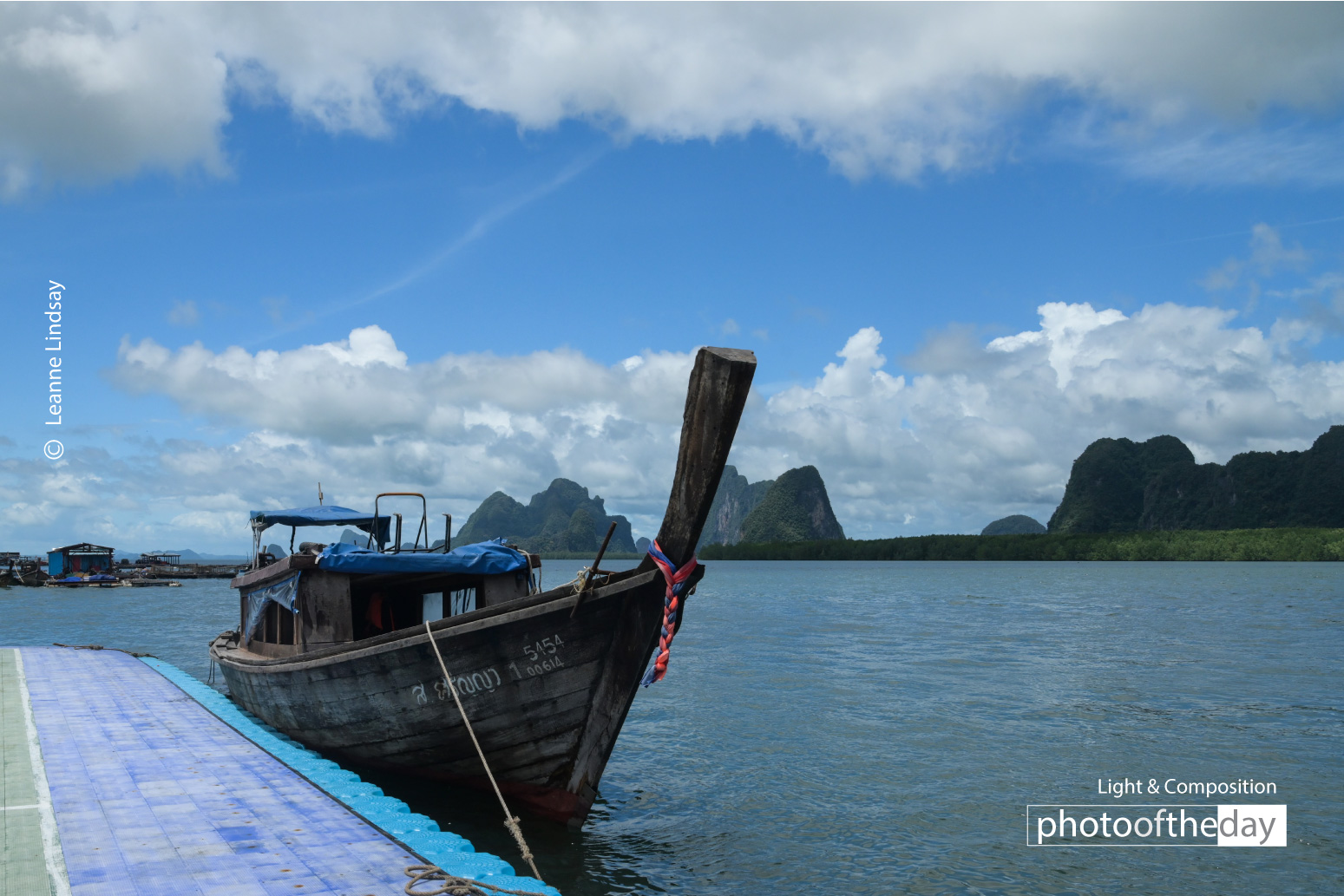
This evocative photograph captures a weathered fishing boat moored within the majestic topography of Phang Nga Bay, Thailand. By framing the vessel against the backdrop of a traditional floating village, the photographer highlights the enduring maritime heritage of the region. The image was captured with a Nikon Z7ii at 24mm, utilizing a fast shutter speed to freeze the intricate details of the boat’s aged texture. This composition is award-worthy for its ability to weave a rich cultural narrative, transforming a simple scene of daily life into a profound visual testament to Thailand’s living history.
Leanne Lindsay
Born in Adelaide in 1962, Leanne Lindsay relocated to Sydney during her youth, where she eventually rediscovered a lifelong passion for photography in her late fifties. Though she specializes in family and newborn portraiture, she possesses a keen eye for the structural beauty of landscapes and architectural subjects. Now based in Sydney, Australia, Lindsay channels her renewed creative energy into documenting the world around her with a focus on narrative depth and technical precision.
Resonance Score Breakdown
Transparency Note: The resonance score (7.8/20) is calculated based on social engagement metrics collected before the award announcement.
Expert Photography Reviews · 7
The Rhythm of the Tides
There is a quiet dignity in things that have spent their lives working against the water.
Read the reflection →The Weight of Wood and Water
When I was seven, my grandfather took me to the creek behind his house to look at his old wooden skiff. I remember the smell of it—damp, salty, and thick with the scent of rot and river mud. He told me that a boat is never just a tool; it is a promise made to the water.
Read the reflection →Reviews & Comments
Share your thoughts about this award-winning photograph. Your reviews contribute to the community engagement score.

Most travel photography is just visual noise, but this boat’s salt-crusted wood tells a story that won’t fade. I’ve seen thousands of shots of Phang Nga Bay, yet this one avoids the usual postcard trap. By anchoring the frame on the boat’s decay against the distant village, Lindsay forces us to confront the passage of time. It’s haunting. I’d hang this in my own home because it makes me feel the humidity of that morning.
The boat sits low. Wood grain against the vast, still water. I’ve spent minutes staring at the horizon line. It’s thin. It’s precise. The village behind doesn’t crowd the frame; it recedes. It’s a quiet exhale. I feel a sudden, sharp ache for that stillness in my own life. Nothing here is accidental. The empty corner is not empty. It’s a breath held in the heat of Phang Nga. It’s enough.
Phang Nga’s limestone karsts evoke the sublime landscapes of early 19th-century travelogues, yet Lindsay’s framing feels tethered to the ethnographic precision of Frank Hurley. While the weathered hull’s texture is rendered with modern digital sharpness, it’s the boat’s isolation that haunts me. It’s a quiet, lonely geometry I haven’t seen captured quite this way in years. I’m genuinely moved by how she’s navigated the tension between travel cliché and a genuine, solitary maritime history.
The boat’s prow creates a sharp vector, slicing the frame into a precise 1:3 ratio against the limestone karst. It’s a masterclass in spatial tension. The vertical mast acts as a stabilizing axis, anchoring the chaotic textures of the weathered hull. I’m genuinely struck by how the negative space in the upper quadrant balances the boat’s visual weight. It’s a perfectly solved equation of mass and void. I’ve rarely seen geometry feel this alive.
At f/9, the Z7ii’s sensor resolves the boat’s weathered timber with a clinical sharpness that borders on the tactile. The diffraction limit hasn’t yet softened the grain of the wood, allowing the Sigma’s optics to render every splinter in high relief. I’m genuinely moved by how the light catches those salt-crusted textures; it’s as if the lens has peeled back the air itself. It’s a rare, precise encounter with reality that the human eye simply can’t replicate.
The light here isn’t searching; it’s settled. I’ve spent enough mornings on the water to know the stillness Leanne felt when she caught this. The boat’s weathered wood doesn’t just sit in the frame; it breathes against the limestone giants. It’s a quiet, heavy peace. Looking at those ripples, I feel a sudden, sharp ache for the humidity of that bay. She didn’t rush the moment, and because of that, the silence remains intact.
The boat’s wood is beautifully weathered, but the frame feels empty. I’m looking for the person who calls this vessel home, yet they’re nowhere to be found. It’s a clean, sharp shot of a landscape, but it lacks the pulse of a life lived on the water. I’ve spent years waiting for a subject to meet my gaze; without that human connection, it’s just a boat. I’m left wanting the story behind the paint.