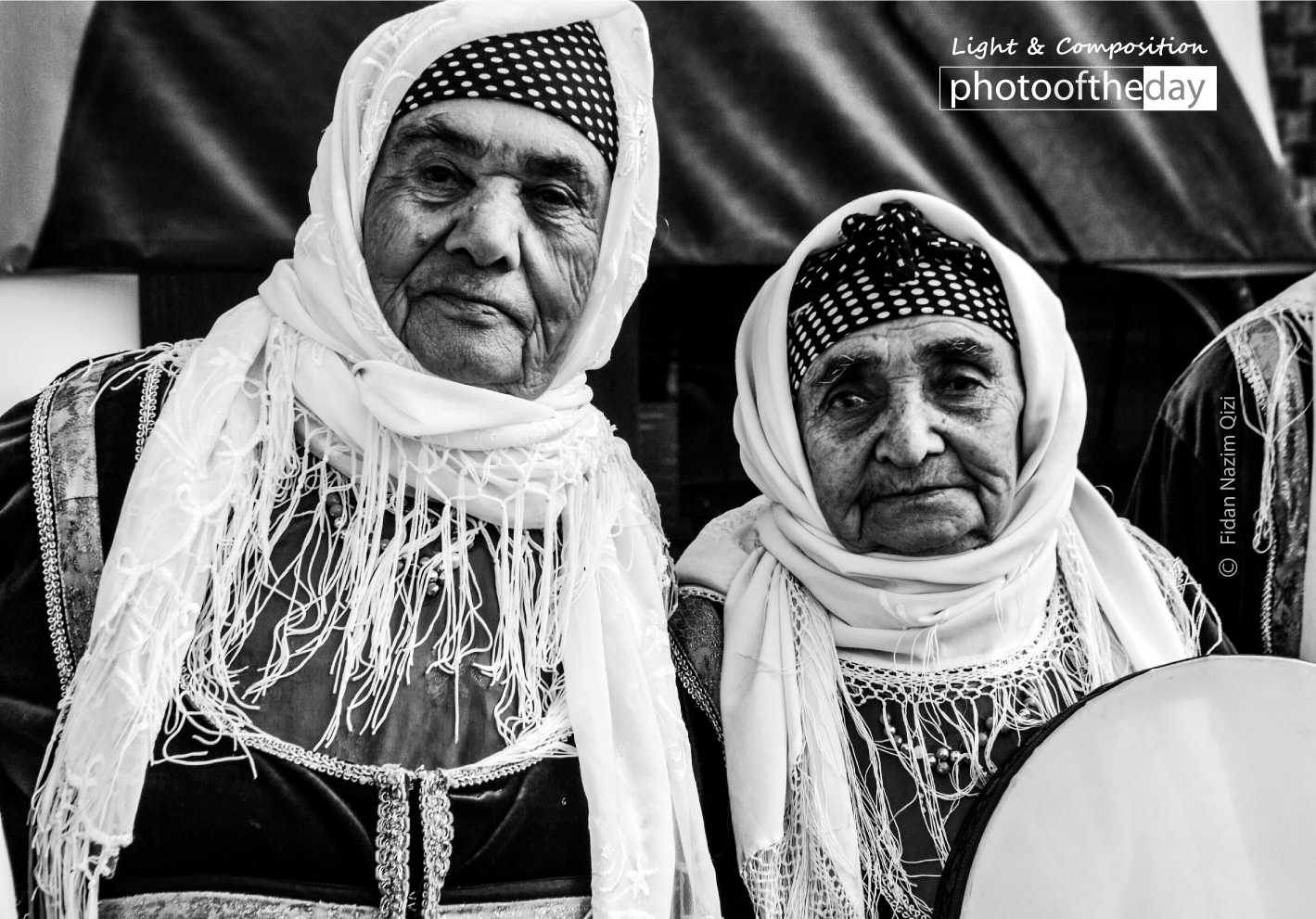
Talysh Grandmothers by Fidan Nazim Qizi
This poignant portrait captures two grandmothers from the Talysh ethnic group, an indigenous community spanning the South Caucasus and the Caspian shore. The photographer utilized a 55mm focal length to create an intimate connection with the subjects, capturing the resilience and cultural heritage etched into their expressions. By focusing on the unique features and traditional presence of these women, the image serves as a powerful ethnographic study. Its award-worthy quality lies in the masterful composition and the photographer's ability to document a vanishing linguistic and cultural identity with profound empathy and technical precision.
Fidan Nazim Qizi
Born in Baku, Azerbaijan, Fidan Nazim Qizi is a dedicated photographer who balances her life in her home city with frequent international travels. Inspired by the evocative black and white imagery of Vivian Maier, she developed a signature style that emphasizes emotional depth and atmospheric storytelling. Her work is driven by a belief in photography's unique capacity to inspire and transmit human energy. An avid hiker and nature enthusiast, she often turns her lens toward the rugged landscapes and diverse cultures of her homeland, seeking to preserve the spirit of the people she encounters.
Resonance Score Breakdown
Transparency Note: The resonance score (11.5/20) is calculated based on social engagement metrics collected before the award announcement.
Expert Photography Reviews · 7
The Weight of Unspoken Dialects
My grandmother’s kitchen used to smell of dried mint and the sharp, metallic tang of a wood-burning stove that no longer exists. It is the specific silence of that room that haunts me now—not a quiet of peace, but a quiet of erasure.
Read the reflection →The Archive of the Face
Seneca once remarked that while we are busy counting our years, we often forget to count our days, failing to see that time is not merely a quantity to be measured, but a vessel to be filled.
Read the reflection →Reviews & Comments
Share your thoughts about this award-winning photograph. Your reviews contribute to the community engagement score.
Most entries in this category rely on costume to do the heavy lifting, but Fidan’s portrait succeeds because of the geography in those faces. The 55mm lens forces an intimacy that feels earned, not stolen. I’ve seen thousands of ethnographic studies, but these women’s eyes hold a specific, stubborn history that makes me ache for a world fading away. It’s the quiet refusal to look away that ensures this will still matter in thirty years.
Two faces. Deep lines. The weight of the Talysh mountains rests in their stillness. I’ve spent minutes watching the shadows between them. It’s a quiet geography. Nothing here is accidental. The empty corner is not empty. It holds the breath they’ve taken for decades. I feel a sudden, sharp ache for the silence they carry. They don’t need to speak. The frame doesn’t ask for more. It’s enough. Just this. The pause between heartbeats.
We sit with these Talysh grandmothers, and we hear the silence of a language fading into the wind. Fidan listened to the stories etched into their skin before she ever clicked the shutter. It’s in the way they lean together, a shared history held in their hands. I’ve looked at this for an hour, and my heart aches for the songs they’ve kept alive. It’s a portrait that asks to be returned to, again and again.
At f/10, the D3100’s sensor resolves the micro-contrast of these women’s skin with startling fidelity. The 55mm focal length avoids the distortion of a wider lens, keeping the focal plane razor-sharp across their weathered features. I’m genuinely moved by how the diffraction limit hasn’t softened the intricate textures of their headscarves. It’s rare to see such optical honesty; the light hasn’t just hit their faces, it’s revealed the very history etched into their pores. It’s breathtaking.
Those faces are maps of a vanishing world. I love the way the light catches the texture of their headscarves; it’s raw, honest, and heavy with history. But is it the decisive moment? It’s a beautiful portrait, sure, but it lacks the kinetic tension of a Winogrand. One tenth of a second later and the gaze might have shifted, the frame collapsing into something deeper. It’s a quiet study, but I’m still waiting for the street to scream.
Shadows here don’t merely frame; they consume the periphery, forcing us to confront the Talysh faces as if they’re emerging from a void. It’s a heavy, suffocating darkness that makes their skin feel like parchment. I’ve stared at these deep, cavernous folds for an hour, and I’m unsettled by how much they’ve already forgotten. It’s not just ethnographic documentation; it’s a confrontation with the silence that inevitably swallows us all. The light doesn’t reveal; it mourns.
1/200sec at f/10, ISO 400, 55mm. Stopping down to f/10 on a D3100 sensor is a calculated risk. It forces sharpness across the frame, ensuring the textures of their headscarves don’t dissolve into noise. It’s a rigid, clinical choice, yet it works. I’ve spent years looking at soft, lazy portraits; this isn’t one of them. The depth of field is unforgiving, but it’s accurate. It’s rare to see such technical discipline applied to human subjects. I actually respect this.
These pictures are very beautiful