Tagliatelle ai funghi by Rodrigo Aliaga
This evocative photograph captures the rustic essence of a classic Italian meal, Tagliatelle ai funghi. By utilizing a high-angle perspective, the photographer provides a comprehensive view of the dish, highlighting the rich textures of the pasta alongside fresh, raw mushrooms that ground the composition in nature. The choice of a raw cloth napkin and a simple table setting reinforces a warm, rural atmosphere. This image is award-worthy for its ability to transform a culinary subject into a sensory experience, balancing technical precision with a deliberate, inviting aesthetic that makes the viewer almost taste the ingredients.
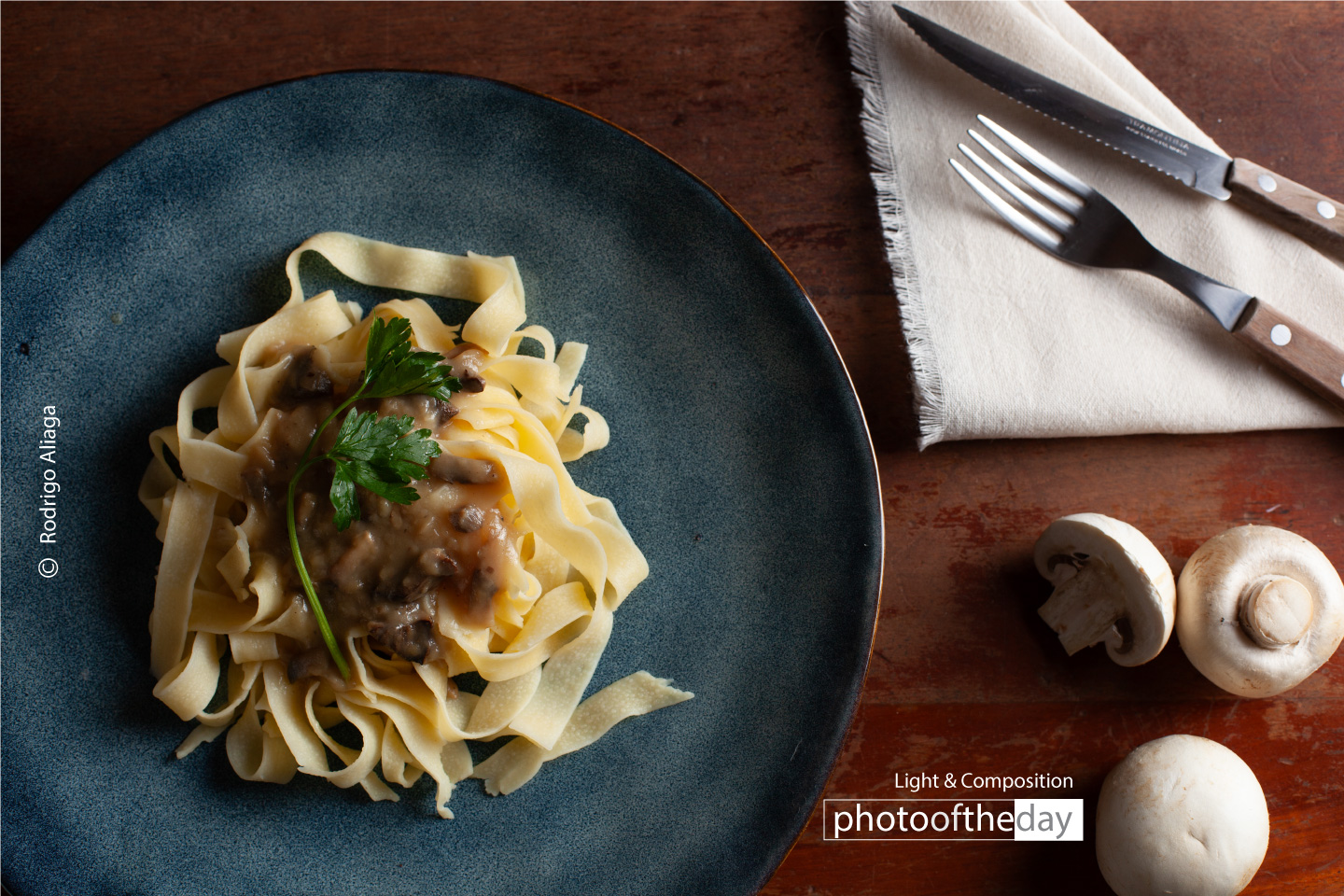
Exposure 1/125sec @ f/6.3 | ISO 200 | Focal Length 50mm
Rodrigo Aliaga
Born in La Paz, Bolivia, Rodrigo Tato Aliaga has built a distinguished career as a director of photography, specializing in film production and television advertising. After mastering the nuances of traditional analog film, he transitioned his creative focus to digital photography. He found his true calling in food photography, where he expertly blends technical precision with artistic flair to capture the exquisite essence of culinary subjects.
Resonance Score Breakdown
Transparency Note: The resonance score (7.8/20) is calculated based on social engagement metrics collected before the award announcement.
Expert Photography Reviews · 4
The Earth on the Plate
There is a quiet holiness in the way the earth offers itself to our tables. We often forget that what sustains us began in the dark, damp silence of the forest floor, hidden beneath layers of fallen leaves and the slow passage of seasons.
Read the reflection →The Weight of the Table
I still keep a small, chipped ceramic bowl that belonged to my grandmother, its glaze worn thin by decades of wooden spoons and Sunday afternoons. It is heavy in the palm, a weight that feels like a promise kept.
Read the reflection →Reviews & Comments
Share your thoughts about this award-winning photograph. Your reviews contribute to the community engagement score.
The high-angle perspective echoes the clinical detachment of early 20th-century New Objectivity, yet here it’s softened by a rustic, tactile warmth. Aliaga’s composition avoids the sterile trap of modern food styling, instead finding a kinship with the earthy, unpretentious still lifes of Edward Weston. It’s a relief to see such restraint. I’m genuinely charmed by how the raw mushrooms anchor the frame; they’ve brought a wild, Andean honesty to an otherwise classic Italian plate.
There’s a quiet, rustic honesty here, but I find myself searching for the hands that prepared this meal. Food is a language of care, yet this feels like a still life staged for a magazine rather than a story told from a kitchen. It’s technically sharp, sure, but it lacks the human pulse I crave. I’d trade that perfect napkin for a glimpse of the cook’s flour-dusted fingers. It’s beautiful, but it’s lonely.
Food isn’t a sprint, but it has a peak moment. Here, the steam has dissipated and the pasta’s tension has slumped; it’s a static, post-effort composition. I’ve spent my life chasing the millisecond of maximum extension, and this lacks that kinetic snap. It’s technically clean, sure, but it’s the frame after the heat left the dish. I’m hungry, but I’m not moved. It’s a record of a meal, not the moment the fork hits the plate.
The composition relies on a tight circular orbit, with the pasta’s chaotic, organic vectors anchored by the rigid, linear weave of the napkin. It’s a study in controlled entropy. The mushrooms act as heavy, dark nodes, perfectly balancing the negative space in the upper quadrant. I’m genuinely struck by how the 50mm lens flattens the depth into a precise geometric plane. It’s a beautifully solved spatial equation where every noodle serves a structural purpose. Simply elegant.