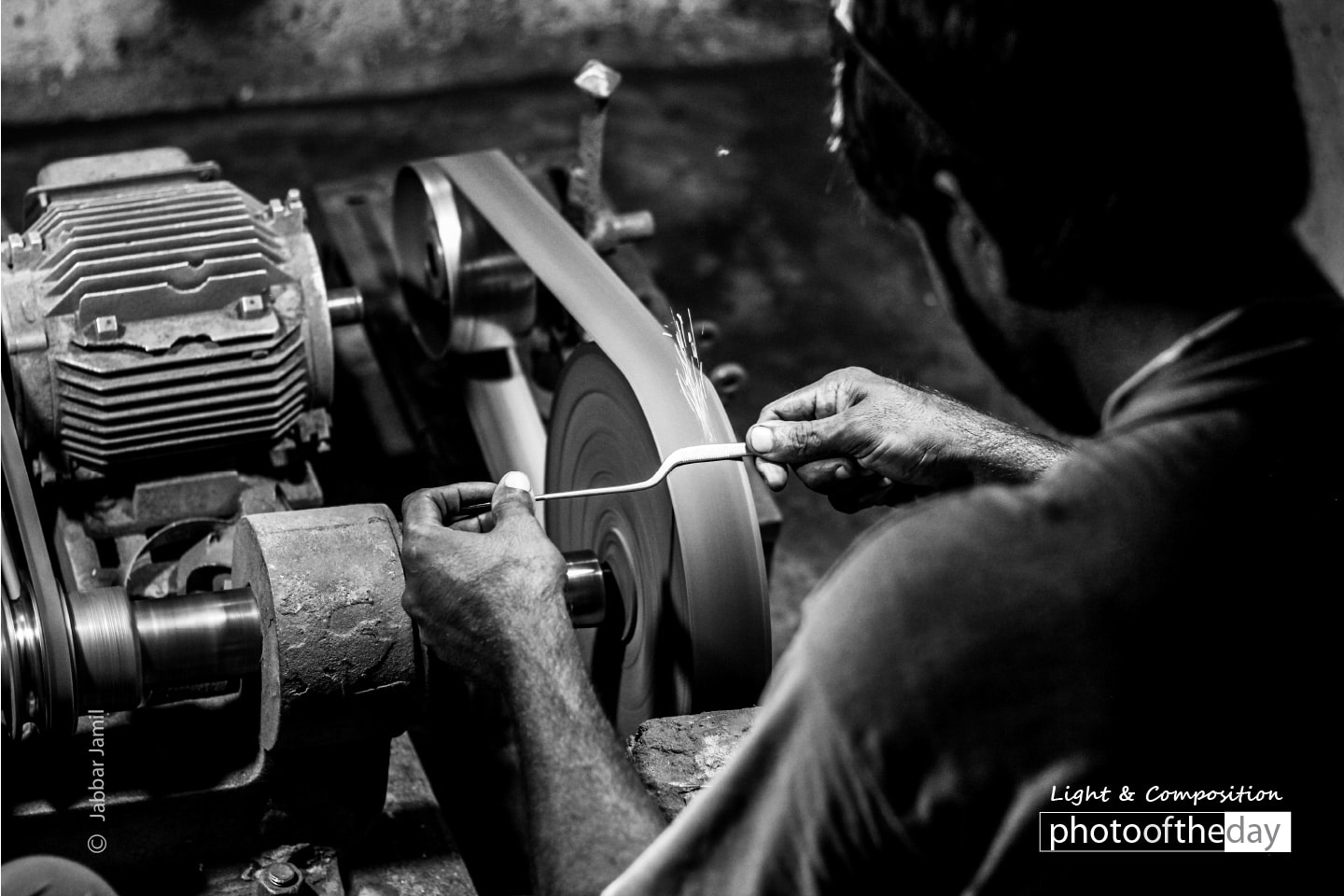
Surgical Product in Making by Jabbar Jamil
Captured within the industrial heart of Sialkot, this photograph documents the meticulous craft behind the world’s largest surgical instrument manufacturing hub. The photographer was invited into a local factory to document the artisans who continue a legacy dating back to the 1890s, when the city first began repairing tools for the local Mission hospital. By focusing on the raw, tactile environment of the workshop, the image highlights the intersection of human skill and industrial necessity. It is an award-worthy study of heritage and labor, transforming a routine workspace into a compelling narrative of Sialkot’s global significance in medical craftsmanship.
Jabbar Jamil
Based in Sialkot, Pakistan, Jabbar Jamil is a dedicated street photographer who views his craft as a vital bridge between his personal perspective and the wider world. He utilizes photography as both a creative outlet and a therapeutic practice, often venturing beyond his comfort zone to document the unfiltered realities of his surroundings. Through his lens, Jamil seeks to forge meaningful connections with his subjects, capturing the essence of the human experience in places that are not always traditionally beautiful.
Resonance Score Breakdown
Transparency Note: The resonance score (11.7/20) is calculated based on social engagement metrics collected before the award announcement.
Expert Photography Reviews · 7
The Weight of the Hand
There is a silence in the work of the hands that the mind cannot replicate. We spend our lives building things that will outlast us, shaping cold metal or stone, hoping to leave a mark that justifies the breath we draw. In the north, we know the value of a tool.
Read the reflection →The Weight of Hands
I spent this morning trying to fix a loose hinge on my kitchen cabinet. It seemed like such a simple task, but my hands felt clumsy and impatient. I kept dropping the tiny screws, and for a moment, I felt a flash of real frustration.
Read the reflection →Reviews & Comments
Share your thoughts about this award-winning photograph. Your reviews contribute to the community engagement score.

Most industrial photography feels cold, but Jamil’s work breathes. Of the thousands of factory shots I’ve reviewed, this one survives because of the grit on the artisan’s hands—it’s the human friction against the steel that anchors the frame. I’ve seen cleaner compositions, but they lack this soul. It’s the way the light catches the metal shavings that makes me believe this craft will still matter in thirty years. It’s honest, and that’s rare.
The focal plane here is razor-thin, slicing through the steel with a precision that mimics the very instruments being forged. I’m mesmerized by how the lens resolves the micro-abrasions on the metal, pushing past the diffraction limit to reveal the artisan’s grit. It’s a brutal, beautiful optical dance. You can almost feel the heat radiating from the friction. Honestly, it’s rare to see a lens capture such raw, industrial truth without losing its soul to the glass.
Sialkot’s steel doesn’t merely reflect light; it consumes it. In these dark, soot-stained corners, the surgical tools emerge like ghosts from the void. I’ve spent hours staring at the way the shadows swallow the artisan’s hands, and it’s unsettling—a reminder that creation is always a violent act of extraction from the dark. It’s not just labor here; it’s a heavy, suffocating silence. I feel the cold bite of the metal against my own skin.
Steel glints against the dark. The artisan’s hands are steady. It’s a quiet rhythm of metal and shadow. I’ve spent minutes staring at the blurred edges of the workshop. They hold a weight that the sharp tools don’t. Nothing here is accidental. The empty corner is not empty. It’s a breath held in the heat of Sialkot. I feel a sudden, sharp ache for the stillness found in such labor. It’s enough.
Sialkot’s industrial grit echoes the stark, unvarnished humanism of Lewis Hine’s early twentieth-century labor studies, yet Jamil’s focus on the surgical steel’s cold, reflective geometry feels distinctly contemporary. It’s a sharp departure from the romanticized documentary style we’ve seen for decades. I’m genuinely struck by how the light catches the metal’s edge, slicing through the gloom like a scalpel. It’s a visceral, precise conversation between ancient craft and modern necessity that I haven’t seen captured quite this way.
In Sialkot, the air is thick with the dust of generations. We look at this artisan’s hands, calloused and steady, and we understand the weight of a legacy forged in steel. Jabbar Jamil didn’t just document a factory; he listened to the rhythm of the metal. I feel a profound ache in my chest seeing such quiet devotion to craft. It’s a portrait that asks to be returned to, reminding us that history is made by human breath.
There’s a quiet dignity in the way this artisan handles the steel. You can tell he’s comfortable with the lens, which tells me Jamil didn’t just barge in; he sat, he waited, and he earned his seat. I’m struck by the grit under those fingernails—it’s a life of honest, exacting labor. This face has a whole life in it. It’s a gift, not a capture, and that’s why it hits home.