Speed Demons by Hairolnizam Sami’on
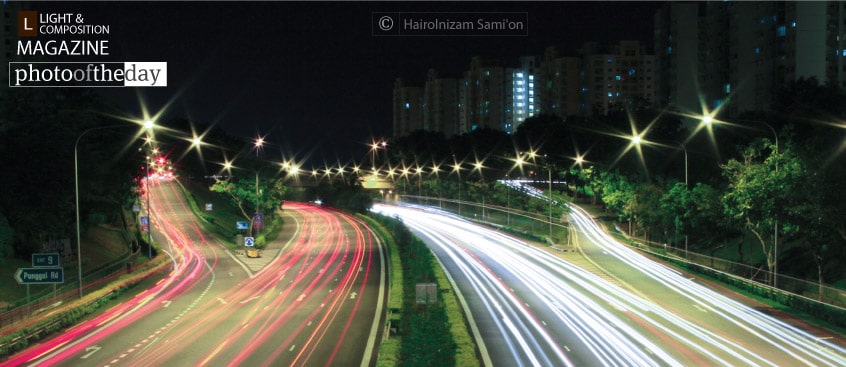
Captured from a bridge spanning a Singaporean expressway, this image freezes the frantic energy of late-night traffic. By utilizing a long exposure, the photographer transforms the high-speed movement of vehicles into vibrant, sweeping ribbons of light that cut through the darkness. The composition highlights the stark contrast between the stillness of the bridge and the relentless velocity of the cars below, emphasizing the 'speed demons' that dominate the road after midnight. This photograph is award-worthy for its technical precision in capturing motion, turning a mundane transit route into a dynamic display of light and urban rhythm.
Hairolnizam Sami'on
Based in Singapore, Hairolnizam Sami'on is a dedicated hobbyist photographer who has spent the last two years actively refining his craft. He is driven by a fascination with the unseen, consistently seeking to capture images that reveal what the human eye often misses in the blur of daily life. With a spontaneous approach to his subjects, he explores his environment with curiosity, aiming to document the world through a unique, observant lens.
Resonance Score Breakdown
Transparency Note: The resonance score (13.4/20) is calculated based on social engagement metrics collected before the award announcement.
Expert Photography Reviews · 4
The Hum of Velocity
The smell of hot asphalt after a summer rain always brings me back to the feeling of being small in a very large world. It is a sharp, metallic scent that clings to the back of the throat, tasting faintly of ozone and grit.
Read the reflection →The Architecture of Transit
We often speak of time as a river, a steady, unidirectional flow that carries us toward some inevitable sea. Yet, in the quiet hours of the night, when the world is stripped of its daytime noise, time feels less like a river and more like a pulse.
Read the reflection →Reviews & Comments
Share your thoughts about this award-winning photograph. Your reviews contribute to the community engagement score.
Standing on a Singaporean overpass at midnight isn’t exactly a hardship, but it’s a tedious sort of commitment. One wonders how many frames were discarded before the light trails balanced just so. It’s clean, precise, and frankly, I’ve spent enough damp nights waiting for traffic to behave to respect the discipline here. It doesn’t scream, yet it holds the eye. He didn’t just snap a shutter; he sat with the city until it finally yielded.
Long exposure traffic shots are the junk food of photography; I’ve seen thousands that blur into forgettable streaks. What separates this from the pile is the deliberate framing of the expressway’s geometry against the encroaching dark. It’s not just light trails; it’s the cold, clinical architecture of Singaporean transit. I actually felt a shiver of loneliness looking at those ribbons of red. It’s a haunting, precise document of a city that never sleeps, even when it should.
The searing, arterial crimson of these light trails, bleeding into the bruised, melancholic indigo of a Singaporean midnight, creates a chromatic dissonance that’s utterly intoxicating. It’s as if Turner had traded his oils for neon, casting the expressway in a feverish, electric glow that makes my pulse quicken. One finds the interplay between the cold, static concrete and those molten, kinetic ribbons of light to be a visceral, hauntingly beautiful collision of urban entropy.
These ribbons of light don’t just record velocity; they carve voids into the Singaporean night. It’s a violent erasure of the static world. I’ve stared at these streaks until my eyes ache, feeling the crushing weight of the darkness that refuses to be illuminated. The bridge is a tomb, and the cars are merely ghosts fleeing their own inevitable silence. It’s haunting, really. When the shutter closes, the shadow remains the only thing that’s truly honest.