Sleep on the Wheel by Avishek Das
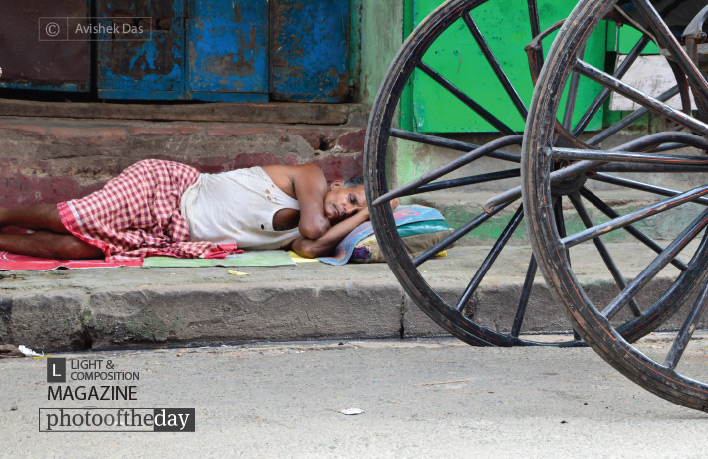
Captured on a quiet afternoon in Sova Bazar, this poignant documentary photograph depicts a rickshaw puller resting beside the wheels of his vehicle. The image serves as a somber reflection on the fading relevance of traditional manual transport in an era dominated by cycle and auto rickshaws. The photographer skillfully utilizes a 52mm focal length to frame the subject in a moment of vulnerable repose, perhaps dreaming of the passengers that are increasingly difficult to find. This work is award-worthy for its empathetic storytelling and its ability to elevate a simple street scene into a powerful social commentary on the struggles of the working class.
Avishek Das
Born in 1986 in Baruipur, India, Avishek Das is a dedicated photographer who balances a professional career in human resources with a profound passion for documenting the human condition. Trained under the guidance of eminent photographer Sayan Sarkar, Das specializes in street, nature, and monochrome photography that explores the rich visual arts and culture of India. As an active member of the Indian Visual Arts Foundation and a photojournalist, he travels extensively, capturing the raw emotions of the streets and the people he encounters with a philosophy centered on shooting the feeling of a moment rather than just its appearance.
Resonance Score Breakdown
Transparency Note: The resonance score (12.9/20) is calculated based on social engagement metrics collected before the award announcement.
Expert Photography Reviews · 5
The Weight of Rest
There is a profound dignity in the way a body finally surrenders to the earth when the day’s labor is done. We often measure our worth by the distance we travel or the burdens we carry, forgetting that the most essential part of the journey is the stillness that follows.
Read the reflection →The Weight of Rest
To stop is not the same as to finish. In the long hours of the day, when the heat presses against the skin and the city hums with a rhythm that does not include you, the body finds its own way to surrender.
Read the reflection →Reviews & Comments
Share your thoughts about this award-winning photograph. Your reviews contribute to the community engagement score.
The rickshaw wheel frames his stillness. He’s curled against the iron, a body surrendered to the shade. It’s quiet here. I’ve spent minutes watching the dust settle near his feet. The space around him isn’t just air; it’s the weight of a long afternoon. Nothing here is accidental. The empty corner is not empty. It’s a pause. I feel a sudden, sharp ache in my chest. He’s waiting for a world that’s moved on.
Most street photography is fleeting, but this frame hits differently. Of the thousands I’ve reviewed, few capture such profound exhaustion. The way his body curls against the rigid, unyielding spokes of that wheel—it’s a brutal geometry of poverty. I’ll admit, it made my chest ache. It’s not just a man sleeping; it’s the physical weight of an obsolete trade pressing into him. Thirty years from now, we’ll still feel the gravity of that afternoon nap.
One wonders how long Das stood in the heat of Sova Bazar before this man finally surrendered to sleep. It’s a quiet, heavy stillness that doesn’t come from a quick snap. I’ve spent enough afternoons waiting for a scene to settle to know when a photographer has actually put in the hours. It’s a rare, honest bit of patience. I find myself wanting to leave him be. It’s a decent bit of work, earned in full.
At f/10, the Nikon’s sensor resolves the rickshaw’s weathered spokes with clinical sharpness, pushing right against the diffraction limit. The focal plane is perfectly tight, isolating the puller’s exhaustion against the soft, chaotic bokeh of Sova Bazar. I’m genuinely moved by how the light catches the grit on those wooden wheels; it’s a visceral reminder that optics don’t just capture geometry, they capture the weight of a life. It’s a haunting, precise optical truth.
The rickshaw wheel acts as a rigid fulcrum, bisecting the frame with brutal geometry. It’s a stark division of space. The subject’s slumped posture echoes the circularity of the spokes, creating a necessary visual rhyme. I’ve grown weary of sentimental street photography, yet the tension here holds. The negative space doesn’t collapse; it anchors the exhaustion. It’s a disciplined arrangement of mass. The frame doesn’t leak. It’s a rare instance where the structure justifies the narrative.
This is an amazing composition and a precious moment frozen in a frame. This photography tells everything without words. Perfect!