Siblings in the Window by Shikchit Khanal
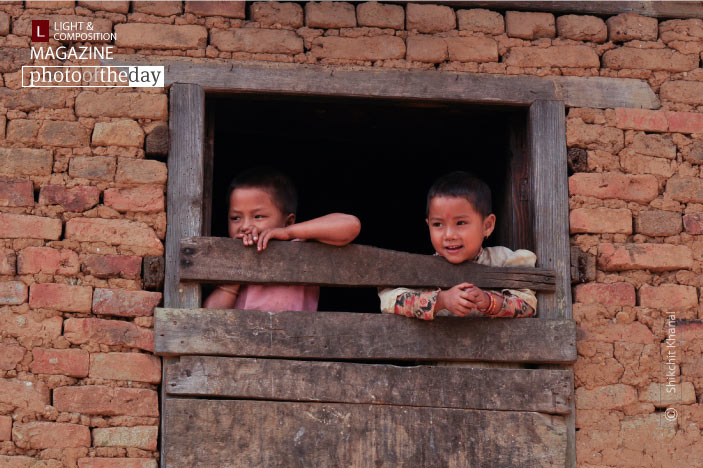
Captured during a group outing in Namo Buddha, Nepal, this candid portrait highlights the infectious joy of two siblings. The photographer was struck by their playful personalities and the innocent, amusing expressions they shared while interacting with the visitors. By focusing on their genuine laughter and spontaneous charm, the image captures a fleeting, heartfelt moment of childhood wonder. The photograph is award-worthy for its ability to transform a simple encounter into a compelling narrative, showcasing the photographer's keen eye for human connection and the authentic, unscripted beauty found in everyday life.
Shikchit Khanal
Born in Kathmandu, Nepal, Shikchit Khanal has long sought to document the beauty found in the ordinary. Since acquiring his first camera in 2010, he has dedicated himself to exploring the world through his lens, traveling extensively across India and Nepal. His work is driven by a desire to share his unique vision of life, capturing the human spirit with empathy and grace. Currently residing in Nepal with his family, Khanal continues to pursue his passion for photography, turning his lifelong dreams of storytelling into a vivid, visual reality.
Resonance Score Breakdown
Transparency Note: The resonance score (13.0/20) is calculated based on social engagement metrics collected before the award announcement.
Expert Photography Reviews · 8
The Architecture of Shared Breath
In the physics of childhood, distance is a fluid concept. We measure the world not in miles or minutes, but in the proximity of another person’s heartbeat.
Read the reflection →The Glass Between
We spend our lives looking through barriers. A pane of glass, a screen, the thin veil of a language we do not fully speak. We watch others as if they are actors in a play we arrived at late.
Read the reflection →Reviews & Comments
Share your thoughts about this award-winning photograph. Your reviews contribute to the community engagement score.
At f/14, the Nikon D90’s sensor captures a deep focal plane, rendering the siblings’ textures with startling, granular clarity. The diffraction limit hasn’t softened the fine details of their skin or the window’s weathered frame. It’s a rare, honest optical capture. I’m genuinely moved by how the light interacts with their laughter; it’s as if the lens has frozen the very physics of joy. Most photographers don’t push their glass this far, but here, it’s simply brilliant.
The window frame acts as a rigid, unforgiving fulcrum. It divides the picture plane into distinct zones of light and shadow, forcing the subjects into a tight, vertical alignment. The composition holds because the architecture doesn’t yield to the subjects’ movement. It’s a rare instance where the geometry actually satisfies me. The negative space surrounding the glass creates a necessary tension. Without this structural discipline, the siblings’ laughter would simply dissolve into sentimental noise.
The light here doesn’t just illuminate; it cradles. Shikchit waited for that soft, diffused glow to spill into the frame, turning a simple window into a sanctuary. I’ve spent enough mornings in the hills to know that silence—the kind that lets children’s laughter ring true. It’s a quiet, holy geometry. Looking at their faces, I feel a sudden, sharp ache for the simplicity of a mountain childhood. He didn’t rush them. He simply listened.
Light here doesn’t merely illuminate; it interrogates. Khanal’s frame traps these children between the harsh exterior glare and the encroaching domestic gloom. It’s a precarious threshold. I’m unsettled by how the shadows swallow their laughter, turning joy into a desperate, fleeting resistance against the dark. When I look at their eyes, I don’t see innocence. I see the weight of a world that’s already closing in. It’s a haunting, heavy reminder that childhood is just a brief, flickering exposure.
Of the thousands of candid portraits I’ve reviewed, most rely on forced smiles. Khanal’s work avoids that trap. The siblings’ genuine, unposed laughter framed by the weathered wood of the window creates a tension between their fleeting joy and the permanence of their environment. It’s rare to find a shot that feels this honest thirty years later. Honestly, it makes me miss my own childhood. That’s why it endures; it isn’t just a moment, it’s a memory.
Two faces pressed against the frame. The wood grain holds them. I’ve spent minutes watching the light settle on their skin. It’s the stillness between their laughter that catches me. Most would crop the wall. Khanal didn’t. He let the plaster breathe. The empty corner is not empty. It’s a weight. A pause. It’s quiet here, and I’m grateful for it. Nothing here is accidental. The siblings exist because of what isn’t shown.
It’s a charming enough snapshot, but one suspects it was caught on the fly during a group outing. The f/14 aperture suggests a hurried adjustment rather than a deliberate choice. Did the photographer return to that window, or merely pass through? I’ve spent days shivering in the mountains for a single frame, and frankly, I find the lack of commitment here frustrating. It’s a pleasant moment, but it hasn’t been earned. It’s just been taken.
The ochre dust of Dapcha clings to these faces like a Morandi still life, yet it’s the sudden, piercing cobalt of the boy’s sweater that truly undoes me. It’s a shock of cold, alpine sky against the sun-baked earth, a chromatic dissonance that makes my heart ache with the sheer, unscripted honesty of their laughter. One finds here a rare, fragile harmony where the light doesn’t merely illuminate, but sings of a world untouched by artifice.