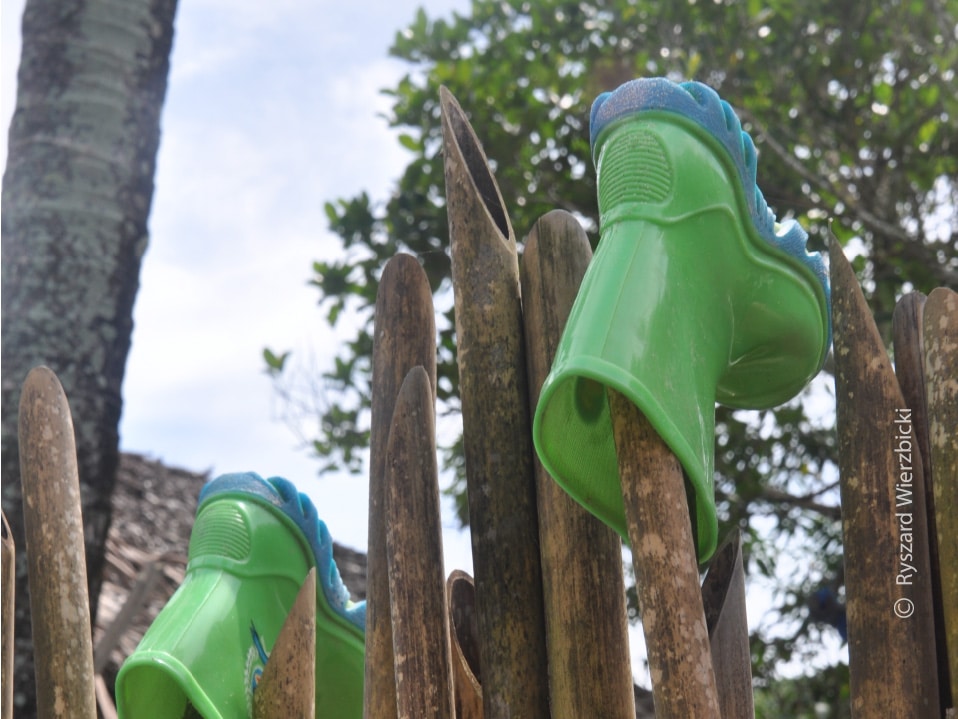
Rubber Boots by Ryszard Wierzbicki
Captured in the quiet, remote Alimanguan village on Palawan Island, this image highlights a simple, authentic moment of rural life. While exploring the area with a drone and camera, the photographer discovered a row of rubber boots drying on a fence—a humble, practical scene that feels worlds away from the fast-paced, high-tech nature of modern civilization. The composition draws beauty from this overlooked daily ritual, celebrating the charm of traditional living. It is an award-worthy photograph because it transforms a mundane, functional object into a poignant cultural observation, masterfully framed to evoke a sense of timelessness and discovery.
Ryszard Wierzbicki
Born in 1963, Ryszard Wierzbicki is a Polish-born photographer and traveler currently based in Swindon, United Kingdom. After a diverse career in education and marketing, he transitioned into a life of exploration, focusing his lens on the landscapes and cultures of South-East Asia. Beyond his photography, he is a dedicated PADI scuba diving instructor and an active volunteer for orphan charities. Wierzbicki shares his passion for global discovery through his travel and photography forums, documenting his journey as he trades the corporate world for the freedom of the open road.
Resonance Score Breakdown
Transparency Note: The resonance score (11.5/20) is calculated based on social engagement metrics collected before the award announcement.
Expert Photography Reviews · 4
The Weight of the Walk
There is a quiet dignity in the things we leave behind at the threshold. We spend our days moving through the world, our feet mapping the terrain, pressing our history into the soil with every step.
Read the reflection →The Shape of Absence
We leave pieces of ourselves in the things we touch, like a ghost of a footprint pressed into the mud or the way a coat holds the curve of a shoulder long after it is hung away.
Read the reflection →Reviews & Comments
Share your thoughts about this award-winning photograph. Your reviews contribute to the community engagement score.
These rubber boots aren’t merely drying; they’re waiting for a return that feels increasingly unlikely. Wierzbicki captures the hollow, gaping mouths of the footwear, casting shadows that swallow the fence’s texture. It’s a haunting stillness. I’ve stared at these shapes until my own feet felt cold, sensing the absence of the bodies that once inhabited them. When light abandons the interior of a boot, we’re left with the weight of a life lived in the margins.
Rubber boots drying on a fence in Alimanguan—is this really a celebration of rural life, or just a tourist’s aestheticization of poverty? I’m unsettled by how the curator frames this as a retreat from modernity. Why do we insist on viewing these lives as timeless, as if they don’t exist in our current century? It’s a pretty composition, sure, but it feels like a hollow souvenir. Whose daily reality have we reduced to a quaint, decorative prop?
These boots aren’t just footwear; they’re vessels of a life lived in the mud. I’ve spent enough dawns waiting for the light to know that Ryszard didn’t just stumble upon this. He stood here in the cooling hour, watching the sun soften against the rubber. It’s a quiet, holy stillness. Looking at them, I feel a sudden, sharp ache for the simplicity of a life that doesn’t demand to be seen, only to be lived.
1/500sec at f/6, 155mm. A tight compression of space. The shutter speed is overkill for static rubber boots, but it’s a safe hedge against motion blur. At f/6, the depth of field is thin enough to isolate the fence, yet deep enough to keep the texture of the rubber readable. It’s functional. I’ve spent too long looking at soft travel shots; this sharpness is a relief. The technical execution is correct. It works.