Returning From Kumbha by Nirupam Roy
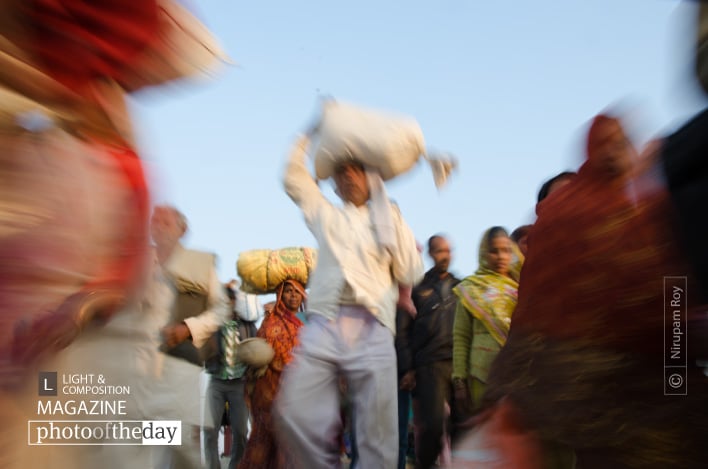
Captured at the conclusion of the 2013 Maha Kumbha in Allahabad, this image explores the human element of the world's largest fair. Seeking to portray the event through a different lens, the photographer employed a slow shutter speed to introduce a sense of motion and fluidity to the departing crowds. The resulting composition masterfully balances the chaos of the mass exodus with a deliberate, ethereal blur, transforming a routine departure into a poignant visual narrative. This evocative approach to motion photography highlights the transient nature of the pilgrimage, earning recognition for its creative interpretation of a monumental cultural gathering.
Nirupam Roy
Nirupam Roy is an educator based in Tufanganj, West Bengal, whose journey into photography began during a family trip to the coast of Odisha. Inspired by the desire to document both the natural landscape and his son's childhood, he transitioned from a casual observer to a passionate visual storyteller. His work reflects a deep appreciation for the intersection of nature and humanity, viewing the photographic process as a meditative practice that brings peace and a renewed perspective to his daily life.
Resonance Score Breakdown
Transparency Note: The resonance score (11.9/20) is calculated based on social engagement metrics collected before the award announcement.
Expert Photography Reviews · 7
The Weight of the Passing
I keep a small, smooth river stone on my desk, worn down by years of being turned over in my palm. It is a heavy, silent thing, smoothed by currents I will never see and waters that have long since moved on to the sea.
Read the reflection →The Weight of Leaving
We are always in transit. Between the arrival and the departure, there is a space where the self thins out. It is not quite being here, and not yet being there.
Read the reflection →Reviews & Comments
Share your thoughts about this award-winning photograph. Your reviews contribute to the community engagement score.
1/62sec at f/22, 18mm, ISO 100. Stopping down to f/22 on a D7000 invites diffraction, yet here it’s a calculated gamble. The shutter speed is just slow enough to smear the crowd into a river of ghosts. It’s technically risky, but it works. I’ve spent years looking at sharp, sterile files; seeing this intentional degradation actually makes me breathe easier. You’ve traded clinical resolution for a genuine sense of mass. The math holds up.
One suspects the shutter was clicked until the light failed and the legs gave out. At f/22, Roy wasn’t just snapping; he was committing to the blur of a million souls. It’s a rare thing to capture the exhaustion of a pilgrimage so viscerally. I’ve spent enough hours in the dust to know that kind of patience isn’t cheap. It’s a haunting, rhythmic piece of work. He clearly didn’t leave until he’d earned it.
We watch the pilgrims dissolve into streaks of saffron and dust, caught in the wake of the Maha Kumbha. Nirupam Roy hasn’t just captured a crowd; he’s captured the rhythm of a collective soul drifting home. It’s a blur of devotion that feels like a fading memory. I find myself holding my breath, feeling the weight of their long journey. It’s a photograph that asks to be returned to, again and again, to find the stillness within.
Before the eye identifies the crowd, a sudden stillness settles in the chest. The blur of the Kumbha pilgrims creates a rhythmic, hypnotic pulse that slows my own breathing. It’s a phantom migration, a collective ghosting of the landscape. I’ve returned to this frame for years, and each time, the motion feels less like a departure and more like a shedding of weight. It’s haunting—I can almost feel the dust settling on my skin.
The Kumbha Mela is a river of humanity, and Roy caught the current. That 1/62 shutter speed is a gamble, but it pays off. The blur isn’t just movement; it’s the exhaustion of a million souls drifting home. I feel the dust in my own lungs looking at this. One tenth of a second later and the rhythm would’ve shattered. It’s a ghost story told in motion. Winogrand would’ve tipped his hat to this chaos.
Blurring the masses at the Kumbh Mela feels like a convenient way to avoid the individuals behind the pilgrimage. Why turn these people into ghostly streaks? It’s a technique that prioritizes aesthetic fluidity over the grit of their actual journey. I find myself frustrated by this erasure. Does the motion represent their spiritual transition, or just our desire to keep them at a distance? It’s a pretty frame, but I’m left wondering who we’re really looking at.
The dust of Allahabad hangs heavy, caught in that final, golden exhale of the Kumbh. He stood there as the tide of humanity dissolved into blur, choosing a shutter speed that turns pilgrims into ghosts. It’s a quiet, aching transition. I’ve felt that same stillness when the crowd thins and the land reclaims its silence. Looking at these ethereal, streaking figures, I feel a sudden, sharp longing for the peace that follows such immense, holy chaos.