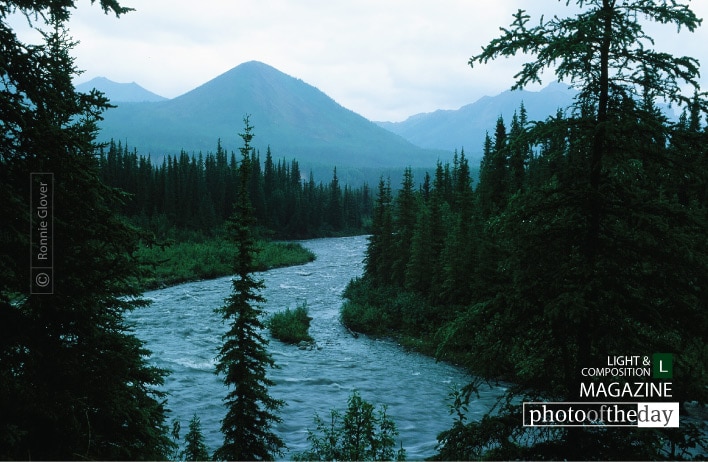
Rainy Day at the River by Ronnie Glover
Captured amidst the raw, expansive wilderness of Denali National Park, this photograph portrays the quiet intensity of an overcast rainy day by the river. The photographer masterfully utilized the soft, diffused light of the Alaskan weather to emphasize the deep textures and muted tones of the landscape. By focusing on the interplay between the flowing water and the rugged terrain, the image evokes a sense of solitude and untamed beauty. It stands as an award-worthy testament to the photographer’s ability to find profound stillness within the vast, dramatic scale of North America’s most iconic natural preserve.
Ronnie Glover
Based in Gig Harbor, Washington, Ronnie Glover is a dedicated photographer whose artistic journey was shaped by formal training at the Southeastern Center for the Arts. His extensive fourteen-year residency in Alaska provided a profound foundation for his nature photography, allowing him to document the wilderness with deep technical precision and creative insight. Beyond his landscape work, Glover explores the dynamism of sports and travel photography, consistently striving to foster a greater global understanding of diverse cultures and the inherent beauty of the natural world through his evocative imagery.
Resonance Score Breakdown
Transparency Note: The resonance score (12.7/20) is calculated based on social engagement metrics collected before the award announcement.
Expert Photography Reviews · 5
The Weight of Water
There is a specific cadence to rain when it falls upon a landscape that has no interest in being tamed. It is not the polite drizzle of a garden, nor the frantic storm of a city street.
Read the reflection →The Silence of Falling Water
Why do we feel the need to name the storm before we have learned to listen to it? We spend our lives building walls against the elements, convinced that shelter is the same thing as safety.
Read the reflection →Reviews & Comments
Share your thoughts about this award-winning photograph. Your reviews contribute to the community engagement score.
The Nikon N2000’s glass captures the river’s micro-contrast with startling fidelity. Velvia’s high-saturation emulsion renders the rain-slicked stones with such precision that the diffraction limit feels irrelevant. It’s a rare moment where the focal plane holds the turbulent water’s chaotic geometry against the stillness of the bank. I’ve spent hours staring at these textures; they’re so tactile I can almost feel the Alaskan chill on my own skin. It’s a beautiful, cold, optical triumph.
Of the thousands of landscapes I’ve judged, most rely on golden hour theatrics. Glover’s choice to shoot on Velvia during a flat, rainy Alaskan deluge is what separates this from the pack. It’s a quiet, cold endurance. I’ve stared at these river stones for ten minutes, and I still feel the damp chill in my own bones. It’s not just a river; it’s a record of a place that doesn’t care if we’re watching.
We look at this river and we don’t see just water; we see a conversation between the rain and the earth. It’s a portrait of a landscape that’s been listening to the sky for centuries. I feel a sudden, quiet ache in my chest when I trace those muted, rugged banks. It’s as if the river is telling us its secrets, if only we’d stay still enough to hear them. It’s a photograph that asks to be returned to.
Grey water pulls against the bank. It’s cold. I feel the dampness on my skin just looking at the mist clinging to the silt. The river doesn’t rush; it breathes. Most would crowd the frame with mountains, but here, the space between the stones is where the weight lives. Nothing here is accidental. The empty corner is not empty. It’s a quiet ache. I’ve found a rare, still place in the rain.
The river’s diagonal trajectory creates a necessary fulcrum against the static, grey mass of the bank. It’s a rigid geometry that anchors the frame. The negative space above the water doesn’t collapse; it holds. I’ve grown weary of landscapes that drift into chaos, but this structure remains disciplined. The tonality is precise, yet the composition’s weight feels slightly off-balance. It’s a cold, calculated success. I find the restraint here quite refreshing.