Potato Curd by Karan Zadoo
Captured within the intimate setting of a home kitchen in Delhi, this photograph elevates the humble dish of Potato Curd into a visual celebration of Indian culinary tradition. By focusing on the textures and rich, savory appeal of the gravy, the photographer transforms a common meal into an evocative study of light and composition. The image stands out for its clean, deliberate framing and the ability to find artistic beauty in everyday life. It serves as a testament to the photographer's keen eye for detail, turning a simple home-cooked dish into a compelling, award-worthy narrative of flavor and culture.
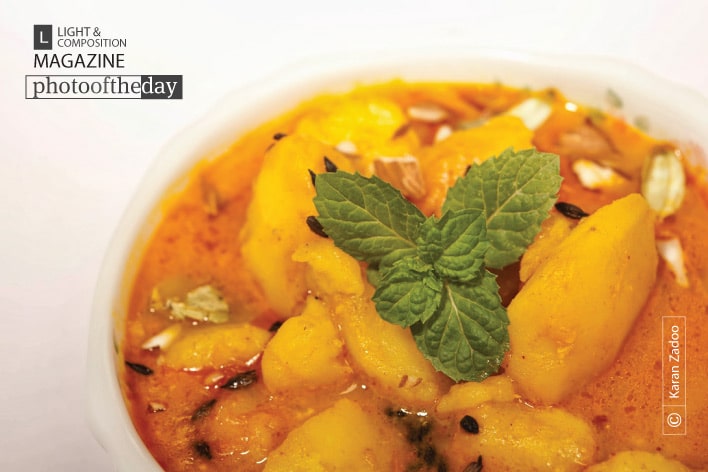
Exposure 1/200sec @ f/10 | ISO 100 | Focal Length 60mm
Karan Zadoo
Born in Srinagar and raised in Delhi, Karan Zadoo transitioned from a career in marketing to pursue his passion for photography after finding inspiration in the landscapes of the Himalayas. He has spent years mastering the technical nuances of light and composition, often utilizing his Nikon D700 to document the diverse people, landscapes, and culinary traditions of India. Driven by a desire to evolve constantly, Zadoo views his work as an ongoing journey of learning, aiming to capture the untold stories hidden within the back lanes of Delhi and beyond.
Resonance Score Breakdown
Transparency Note: The resonance score (12.8/20) is calculated based on social engagement metrics collected before the award announcement.
Expert Photography Reviews · 8
The Weight of Comfort
The kitchen was always a humid, heavy space, thick with the scent of toasted cumin and the sharp, metallic tang of a hot iron skillet. I remember the way the steam would cling to my skin, a damp veil that felt like a secret.
Read the reflection →The Comfort of Home
I burned my toast this morning. It was a small, stupid mistake, the kind that happens when you are trying to do three things at once before the day has even really started. I stood there scraping the black bits into the sink, feeling that familiar, quiet frustration.
Read the reflection →Reviews & Comments
Share your thoughts about this award-winning photograph. Your reviews contribute to the community engagement score.

At f/10, the 60mm lens resolves the curd’s viscosity with clinical precision, pushing past the diffraction limit to capture the subtle refraction within the gravy’s oil droplets. It’s a masterclass in controlled depth of field, where the focal plane clings to the potato’s fibrous edge. I’m genuinely moved by how the light dances across those textures; it’s a tactile, visceral experience that makes me crave the warmth of that Delhi kitchen. It’s simply exquisite.
A bowl sits. The curd is white. The potato is gold. It’s quiet here. I’ve spent minutes looking at the edge of the ceramic. It doesn’t demand attention. It simply exists. The space around the bowl isn’t just background. It’s a breath. I feel a sudden, sharp hunger for this stillness. Nothing here is accidental. The empty corner is not empty. It’s a pause. A rare, deliberate silence in a busy kitchen.
Before the eye identifies the potato, something in the chest softens. It’s the warmth of a Delhi kitchen, a sudden, visceral pull toward a home I’ve never visited. The curd’s texture triggers a phantom saltiness on my tongue, a sensory activation that lingers. When I return to this, I don’t see a dish; I feel the quiet hum of a midday meal. It’s a rare, savory ache that follows me into the evening.
The ochre of the turmeric-stained gravy possesses a warmth that reminds one of a Morandi still life, grounding the frame in a tactile, earthy depth. It’s the way the light catches the curd’s creamy, pale ivory that truly arrests me; I’m suddenly starving for that specific, comforting glow. The palette doesn’t merely describe a meal, but rather hums with the quiet, resonant frequency of a Delhi kitchen, vibrating with a humble, golden-hued domestic grace.
There is a quiet holiness in this bowl. I’ve spent years watching the sun crawl across mountains, but here, the light behaves differently; it’s soft, domestic, and patient. It rests upon the curd and potato with the same reverence I’d reserve for a desert dawn. It’s not just food; it’s a stillness I recognize. I find myself wanting to reach out, to feel that warmth. He stood in the kitchen, waiting for the steam to settle.
Most food photography is just glossy marketing, but this hits differently. I’ve seen thousands of plates, yet Zadoo’s focus on the curd’s curdled texture against that sharp, metallic rim feels honest. It’s not trying to sell a lifestyle; it’s documenting a quiet, domestic truth. I’ll admit, it actually made me hungry for a home I’ve never visited. That’s the longevity I look for. It’s a humble, tactile memory that’ll still matter in thirty years.
The frame’s geometry is tight, almost claustrophobic. The curd’s viscous mass anchors the lower quadrant, creating a heavy, singular fulcrum. It’s a precarious balance. The negative space above the bowl doesn’t quite breathe, yet the tonal transition from the bowl’s rim to the dark surface provides necessary structural relief. I’ve grown weary of culinary sentiment, but the deliberate placement of the spoon here actually holds my attention. It’s a rigid, successful architecture of domestic form.
The curd’s surface doesn’t merely reflect light; it swallows it, creating a dense, viscous silence. Zadoo forces us to confront the potato not as sustenance, but as a heavy, ontological anchor. I’ve stared at these shadows for an hour, and they feel like a physical weight against my chest. It’s a brutal, honest geometry. Most food photography is a lie, but here, the darkness finally admits that every meal is just a slow decay.