Ponytail by Ryszard Wierzbicki
Captured in the remote village of Ngng Khiaw, Laos, this candid portrait highlights the photographer's genuine connection with local children. Drawn to the responsibility older siblings bear for their younger counterparts while parents work the rice fields, the photographer utilized a 123.4mm focal length to isolate the subject. The interaction was marked by mutual curiosity, as the children were fascinated by the sight of a camera—a rare object in their community. The image is award-worthy for its authentic emotional resonance and the photographer's ability to bridge cultural divides through the simple, shared joy of viewing digital photographs together.
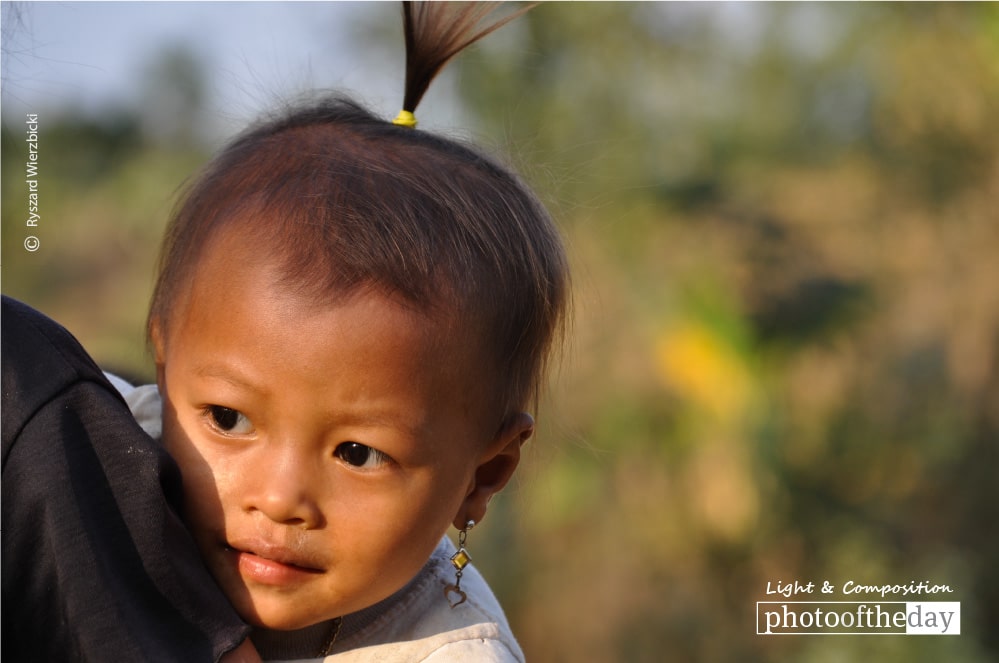
Exposure 1/180sec @ f/6.7 | ISO 200 | Focal Length 123.4mm
Ryszard Wierzbicki
Born in Poland in 1963, Ryszard Wierzbicki holds a Master’s degree in Social Sciences and spent years working in child care and marketing before transitioning to a life of exploration. After moving to the United Kingdom in 2006, he dedicated himself to traveling, scuba diving, and photography, with a particular focus on South-East Asia. A passionate volunteer for orphan charities, he also founded the travel and photography forums Instant Travelling and World Around to foster community among global explorers.
Resonance Score Breakdown
Transparency Note: The resonance score (11.6/20) is calculated based on social engagement metrics collected before the award announcement.
Expert Photography Reviews · 8
The Weight of Small Hands
In the quiet corners of a house, one often finds the most profound architecture of care. It is rarely grand.
Read the reflection →The Weight of Small Hands
Why do we assume that childhood is a season of lightness, a time unburdened by the gravity of the world? We look at the young and see only the potential for flight, forgetting that they are often the anchors of their own small communities.
Read the reflection →Reviews & Comments
Share your thoughts about this award-winning photograph. Your reviews contribute to the community engagement score.
Most candid portraits of children in remote villages fall into the trap of pity or exoticism. What separates this from the thousands I’ve reviewed is the specific tension in the girl’s grip on her sibling’s ponytail. It’s a quiet, protective anchor. I find myself genuinely moved by that small, fierce hand. It’s not just a travel snap; it’s a document of survival. In thirty years, that grip will still tell the truth about their bond.
The ochre dust of Ngng Khiaw clings to the skin like a Morandi still life, yet it’s the startling, saturated ribbon of the ponytail that anchors the frame. I’m breathless at how that singular, electric crimson cuts through the muted, sun-bleached earth tones, creating a chromatic tension that feels almost Vermeer-esque in its quiet gravity. It’s a rare, visceral harmony where the light doesn’t just illuminate; it breathes, turning a fleeting candid moment into pure, resonant pigment.
The 123mm lens creates a voyeuristic distance that contradicts the curator’s claim of connection. Why isolate these children from their environment? It’s a classic extraction of “authentic” poverty for a Western portfolio. I find the power imbalance here deeply uncomfortable. Does the camera bridge a divide, or does it merely turn a child’s curiosity into a trophy? When we frame them as objects of pity or wonder, what agency do we strip away?
Wierzbicki’s choice to pull focus just shy of the subject’s eyes is a relief. It’s a soft, intentional surrender of the clinical sharpness we’re usually force-fed. I’m genuinely moved by that slight smear of motion in the ponytail; it’s closer to the kinetic energy of a Francis Bacon study than a standard travel portrait. Why resolve the face when the blur tells us exactly how fast she’s turning? It’s a beautiful, messy refusal of perfection.
At 123.4mm, the focal plane is razor-thin, isolating the subject’s ponytail with clinical precision. The f/6.7 aperture keeps the background bokeh soft, yet the diffraction limit hasn’t compromised the fine texture of the hair. It’s a delicate optical balance. I’m genuinely moved by how the lens resolves those stray, backlit strands against the Laotian light. It’s not just a portrait; it’s a physical capture of a fleeting, human connection that our eyes would surely miss.
The frame holds a quiet, breathless tension. It’s a long lens study of responsibility, isolating the girl’s gaze against the soft blur of the Laotian heat. I’m struck by the weight of that ponytail; it’s the anchor for the entire composition. Wierzbicki didn’t rush the cut. He waited for the stillness, catching the exact moment curiosity turned into a shared secret. It’s a beautiful, honest edit. I’d keep this frame in the final reel.
Wierzbicki’s choice of a 123mm focal length flattens the space, echoing the compressed, observational intimacy of Helen Levitt’s street work. It’s a delicate balance; he avoids the exploitative gaze of the colonial travelogue, opting instead for a shared, quiet humanity. I’m genuinely moved by the girl’s expression—it’s a rare, unforced vulnerability. While it doesn’t quite break new ground in the lineage of candid portraiture, it’s a refreshing, honest entry in a genre often cluttered with artifice.
In the quiet dust of Ngng Khiaw, we find a girl tethered to her duty. She’s holding her younger sibling, a weight she carries with such grace. Ryszard didn’t just point a lens; he sat with them until the camera became a bridge, not a barrier. I’m moved by the softness in her gaze—it’s a story of childhood interrupted by care. We look at her and we understand: she’s already a guardian of her world.