Pierced Smile by Ryszard Wierzbicki
Captured in the humid, open-air classrooms of rural Bodhgaya, India, this poignant portrait highlights the resilience of children learning in challenging environments. The photographer masterfully isolates a single, genuine expression, turning a candid moment into a powerful testament to human spirit. By focusing on the subject's smile amidst humble surroundings, the image transcends its documentary roots to become a narrative of hope and endurance. The careful use of a long focal length creates a soft, intimate background, ensuring the viewer’s attention remains fixed on the subject’s radiant, pierced smile, which serves as the emotional anchor of this award-winning composition.
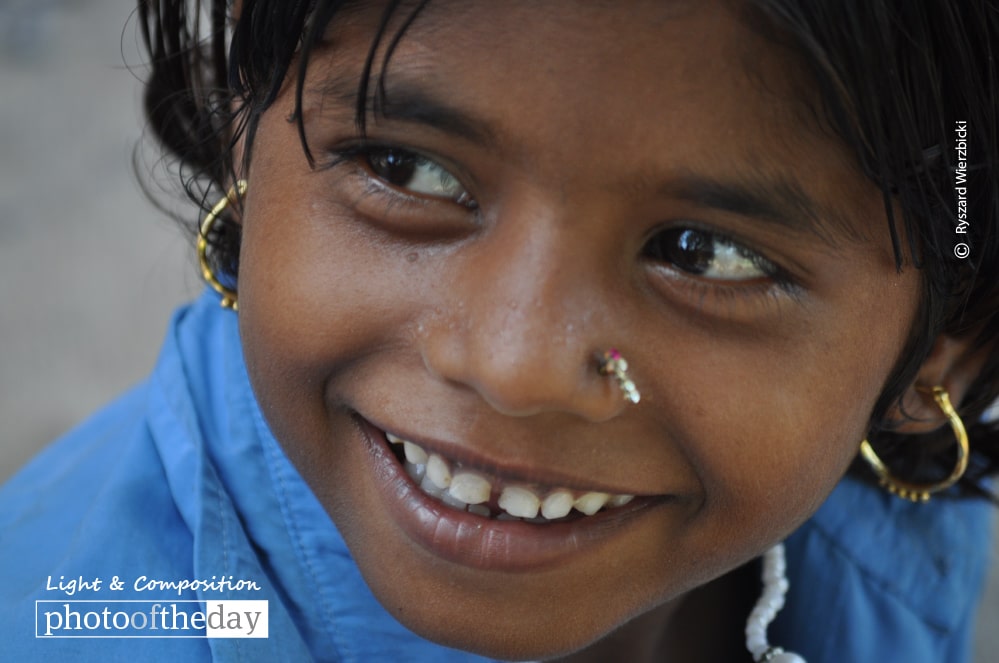
Exposure 1/250sec @ f/5.6 | ISO 400 | Focal Length 180mm
Ryszard Wierzbicki
Born in 1963, Ryszard Wierzbicki is a Polish-born educator and adventurer who transitioned from a career in social sciences and marketing to a life of global exploration. After emigrating to the United Kingdom in 2006, he dedicated himself to photography and travel, often focusing his lens on the human experience in South-East Asia. Beyond his creative pursuits, he is deeply committed to humanitarian efforts, volunteering with organizations that support orphans in Thailand and Burma. His work reflects a profound empathy for his subjects, shaped by his background in child care and his extensive travels.
Resonance Score Breakdown
Transparency Note: The resonance score (11.1/20) is calculated based on social engagement metrics collected before the award announcement.
Expert Photography Reviews · 6
The Architecture of Joy
We often mistake joy for a fragile thing, a petal that falls at the first sign of a cold wind. But look closer at the roots of a smile that survives the dust of a long, dry season. It is not a delicate bloom; it is a stubborn, ancient architecture.
Read the reflection →The Architecture of Resilience
We often mistake the city for its hard surfaces—the concrete, the steel, the zoning lines that dictate who belongs where. But the true geography of a place is written in the faces of those who navigate its margins.
Read the reflection →Reviews & Comments

Share your thoughts about this award-winning photograph. Your reviews contribute to the community engagement score.
The frame snaps shut, locking that grin in amber. It’s a tight, 180mm compression that flattens the world, pushing the classroom into a soft, bokeh blur. The focus is razor-sharp on the teeth, the light catching the metal. I’ve seen a thousand portraits, but this one hits me in the gut. It’s the perfect cut. The editor wouldn’t change a single frame here. It’s a film that refused to move, and I’m glad it stayed.
1/250sec at f/5.6, 180mm, ISO 400. It’s a standard telephoto reach, but the D5000 sensor struggles here. The noise at ISO 400 is visible in the shadows, yet the compression at 180mm effectively isolates the subject. I’ve seen enough soft portraits to know this focus is sharp where it counts. It’s technically competent, though I’d prefer a wider aperture to kill that background clutter. It’s a cold, calculated choice that actually works.
Most candid portraits of children in poverty feel exploitative, but Wierzbicki avoids that trap. The 180mm compression flattens the background into a soft, indistinct haze, forcing us to confront only the boy’s joy. It’s the piercing—the literal metal against skin—that stops me cold. It’s a jarring, visceral detail that anchors the humanity of the shot. I’ll remember this face in thirty years because it doesn’t ask for pity; it demands recognition of his spirit.
The light in Bodhgaya doesn’t just fall; it settles, thick with the dust of centuries. He stood here in the cooling hour, waiting for that specific, fleeting grace. I’ve felt that same stillness, where the world narrows down to a single, radiant expression. It’s not just a portrait; it’s a quiet communion. Looking at that pierced smile, I find myself holding my breath, humbled by the simple, enduring weight of a child’s joy amidst the earth.
The subject’s face occupies the right-hand vertical third, creating a perfect golden ratio balance against the blurred, negative space of the classroom. The diagonal vector of the nose leads directly to the pierced smile, which acts as the frame’s singular point of visual gravity. I’m genuinely struck by how the shallow depth of field isolates this geometry. It’s a beautifully solved spatial equation where the soft background doesn’t distract; it simply supports the subject’s precise, radiant alignment.
You waited for that split second, and it paid off. I’ve spent enough time in classrooms like this to know how easy it is to miss the light in a child’s eyes. You didn’t. That smile isn’t just a reaction; it’s a defiance of the dust and the heat. It actually made me stop and breathe for a second. You felt something real here, and because you did, I can feel it too. Good work.