Photographing Monk by Ryszard Wierzbicki
Captured in October 2013, this evocative image depicts a group of Buddhist monks engaging in a lighthearted moment by the lakeside in Pokhara, Nepal. Set against the dramatic backdrop of Himalayan trekking trails, the scene highlights a rare, candid intersection between traditional monastic life and the modern influence of travel culture. The photographer’s decision to frame these figures in such a picturesque, high-traffic destination emphasizes the human element within a landscape defined by its spiritual and natural grandeur. This photograph is award-worthy for its ability to capture a spontaneous, authentic interaction that bridges cultural boundaries, rendered with technical precision and a keen eye for storytelling.
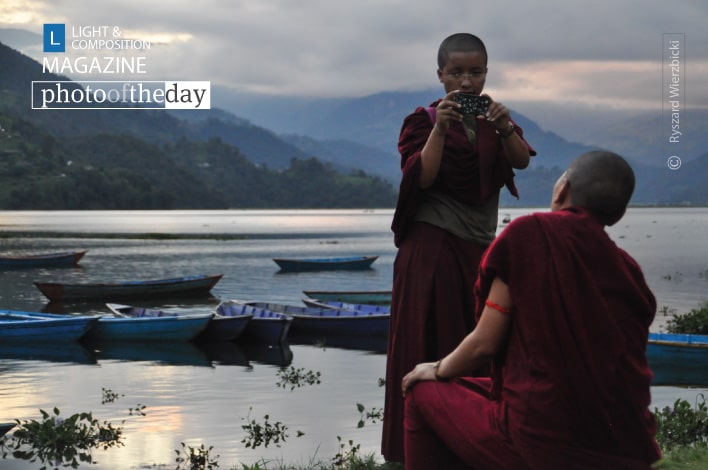
Exposure 1/90sec @ f/5.3 | ISO 1600 | Focal Length 62mm
Ryszard Wierzbicki
Born in Poland in 1963, Ryszard Wierzbicki transitioned from a career in social sciences and marketing to a life dedicated to global exploration and photography. After relocating to the United Kingdom in 2006, he shifted his focus toward documenting his extensive travels across South-East Asia and his volunteer work with orphanages. As the founder of the travel and photography forums Instant Travelling and World Around, Wierzbicki combines his professional background with a deep-seated passion for visual storytelling, frequently capturing the intersection of culture, travel, and the human experience through his lens.
Resonance Score Breakdown
Transparency Note: The resonance score (12.9/20) is calculated based on social engagement metrics collected before the award announcement.
Expert Photography Reviews · 8
The Weight of a Smile
We often imagine devotion as a heavy stone, something carried in silence up the steep, jagged spine of a mountain. We think of the spirit as a flame that must be shielded from the wind, kept behind closed doors or within the cool, damp walls of a sanctuary.
Read the reflection →The Quiet Joy of Being
There is a particular kind of grace found in the laughter of those who have turned away from the noise of the world. We often imagine the path of wisdom as one of rigid silence, a heavy mantle worn in solitude.
Read the reflection →Reviews & Comments
Share your thoughts about this award-winning photograph. Your reviews contribute to the community engagement score.
मनै त हेा ।
The light here isn’t the dramatic glow of the peaks, but the soft, diffused clarity of a Pokhara afternoon. Ryszard didn’t rush; he waited for the monks to forget he was there. I feel a strange, quiet ache in my chest looking at their laughter against those ancient, indifferent mountains. It’s a rare, fleeting grace. He didn’t just take a picture; he listened to the rhythm of their joy until the land finally let him in.
The shutter clicks, and the scene breathes. It’s a candid cut, a moment of levity caught against the heavy, silent backdrop of the Himalayas. I love the way the monks’ laughter disrupts the landscape’s stoic rhythm; it’s a perfect edit. Wierzbicki didn’t overthink the frame, he just let the motion settle. It’s a sequence frozen in time, the kind of shot an editor keeps because it’s the only one that feels truly alive.
1/90sec at f/5.3, ISO 1600, 62mm. It’s a messy compromise. The D5000 sensor struggles at ISO 1600, and the noise floor is visible in the shadows. Why f/5.3? You’ve sacrificed shutter speed for a depth of field that doesn’t isolate the subjects enough. It’s technically lazy. I’ve seen better handling of light in Pokhara. It’s frustrating because the moment is genuine, but the sensor data just doesn’t support the narrative. It’s a missed opportunity.
The monks laugh by the water. It’s a fleeting sound. I’ve spent minutes watching the space between their robes and the mountain’s edge. The frame doesn’t crowd them. It lets the air breathe. I feel a sudden, quiet ache for that stillness. Nothing here is accidental. The empty corner is not empty. It holds the weight of the lake. Wierzbicki knows when to stop. He leaves room for the silence to settle. It’s enough.
The monks laugh, yet they’re tethered to a landscape that demands silence. It’s a jarring friction. I’m struck by how the light clings to their robes, refusing to surrender to the encroaching gloom of the Pokhara dusk. They’ve invited the modern world into their frame, but the shadows behind them remain indifferent, ancient, and heavy. It’s a beautiful, unsettling tension. They’re playing at joy, but the darkness knows they’re merely passing through a much older, colder history.
Most travel photography is just scenery with people as props. I’ve seen thousands of monks in frames, but this one actually breathes. It’s the way the laughter breaks the rigid expectation of monastic silence that gets me; it feels like a secret I wasn’t supposed to overhear. The off-center framing keeps the mountains from swallowing the humanity of the moment. It’s a rare, honest slice of life that’ll still feel human thirty years from now.
At 62mm, the Nikon’s variable aperture creates a soft, manageable bokeh that isolates the monks from the Pokhara haze. It’s a delicate balance; the diffraction limit at f/5.3 keeps the textures of their robes crisp without introducing harsh micro-contrast. I’m genuinely moved by how the light catches the fabric’s weave—it’s a tactile intimacy the human eye usually misses. Wierzbicki’s choice of focal plane doesn’t just capture a moment; it resolves the very air between these men.
Before the eye identifies the monks, a sudden stillness settles in the chest. It’s the laughter that catches me—that fleeting, human warmth against the cold, jagged Himalayan backdrop. When I return to this, I don’t see travel culture; I feel the relief of their shared joke. It’s a quiet, rhythmic pulse of joy that lingers long after I’ve looked away. I’d forgotten how much we crave that specific, unburdened lightness in such heavy, ancient places.