Philly Flow by José J. Rivera-Negrón
On a warm summer day in Philadelphia, I was exploring the downtown streets. As I paused to frame a shot, a cyclist gracefully rode across the intersection. I waited a few moments, letting them pass, to capture the perfect photograph. The city buzzed with a vibrant energy all around, making the moment feel even more special.
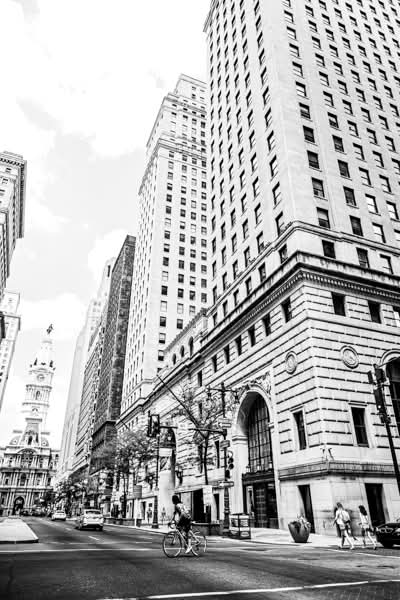
Exposure 1/200sec @ f/4.5 | ISO 250 | Focal Length 24mm
José J. Rivera-Negrón
José J. Rivera-Negrón was born in Puerto Rico and later moved to the United States, where he faced years of addiction, poverty, and life on the streets. After reaching a personal turning point, he sought help, completed rehabilitation, and made a firm decision to change his life. Those difficult experiences deeply shaped his perspective and eventually led him to photography—a medium through which he could express truth, struggle, and hope.
Today, Jose is a photographer whose work reflects resilience, recovery, and human connection. Through his travels, he documents diverse cultures and tells stories that carry messages of awareness, especially around addiction recovery and mental health. Working with Light and Composition has allowed him to share his vision with a wider audience. His journey stands as a reminder that even after the darkest chapters, it is always possible to start again and pursue one’s purpose.
Resonance Score Breakdown
Transparency Note: The resonance score (1.1/20) is calculated based on social engagement metrics collected before the award announcement.
Expert Photography Reviews · 5
The Velocity of Absence
The city is a machine of ghosts. We walk through intersections, leaving behind the heat of our own passing. A blur of motion.
Read the reflection →The Rhythm of Asphalt
The smell of hot pavement after a sudden summer rain is a scent that clings to the back of the throat, metallic and sharp.
Read the reflection →Reviews & Comments
Share your thoughts about this award-winning photograph. Your reviews contribute to the community engagement score.
Most street photography is just noise, but Rivera-Negrón’s frame captures a rare, rhythmic stillness. The cyclist’s blur against the rigid, static architecture of Philadelphia creates a tension that’s hard to manufacture. I’ve seen thousands of intersection shots, yet this one lingers because it feels like a heartbeat in a concrete chest. It’s the precise geometry of the motion that makes me smile. Thirty years from now, this won’t just be a street scene; it’ll be a memory.
Waiting for the cyclist to clear the frame is a missed opportunity. By chasing the clean, static street scene, you’ve settled for the conventional. I’d have preferred the blur of that passing motion, a ghosting of the city’s pulse. It’s closer to Sugimoto’s long-exposure theatres than this polite, sharp stillness. Why resolve the architecture so perfectly while ignoring the kinetic energy that actually defines Philadelphia? It’s technically sound, sure, but honestly, I’m bored.
The cyclist cuts through the frame, but the timing feels soft. You waited for them to pass, and that’s the trap. Cartier-Bresson would’ve fired when the bike hit the apex of the light, not after. It’s a clean shot, sure, but the pulse is missing. I wanted to feel the city’s friction, not just watch it roll by. One tenth of a second earlier and the frame would’ve snapped into focus. It’s almost there.
It’s a clean frame, but I find myself craving the wild. Rivera-Negrón’s cyclist is a fleeting human blur, yet it lacks the tension of a creature caught in its own rhythm. I’ve spent weeks in blinds waiting for a fox to emerge, and I’m struck by how much easier it is to capture a city street. It’s a pretty composition, sure, but it’s an extraction of a moment, not a relationship earned through stillness.
The cyclist has vanished. Only the intersection remains. I’m left with the weight of the asphalt and the stillness of the frame. It’s a rare relief. Rivera-Negrón didn’t chase the motion. He let the city breathe instead. I feel a sudden, quiet peace looking at this expanse of gray. Nothing here is accidental. The empty corner isn’t empty. It’s a pause. It’s where the city finally stops talking. I could stand here all day.