Echoes of Time by José J. Rivera-Negrón
The lady's tired face, holding onto her bags and wearing a mask that hinted at illness, made me feel a deep sadness. It was a moment of reflection on how quickly time slips away, yet how long and winding the path of life can be. Seeing her alone and looking sick made me understand the path she had to walk.
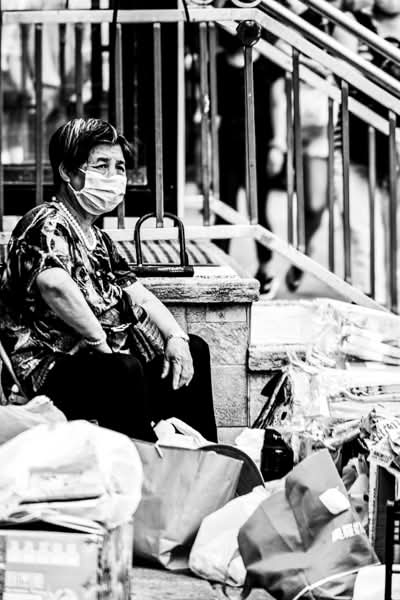
Exposure 1/125sec @ f/6 | ISO 250 | Focal Length 330mm
José J. Rivera-Negrón
José J. Rivera-Negrón was born in Puerto Rico and later moved to the United States, where he faced years of addiction, poverty, and life on the streets. After reaching a personal turning point, he sought help, completed rehabilitation, and made a firm decision to change his life. Those difficult experiences deeply shaped his perspective and eventually led him to photography—a medium through which he could express truth, struggle, and hope.
Today, Jose is a photographer whose work reflects resilience, recovery, and human connection. Through his travels, he documents diverse cultures and tells stories that carry messages of awareness, especially around addiction recovery and mental health. Working with Light and Composition has allowed him to share his vision with a wider audience. His journey stands as a reminder that even after the darkest chapters, it is always possible to start again and pursue one’s purpose.
Resonance Score Breakdown
Transparency Note: The resonance score (1.2/20) is calculated based on social engagement metrics collected before the award announcement.
Expert Photography Reviews · 5
The Architecture of a Breath
We carry our histories in the way we hold our shoulders, a map of every burden we have ever agreed to shoulder.
Read the reflection →The Weight of the Passing
Seneca once observed that we are all in a state of constant departure, for life is not a static possession but a river that flows beneath us even as we stand upon the bank.
Read the reflection →Reviews & Comments
Share your thoughts about this award-winning photograph. Your reviews contribute to the community engagement score.
The mask hides the breath. The bags pull at the shoulders. It’s a heavy stillness. I’ve spent minutes watching the way the light falls against the wall behind her. It’s not just a backdrop. It’s the weight of the years she’s carried. Nothing here is accidental. The empty corner is not empty. It’s the space where her exhaustion finally rests. I feel a sudden, sharp ache in my own chest. It’s quiet. Perfectly quiet.
Why chase the crispness of a mask’s edge when the blur tells the real story? Rivera-Negrón’s choice to let the motion soften her face feels like a deliberate refusal to pin her down. It’s closer to Sugimoto’s temporal ghosts than standard street portraiture. I’m genuinely moved by what he didn’t resolve here. By abandoning technical perfection, he’s captured the exhaustion of time itself. It’s a brave, messy, and far more honest way to see.
At 330mm, the compression of the focal plane is aggressive, forcing the subject’s weary features into a tight, unforgiving geometry. The f/6 aperture sits just above the diffraction limit, preserving the micro-contrast of her skin’s texture against the soft, bokeh-rendered background. It’s technically precise, yet the way the light catches the mask’s weave is haunting. I’ve stared at these pixels for an hour; the sheer optical clarity of her exhaustion honestly breaks my heart.
The mask doesn’t hide her illness; it anchors her to a void. Rivera-Negrón understands that shadow isn’t merely the absence of light, but the architecture of grief. I’ve stared at those heavy, dark bags until the Philadelphia pavement felt like a precipice. It’s a brutal, honest confrontation with mortality. When light fails to penetrate the folds of her coat, we aren’t seeing a lack of detail. We’re seeing the precise weight of a life refusing to be illuminated.
The woman’s face is a map of transit, a brief flicker against the vast, cold indifference of the universe. At f/6 and ISO 250, Rivera-Negrón has captured a human life with the same patience I usually reserve for distant nebulae. It’s haunting. We are all just photons traveling through a dark station, waiting for a train that never arrives. I feel a strange, heavy ache looking at her; she’s a star burning out in Philadelphia.