Pensive Little Darling by Shikchit Khanal
Captured in the quiet village of Dapcha, Nepal, this poignant portrait features a young child gazing through a window with a deeply contemplative expression. The photographer, drawn to the boy's pensive demeanor, waited for the perfect moment as the child balanced curiosity with a thoughtful, lingering smile. The image is award-worthy for its raw, candid intimacy and the soft, natural light that highlights the subject's soulful gaze. By focusing on the subtle interplay between the child's internal world and the surrounding environment, the photograph transforms a simple, everyday encounter into a powerful, timeless narrative of childhood wonder.
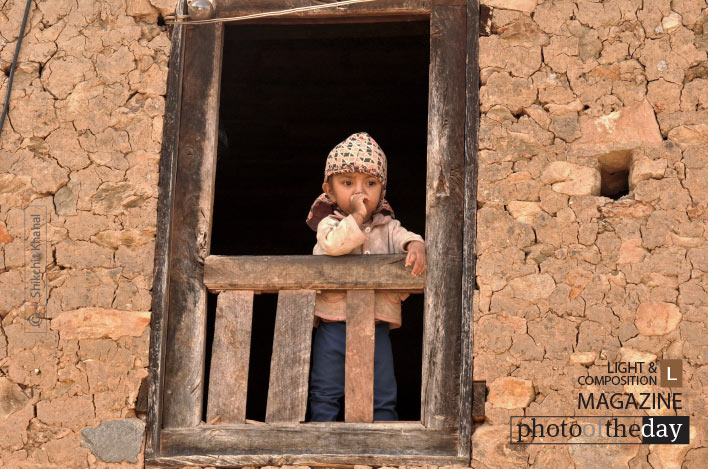
Exposure 1/80sec @ f/14 | ISO | Focal Length 90mm
Shikchit Khanal
Born in Kathmandu, Nepal, Shikchit Khanal has long been driven by a desire to document the beauty found in the mundane aspects of daily life. Since acquiring his first camera in 2010, he has dedicated himself to traveling extensively across India and Nepal, capturing the world through a unique, observant lens. Now based in Kathmandu with his family, Khanal continues to pursue his vision of sharing the human experience, transforming his lifelong dreams of storytelling into a compelling body of photographic work.
Resonance Score Breakdown
Transparency Note: The resonance score (12.6/20) is calculated based on social engagement metrics collected before the award announcement.
Expert Photography Reviews · 4
The Architecture of Waiting
There is a specific weight to the silence of a house when the afternoon sun begins its slow retreat. It is a time for observation, for the kind of stillness that children seem to master long before the rest of us learn to fear it.
Read the reflection →The Quiet Between Thoughts
I was sitting on my porch this morning, watching my neighbor’s toddler stare at a ladybug crawling across the railing. He didn't move for a long time.
Read the reflection →Reviews & Comments
Share your thoughts about this award-winning photograph. Your reviews contribute to the community engagement score.
What a brilliant capture of this child,really enjoy your style of photography, thanks for sharing :)
At f/14, the diffraction limit begins to soften the micro-contrast, yet it’s precisely this choice that renders the child’s skin texture with such organic, tactile grace. The focal plane is razor-thin across the iris, capturing a refractive brilliance I rarely see in candid work. It’s haunting. When I look at the way the light catches those pupils, I’m genuinely moved; it’s as if the lens has mapped the very architecture of his quiet, contemplative soul.
The window frame cuts the world in two. It’s a border. The boy’s gaze doesn’t land on the lens; it drifts into the dust of Dapcha. I’ve spent minutes watching him, and I feel a sudden, sharp ache for the quiet he carries. Nothing here is accidental. The empty corner is not empty. It’s the weight of his solitude. He isn’t waiting for us. He’s already somewhere else. A rare, still breath.
The window frame acts as a rigid, unforgiving cage. It’s a geometric anchor that forces the subject’s gaze into a singular, vertical axis. The spatial tension between the child’s face and the dark, recessed wood is precise. It’s rare to find such structural discipline in candid work. I’m genuinely unsettled by how the frame doesn’t collapse under the weight of the subject’s expression. It holds. The composition demands total attention to the negative space.
One suspects the photographer didn’t just stumble upon this window. It’s a quiet, patient study. Most would’ve snapped and moved on, but Khanal clearly lingered until the boy’s guard dropped. I’ve spent enough hours shivering in doorways to recognize that specific, earned stillness. It’s not just a portrait; it’s a truce between subject and lens. I find myself genuinely moved by that lingering smile. It’s a rare, honest bit of craft. Well done.
Thank you so much Smarty :)
I love this photo! You can make out every crack and color change in the wall, and the boy is just so sweet. Great job Shikchit!