Painted Smile by Ryszard Wierzbicki
Captured during a journey through the villages surrounding Bagan, Myanmar, this portrait captures a moment of genuine connection between the photographer and a local child. Drawn to the warmth and openness of the Burmese people, the photographer engaged with the girl by sharing the digital previews of her portrait session, turning the technical process into a collaborative and joyful experience. The image is award-worthy for its ability to transcend the barrier of the lens, showcasing a candid, radiant smile that reflects the photographer's deep empathy and his commitment to documenting the human spirit with grace and authenticity.
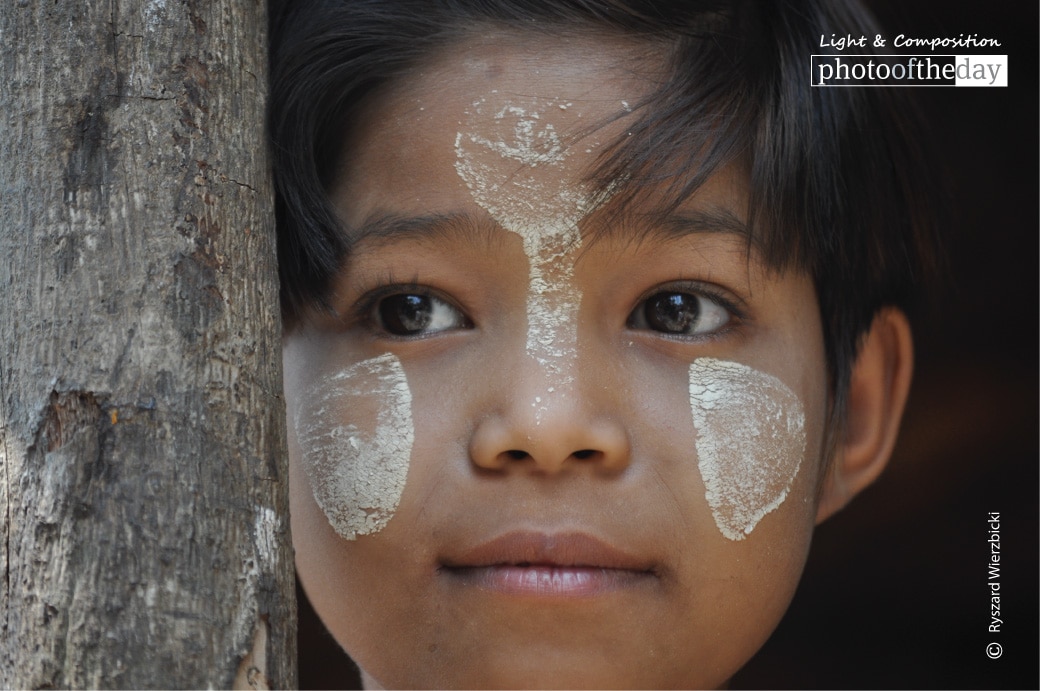
Exposure 1/350sec @ f/5 | ISO 400 | Focal Length 135mm
Ryszard Wierzbicki
Born in 1963, Ryszard Wierzbicki is a Polish-born photographer and educator currently based in Swindon, United Kingdom. After a diverse career in social sciences and marketing, he transitioned into full-time travel photography and exploration, with a particular focus on South-East Asia. His work is deeply informed by his background in child care and his volunteer efforts with orphanages in Thailand and Burma. Through his platforms, Instant Travelling and World Around, Wierzbicki shares his passion for global discovery, blending his technical expertise with a profound commitment to humanitarian storytelling.
Resonance Score Breakdown
Transparency Note: The resonance score (12.2/20) is calculated based on social engagement metrics collected before the award announcement.
Expert Photography Reviews · 8
The Currency of Joy
Can a face ever truly belong to the person who wears it, or is it merely a mirror reflecting the light of those who look upon us? We spend our lives constructing masks, carefully curated expressions designed to navigate the expectations of the world.
Read the reflection →The Architecture of Joy
We often mistake happiness for a destination, a place we might eventually reach if we walk long enough in the right direction. But joy is not a map; it is a sudden weather pattern, a shift in the light that catches the dust motes in a room and turns them into gold.
Read the reflection →Reviews & Comments
Share your thoughts about this award-winning photograph. Your reviews contribute to the community engagement score.
You didn’t just take a picture; you invited her into the process. That smile isn’t for the camera, it’s for you. I’ve spent enough time in the field to know when a subject is performing, but this is different. It’s a genuine exchange. Because you shared the screen, you broke the glass. I feel a real warmth looking at her eyes. You waited, you connected, and you caught the light. That’s the work.
The subject’s face occupies the right-hand vertical axis, creating a perfect 1:2 ratio against the negative space of the blurred background. It’s a classic golden section application. The diagonal vector of her gaze pulls the viewer’s eye toward the upper-left quadrant, balancing the heavy mass of her hair. I’m genuinely struck by how the geometry anchors that radiant smile. It’s a solved equation of warmth, where the spatial tension finally resolves into pure, mathematical joy.
Technically, it’s a standard portrait, but I’m struck by the soft, painterly rendering of the child’s skin. It’s closer to the ethereal, dreamlike quality of a gum bichromate print than a digital file. Why resolve every pore when you can capture the vibration of a smile? I’d have pushed the motion blur further to dissolve the background entirely. It’s a lovely moment, but it’s playing it safe with the sensor’s clinical precision.
The light here isn’t just illumination; it’s a soft, diffused grace that settles on the child’s face like dust in a temple. Ryszard didn’t rush this. He waited until the air held that stillness only found in the Bagan heat. I’ve felt that same quiet hum in my own travels. Looking at her, I can’t help but smile back. It’s a rare, honest communion where the lens simply disappears, leaving only the spirit behind.
That smile is undeniably radiant, but I’m left uneasy. Why does the child’s joy feel like a performance for the lens? The curator claims this was a collaborative moment, yet the power dynamic remains skewed. Does the girl truly understand the permanence of this digital capture? I find myself wincing at the exoticism inherent in such portraits. It’s a beautiful frame, sure, but whose narrative are we actually consuming here? It’s just too convenient.
The ochre dust of Bagan clings to the girl’s skin, a warm, sun-baked terracotta that echoes the palette of a Morandi still life, yet it’s the sudden, startling clarity of her smile—a flash of pure, unadulterated ivory—that truly arrests one’s breath. I’m utterly undone by how the golden light catches her eyes, turning them into pools of molten amber; it’s a chromatic symphony that makes the heart ache with its quiet, radiant, dusty grace.
The girl’s face occupies the frame, yet the dust behind her holds the weight. It’s a blur of ochre and heat. I’ve spent minutes watching the way the light catches her cheek. It’s quiet. The background doesn’t intrude; it recedes. Nothing here is accidental. The empty corner is not empty. It’s the silence of Bagan. I feel a sudden, sharp ache for that stillness. It’s rare to find a portrait that breathes this deeply.
Before the eye identifies the girl, something in the chest softens. It’s the sudden, unearned intimacy of that smile. I’ve felt my own pulse sync with her radiance, a visceral activation that lingers long after I look away. When I return to this, I don’t see a portrait; I see a mirror of my own forgotten joy. It’s rare to feel so disarmed by a stranger’s face. It’s a quiet, persistent ache of pure recognition.