Paddy Husking by Siew Bee Lim
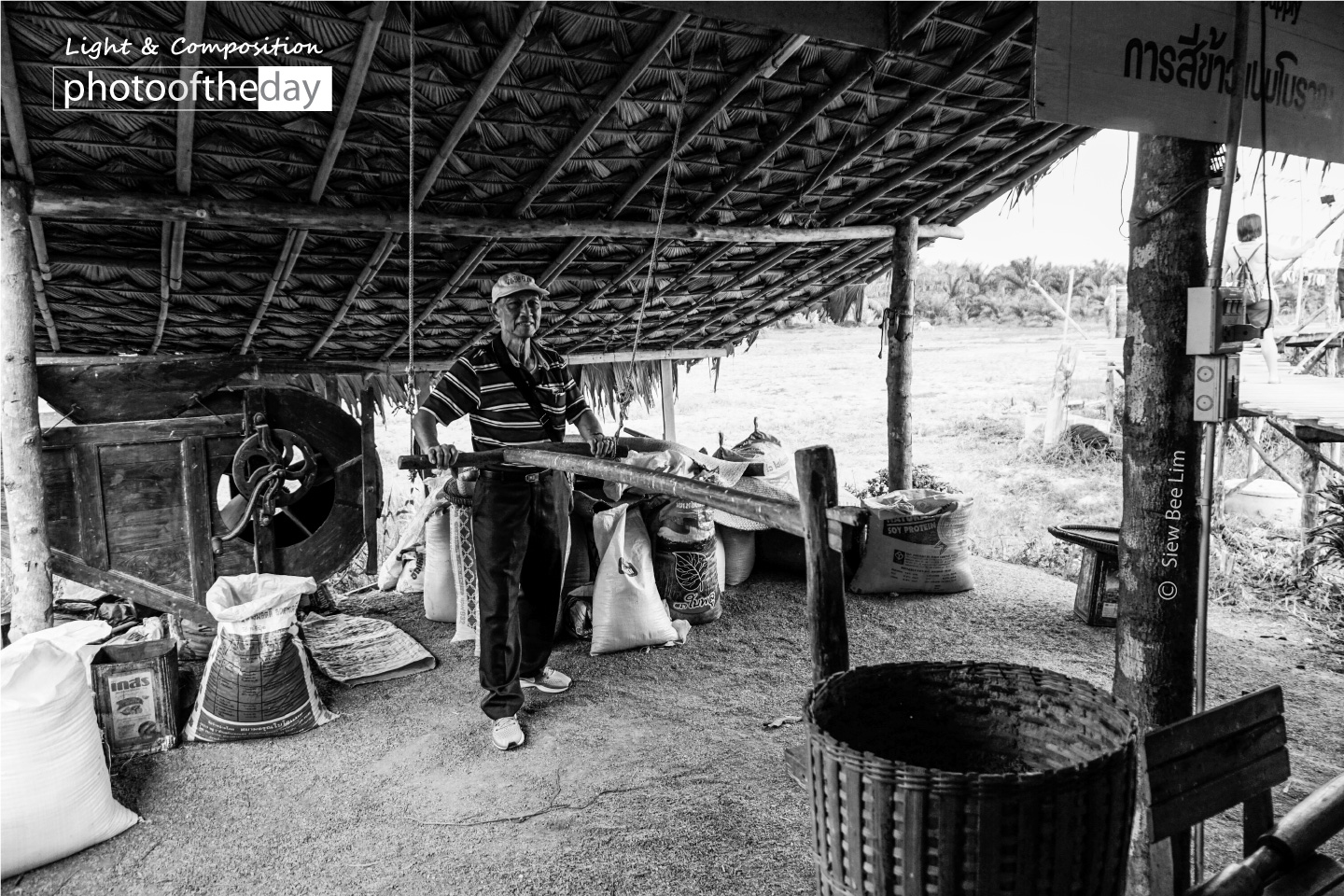
In the rural landscapes of Phatthalung, Thailand, Siew Bee Lim captures a moment of cultural preservation at a local paddy field. The photograph documents a visitor engaging with an antique husking machine, a relic of traditional agriculture. By synchronizing push and pull forces, the subject attempts to master the manual process demonstrated by a local worker. The image is award-worthy for its authentic portrayal of human interaction with heritage, highlighting the physical effort and curiosity involved in keeping traditional practices alive. Through a thoughtful black-and-white lens, the photographer emphasizes the texture of the machine and the genuine expression of the participant.
Siew Bee Lim
Born in Singapore in 1965, Siew Bee Lim is a dedicated photographer who transitioned from a career in programming to a formal pursuit of the photographic arts. Although she initially explored photography as a hobby in her youth, her current journey with Light & Composition represents a renewed commitment to mastering the craft. Drawing inspiration from her lifelong appreciation of literature and Chinese painting, she seeks to overcome her self-perceived lack of artistic hand by developing a sophisticated eye for composition and narrative storytelling in her work.
Resonance Score Breakdown
Transparency Note: The resonance score (8.6/20) is calculated based on social engagement metrics collected before the award announcement.
Expert Photography Reviews · 7
The Weight of the Grain
I am generally suspicious of any scene that feels like a museum exhibit. We have a habit of turning the past into a performance, dressing up the labor of our ancestors in a way that feels safe, clean, and ultimately hollow.
Read the reflection →The Rhythm of the Grain
There is a quiet wisdom in the way we handle the things that sustain us. We have become accustomed to the speed of modern life, where the origin of our nourishment is hidden behind layers of convenience and distance.
Read the reflection →Reviews & Comments
Share your thoughts about this award-winning photograph. Your reviews contribute to the community engagement score.

You waited for the exact second the tension hit their shoulders. I can feel the weight of that wooden handle in their grip. It’s not just a machine; it’s a bridge between two lives. Because you didn’t rush the frame, I’m right there in the dust with them, feeling that same curiosity. There’s something honest happening here. You’ve captured the friction of history, and honestly, it makes me miss the smell of a real harvest.
The visitor’s hands grip the antique husking machine, but who is truly laboring here? The local worker stands back, relegated to a prop in this performance of heritage. It’s a staged encounter that leaves me feeling deeply uneasy. Why does the tourist’s curiosity take precedence over the worker’s lived reality? We’re watching a power dynamic masquerading as cultural appreciation. Does the black-and-white filter exist to romanticize this imbalance, or simply to hide the friction?
We look at this face and we understand the weight of the past. In Phatthalung, Siew Bee Lim captures more than a machine; she captures a conversation between generations. As the visitor grips the wood, we feel the friction of history against their palms. It’s a quiet, rhythmic dance of labor. I find myself holding my breath, hoping they find the rhythm. It’s a photograph that asks to be returned to, again and again.
There’s a quiet dignity in the way the subject engages with that antique husking machine. I’ve spent enough time in the field to recognize when someone is truly present versus just performing for a lens. This doesn’t feel extracted; it feels earned through genuine participation. I find myself genuinely moved by the texture of the wood and the focus in their hands. It’s a rare, honest connection to heritage that hasn’t been staged for a quick click.
That antique husker is a beast, and Siew Bee Lim caught the exact tension in the subject’s grip. It’s a rhythmic dance of labor. If she’d clicked a fraction later, the physical strain would’ve vanished into a static pose. I love the grit on those wooden handles; it feels like I can smell the dust. It’s not just heritage—it’s the raw, kinetic energy of a moment that refuses to be staged. She nailed the timing. Perfect.
The subject’s shoulders are hunched, but the kinetic chain is broken. To operate that husking machine, the force must travel from the heels through the core. Here, the arms are pulling while the feet are static, lacking the necessary drive. It’s a static pose, not a peak moment of exertion. I’ve spent my life watching bodies fail to engage their power, and this misses the mark. It’s just a rehearsal, not the work itself.
f/4 at 1/250s, ISO 400, 35mm. A standard choice for a static subject, yet the motion blur on the worker’s hands suggests a failure to account for the kinetic energy of the husking machine. It’s technically lazy. I’ve spent years watching people fumble with manual tools, and this lack of sharpness irritates me. The depth of field is sufficient, but the shutter speed didn’t commit to the action. It’s a missed opportunity for precision.