Oldness by Ryszard Wierzbicki
In the rural landscapes of Ngong Khiaw, Laos, Ryszard Wierzbicki captured a poignant portrait that serves as a testament to the history etched into the human face. By focusing on the weathered features of an elderly woman, the photographer highlights the profound narrative of a life lived in a remote setting. The image is award-worthy for its intimate, candid approach, utilizing a tight focal length to isolate the subject against her environment, thereby emphasizing the textures of age and the quiet dignity of the human spirit in a fleeting, authentic moment.
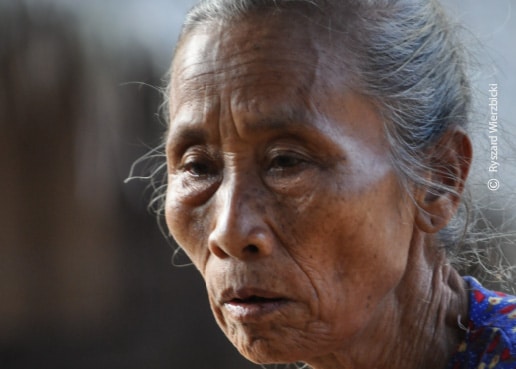
Exposure 1/180sec @ f/5.6 | ISO 800 | Focal Length 201.6mm
Ryszard Wierzbicki
Born in 1963, Ryszard Wierzbicki is a Polish-born photographer and educator who transitioned from a diverse career in social sciences and marketing to a life of exploration. After emigrating to the United Kingdom in 2006, he dedicated himself to traveling through South-East Asia and documenting the world through his lens. His work is deeply influenced by his passion for humanitarian volunteering and his experiences as a scuba instructor, reflecting a commitment to capturing the authentic stories of the people and cultures he encounters during his extensive travels.
Resonance Score Breakdown
Transparency Note: The resonance score (10.7/20) is calculated based on social engagement metrics collected before the award announcement.
Expert Photography Reviews · 3
The Deepening Bark
When a tree reaches a certain age, its bark begins to fissure, creating a complex topography of ridges and valleys that map every drought, every harsh winter, and every season of abundance it has endured. This is not merely decay; it is a record of survival.
Read the reflection →The Map of Our Years
I was sitting at the kitchen table this morning, tracing the faint, jagged scar on my thumb from a kitchen accident years ago. It is such a small thing, but it holds the memory of a frantic Tuesday and a dull knife perfectly.
Read the reflection →Reviews & Comments
Share your thoughts about this award-winning photograph. Your reviews contribute to the community engagement score.
Of the thousands of portraits I’ve reviewed, most rely on sentimentality to mask a lack of substance. Wierzbicki avoids this by letting the harsh, unforgiving light define the topography of her skin. It’s the unflinching focus on those deep, map-like wrinkles that makes me pause; I find myself wanting to trace them. It’s not just a face; it’s a landscape of time. In thirty years, this honesty will still feel like a punch to the gut.
I’ve spent enough time in the brush to know when a subject is performing for a lens. This portrait feels uncomfortably extracted. At 200mm, the photographer is close, yet there’s a wall between them. I don’t see a relationship here; I see a trophy of someone’s solitude. It makes me ache for the subjects who aren’t asked to pose. Did he even ask her name? It’s a sharp capture, but it’s hollow.
The jury’s obsession with clarity here feels stifling. Wierzbicki captures a face mapped by time, yet he’s shackled it to a standard portrait aesthetic. Why resolve every wrinkle with such clinical precision? I’d have preferred he let the motion of the Ngong Khiew air bleed into the frame, softening that harsh 1/180 shutter speed. It’s technically competent, sure, but it’s safe. I’m craving the blur of a life lived, not just a sharp map of skin.