My Next Meal . . . by Ganesh V Ramanathan
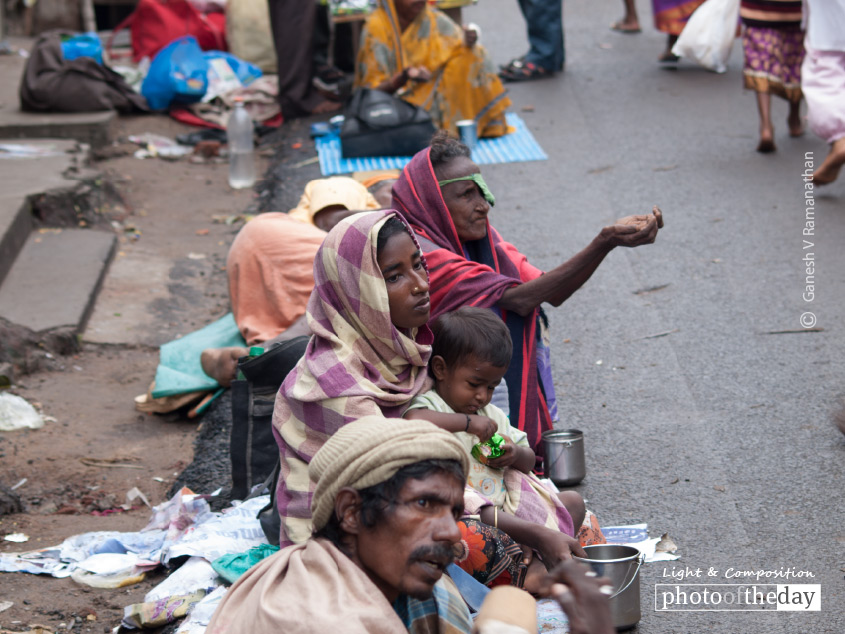
Captured during an annual pilgrimage in India, this poignant street photograph highlights a quiet, human moment amidst the bustle of daily life. The photographer focused on a mother sitting with her child, capturing her contemplative expression as she remained seemingly oblivious to the surrounding banter. By isolating this intimate scene, the image invites the viewer to reflect on the universal struggle for sustenance and the quiet dignity of those often overlooked. The composition is award-worthy for its ability to transform a common street scene into a powerful narrative of empathy and human connection.
Ganesh V Ramanathan
Based in Singapore, Ganesh V Ramanathan was introduced to the art of photography by his father, who instilled in him a deep appreciation for the quality of light. After a long hiatus following his father's passing, he rediscovered his passion for the craft at age thirty and has since dedicated seven years to honing his skills. A self-described traveller rather than a tourist, Ganesh specialises in travel photography, capturing authentic moments across the globe with a humble approach that prioritises the story over the equipment.
Resonance Score Breakdown
Transparency Note: The resonance score (12.4/20) is calculated based on social engagement metrics collected before the award announcement.
Expert Photography Reviews · 7
The Weight of Quiet
I was standing in the grocery store aisle this morning, staring at a shelf of canned goods, when I realized I had completely forgotten what I came in for. A woman stood a few feet away, her brow furrowed as she counted coins in her palm.
Read the reflection →The Weight of a Quiet Root
We often mistake stillness for an absence of motion, as if the earth were not turning beneath our feet while we sit. But there is a particular gravity to the way a person holds their own life, a quiet concentration that anchors the soul against the gale of the world.
Read the reflection →Reviews & Comments
Share your thoughts about this award-winning photograph. Your reviews contribute to the community engagement score.
The frame holds a heavy, rhythmic silence. It’s a long take in a crowded street, a moment where the world stops spinning for a mother and child. I’m struck by the stillness; it’s almost breathless. At 1/40sec, the motion blur of the pilgrimage is just a ghost, keeping the focus locked on her eyes. It’s the shot an editor keeps because it’s the only one that tells the truth. A cut here would be a crime.
1/40sec at f/4.5, 70mm. It’s a precarious shutter speed for a 70mm focal length on an E-3. You’ve risked motion blur for a shallow depth of field that barely isolates the subjects. The ISO 100 choice is rigid, forcing that slow shutter. It’s technically reckless, yet the focus holds. I’ve spent years looking for this kind of precision in chaos. You’ve balanced the exposure perfectly. It’s a correct technical gamble that actually paid off.
Before the eye identifies the mother and child, a sudden stillness anchors the chest. The frame doesn’t just show hunger; it forces a physiological pause, a tightening in the throat that I’ve felt every time I return to it. It’s the weight of her gaze, detached from the pilgrimage’s noise, that lingers. When I look away, the image follows me, haunting my own quiet moments with the ache of her silent, enduring resolve.
You waited for the noise of the pilgrimage to fall away, and that’s where the truth lives. I look at her face and I don’t see a subject; I see a mother carrying the weight of the next hour. It’s heavy, isn’t it? You didn’t just take a picture of a woman in Thiruvanamalai. You felt her exhaustion. And because you stayed still, I’m sitting there with her, feeling that same quiet, crushing uncertainty.
Dust settles on the pavement. The mother sits. She doesn’t look at the lens. Her gaze rests on the ground. It’s a heavy stillness. I’ve felt that weight before, the quiet hunger of a long afternoon. The frame holds the space between her and the world. It’s not just a street scene. It’s a breath held. Nothing here is accidental. The empty corner is not empty. It’s the silence she carries. I’m humbled.
The frame divides into a precise 1:2 vertical ratio, anchoring the mother’s silhouette against the negative space of the wall. Her posture creates a sharp, descending diagonal that terminates at the child’s center of gravity. It’s a beautifully solved spatial equation. I’m genuinely moved by how the geometry traps their isolation within the rectangle. The tension between the heavy, dark mass of the figures and the empty, light-filled background creates a perfect, silent equilibrium.
The ochre dust of Thiruvanamalai clings to the mother’s sari, a shade reminiscent of Morandi’s muted earth pigments, grounding the frame in a weary, sun-baked stillness. It’s the way the light catches the child’s skin—a soft, bruised apricot—that truly breaks my heart, creating a chromatic tension against the cooling shadows. One finds here a quiet, visceral harmony, where the palette doesn’t merely describe poverty, but feels it, vibrating with a raw, unspoken, and deeply human ache.