Morning by Shirren Lim
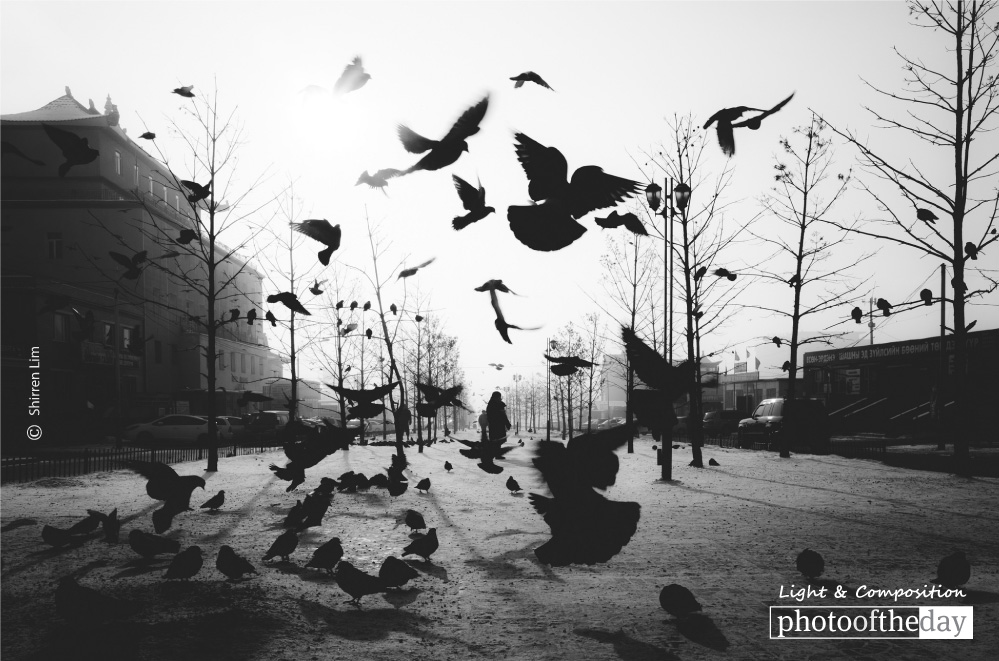
Captured during a frigid morning at the Gandantegchinlen Monastery in Ulaanbaatar, Mongolia, this image reflects a patient observation of life. The photographer spent time documenting the monastery before turning her lens toward the birds circling the grounds. By carefully timing her shots to coincide with the movement of passersby, she created a dynamic composition that balances the stillness of the historic site with the fleeting energy of the street. This photograph is award-worthy for its masterful use of timing and its ability to transform a routine morning scene into a compelling narrative of human and avian interaction within a sacred space.
Shirren Lim
Born in Penang Island, Malaysia, in 1970, Shirren Lim is a Jakarta-based photographer who discovered her true passion for the craft in 2009. Her work is celebrated for its intense, earthy quality and a simple composition that cuts directly to the heart of her subjects, with a particular focus on the sincerity of human expression. Deeply inspired by the iconic imagery of Steve McCurry, she strives to capture profound, world-changing moments, and her evocative photography has been featured in numerous international web and printed publications.
Resonance Score Breakdown
Transparency Note: The resonance score (2.0/20) is calculated based on social engagement metrics collected before the award announcement.
Expert Photography Reviews · 3
The Weight of a Breath
I woke up this morning to the sound of pigeons landing on my fire escape. It was a frantic, clumsy noise, a sudden flurry of wings that made me stop mid-pour with my tea. I stood there for a long time, just watching them pace back and forth on the metal grating.
Read the reflection →The Weight of Breath
There is a particular cold that settles into the marrow. It is not merely a lack of heat; it is a presence. In the north, we learn to move slowly, to conserve the warmth that remains in the chest.
Read the reflection →Reviews & Comments
Share your thoughts about this award-winning photograph. Your reviews contribute to the community engagement score.
The swirling pigeons evoke Kertész’s rhythmic urban geometry, yet Lim anchors them within the spiritual gravity of Ulaanbaatar. It’s a delicate dance between the sacred and the mundane. I’ve spent decades watching photographers chase the decisive moment, but the way she balances the monastery’s stillness against that chaotic, feathered kineticism genuinely stopped me in my tracks. It’s rare to see a composition that feels both ancient and startlingly alive. She’s found a new pulse in an old ritual.
In Ulaanbaatar, the cold bites, yet we feel a strange warmth here. Shirren didn’t just chase the birds; she waited for the rhythm of the monastery to reveal itself. We see the flutter of wings meeting the steady, quiet pace of a life lived in prayer. It’s a delicate dance between the sacred and the fleeting. I’m moved by how she let the silence settle before clicking the shutter. It’s a photograph that asks to be returned to.
The monastery’s vertical axis anchors the frame, creating a rigid anchor for the chaotic vectors of the birds. It’s a classic study in equilibrium; the 1:3 ratio of human presence to avian motion creates a perfect tension. I’m genuinely struck by how the birds’ flight paths intersect the architecture’s cold lines, solving a complex spatial equation with such grace. It’s not just a scene; it’s a calculated, rhythmic distribution of mass that keeps the eye perpetually moving.