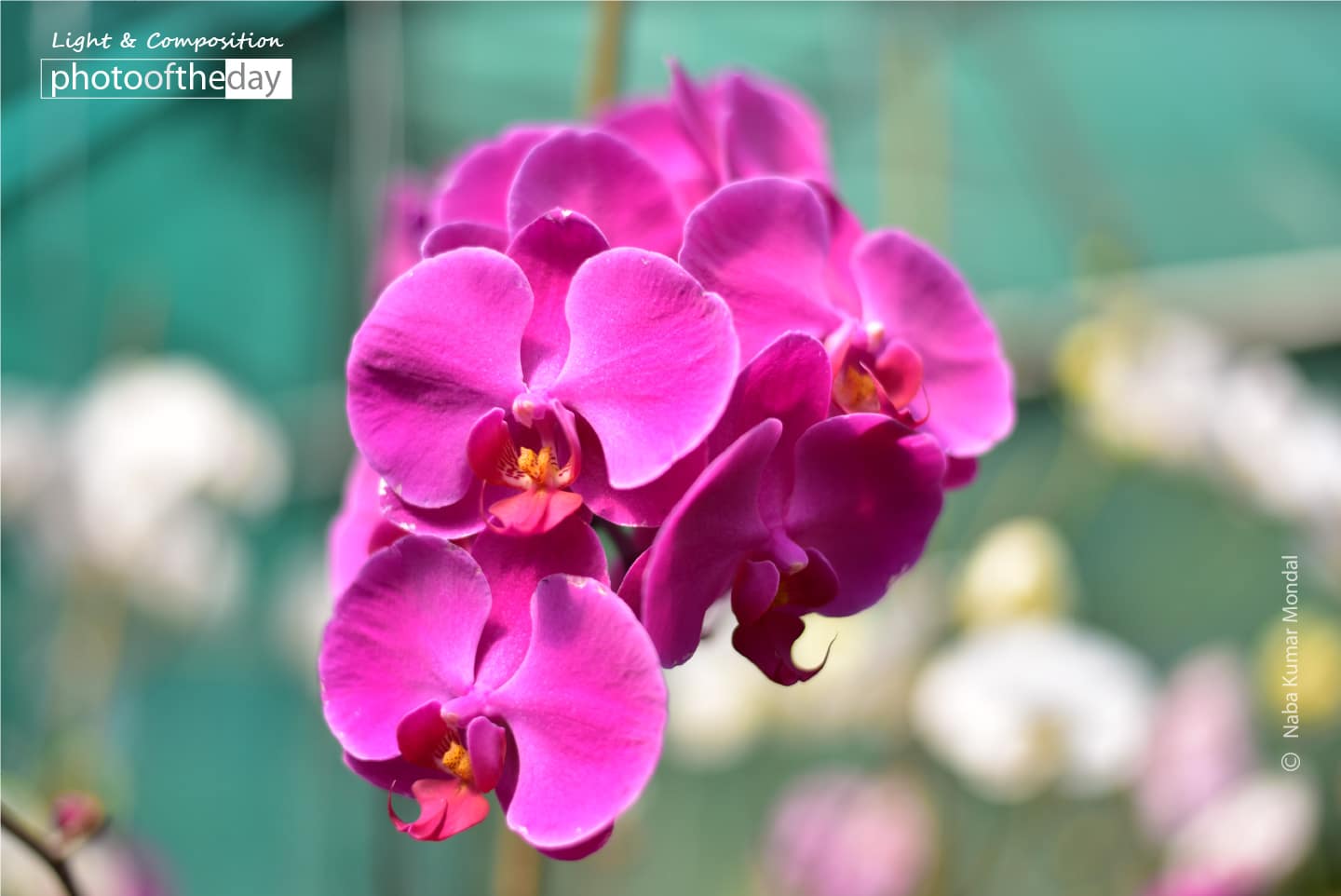
Morning Bliss by Naba Kumar Mondal
Captured during an early morning visit to the Orchid Garden and Research Center in Tipi, North East India, this photograph celebrates the delicate beauty of an endangered orchid species. The photographer arrived at dawn, finding the garden in full, vibrant bloom under perfect morning light. By focusing on the intricate textures and rich colors of these rare flowers, the image highlights the vital importance of conservation efforts in the region. This work is award-worthy for its ability to transform a scientific research site into a serene, blissful visual narrative that underscores the fragile elegance of wild flora.
Naba Kumar Mondal
Following a distinguished corporate career as an electrical engineer in India, Naba Kumar Mondal transitioned into the world of professional photography to pursue his creative passions. Based in Delhi, he travels extensively to document the diverse tapestry of human culture, tradition, and the vibrant colors of life. His work is defined by a deep fascination with storytelling and a belief that true photography requires a touch of madness, driving him to capture the essence of his subjects with artistic intensity.
Resonance Score Breakdown
Transparency Note: The resonance score (11.8/20) is calculated based on social engagement metrics collected before the award announcement.
Expert Photography Reviews · 7
The Silence of Unfolding
Why do we assume that beauty must be loud to be noticed? We live in a world that prizes the roar of the storm and the sudden flash of lightning, yet the most profound transformations occur in the quiet, unobserved hours of the morning.
Read the reflection →The Breath of Petals
The air at dawn has a specific weight, a cool dampness that clings to the skin like a damp silk sheet. It smells of wet earth and the sharp, green promise of things waking up.
Read the reflection →Reviews & Comments
Share your thoughts about this award-winning photograph. Your reviews contribute to the community engagement score.
We often forget that flowers have a pulse, too. In Tipi, Naba Kumar Mondal didn’t just photograph an orchid; he sat with it until it shared its secret. We look at these petals and feel the quiet patience of a dawn conversation. It’s a portrait of resilience, a living thing breathing in the morning mist. I find myself holding my breath, afraid to disturb such fragile, blooming grace. It’s a photograph that asks to be returned to.
The light hits the petals like a soft focus lens flare, turning the orchid into a lead character. It’s a quiet, static tracking shot that breathes. I’ve spent hours in edit suites hunting for this kind of stillness, where the frame doesn’t need a cut to justify its existence. It’s rare to find such patience in a shutter click. Honestly, looking at these textures, I just want to reach out and touch the dew. It’s pure cinema.
Arriving at dawn is the bare minimum, not a triumph. One suspects the light cooperated on the first attempt; it often does, for the lucky. While the orchids are undeniably pretty, I’m left wondering if the photographer ever returned when the weather turned foul. It’s a pleasant enough study, but it lacks the grit of a truly earned frame. I’ve spent enough mornings shivering in the damp to know when a shot came too easily.
Botanical photography often falls into the trap of sterile documentation, yet here, the light recalls the soft, diffused luminosity of Anna Atkins’s early cyanotypes, albeit with a modern chromatic intensity. It’s a delicate balance. While the composition echoes the structured precision of Karl Blossfeldt’s plant portraits, the vibrant saturation brings a contemporary urgency to the frame. I’m genuinely moved by how the dew clings to the petals; it’s a rare, quiet intimacy I haven’t felt in years.
Dawn in Tipi. The light hits those petals, and for a second, the world stops. It’s beautiful, sure, but where’s the pulse? Cartier-Bresson hunted the human condition; here, I’m just looking at a flower. It’s technically sharp, but it lacks that frantic, unrepeatable tension of the street. I want the chaos of Arunachal, not a postcard. One tenth of a second later and the light shifts, but does it matter? I’m left wanting more grit.
Dew clings to the petals. It’s a quiet morning in Tipi. I’ve spent too long looking at the chaos of color, but here, the stillness holds. The orchid doesn’t demand attention. It simply exists. I find myself holding my breath, afraid to disturb the light. Nothing here is accidental. The empty corner is not empty. It’s a pause. A rare, fragile breath of air. I feel a sudden, sharp ache for this silence.
The focal plane here is razor-thin, slicing through the orchid’s labellum with clinical precision. At this magnification, the diffraction limit hasn’t yet softened the cellular structure, allowing the lens to resolve textures the naked eye simply misses. It’s breathtaking. I’ve spent years studying optics, yet the way the light refracts through those dew-laden petals, creating such soft bokeh as a function of the wide aperture, still makes my heart skip a beat. It’s pure, luminous science.