Monk by Shirren Lim
Captured on a sweltering Sunday morning in Bangkok’s Sanum Luang district, this portrait documents a fleeting encounter with a passing monk. The photographer was drawn to the profound character etched into the subject's face, prompting a quick, instinctive capture as he walked by the local amulet sellers. By focusing on the intricate lines and weathered texture of the monk’s features, the image transcends a simple street snap to become a study in human history. This photograph is award-worthy for its raw, candid intimacy and the photographer's ability to extract a timeless, soulful narrative from a brief moment of transit.
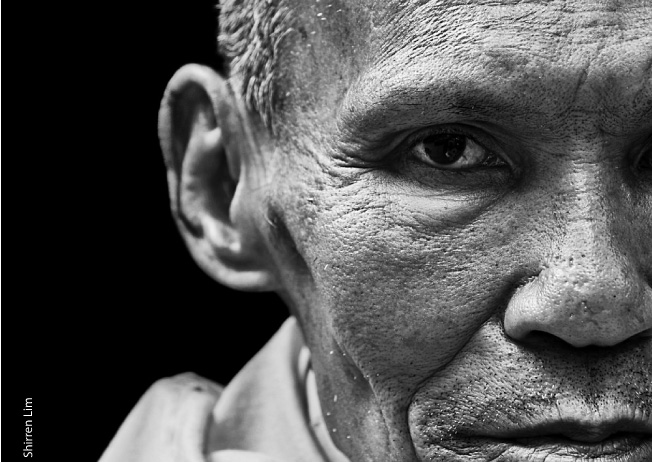
Shirren Lim
Born in Penang Island, Malaysia, in 1970, Shirren Lim is a Jakarta-based photographer who discovered her true passion for the craft in 2009. Specializing in portraiture, she seeks to capture the sincere, uncovered expressions of humanity, producing work often described as intense and earthy. Inspired by the iconic imagery of Steve McCurry, Lim strives to create photographs that resonate with the same emotional depth and global impact, aiming to capture moments that reveal the heart of the human experience.
Resonance Score Breakdown
Transparency Note: The resonance score (12.0/20) is calculated based on social engagement metrics collected before the award announcement.
Expert Photography Reviews · 8
The Weight of Quiet
I remember sitting in a small tea shop in Kyoto, watching an elderly man fold his napkin with the kind of precision usually reserved for origami. He didn't look up, didn't check his watch, and didn't seem bothered by the rain drumming against the glass.
Read the reflection →The Architecture of Stillness
The city is often defined by its velocity—the relentless push of commerce, the aggressive expansion of glass towers, and the frantic transit of bodies moving between points of production.
Read the reflection →Reviews & Comments
Share your thoughts about this award-winning photograph. Your reviews contribute to the community engagement score.
The shutter speed drags, just enough to catch the heat rising off the pavement. It’s a tight 80mm frame, isolating the monk from the chaos of Sanum Luang. I’m struck by the stillness in his eyes; it’s the kind of gaze that stops a film dead in its tracks. Lim didn’t chase the movement. She waited for the character to land. It’s the frame the editor keeps because the cut would’ve been a mistake.
The frame’s geometry hinges on the monk’s gaze, which anchors the composition against the chaotic blur of the background. It’s a tight, disciplined study of verticality. The spatial tension between the subject’s weathered skin and the soft, out-of-focus periphery creates a necessary friction. I’ve rarely seen such a brutal economy of space. It doesn’t rely on sentiment; it relies on the sheer weight of the subject’s placement. The architecture of the shot holds perfectly.
Bangkok’s Sanum Luang is a dense, shifting datum of urban life, yet here the architecture dissolves. The monk’s saffron robes provide the only verticality against the blurred, chaotic fenestration of the market stalls. It’s a fleeting threshold, really. I’m struck by how the light catches the deep, weathered topography of his skin, echoing the worn surfaces of the city itself. It doesn’t just document a man; it captures the weight of a space in transit.
The monk’s face is a map of suffering, but who authorized this cartography? Lim treats his wrinkles like a landscape to be mined for aesthetic gravity. It’s technically sharp, yet I feel a prickle of resentment at how easily he’s reduced to a prop for a soulful narrative. Why does the photographer’s instinct to capture always override the subject’s right to remain unobserved? Does this intimacy actually belong to the monk, or just to the lens?
You caught him in a moment of pure, unvarnished existence. I’ve spent enough time in the heat of Bangkok to know that look—it’s not just age; it’s a lifetime of quiet observation etched into his skin. You didn’t just snap a portrait; you waited for his soul to show up. And honestly, looking at those deep lines, I felt a sudden, sharp ache for the stillness he carries. You were there, and you felt it. That’s everything.
The 1/30sec shutter speed here is a delicious gamble. Most would chase a crisp portrait, but Lim’s choice to let the monk’s movement bleed into the frame creates a ghostly, temporal friction. It’s closer to Sugimoto’s long-exposure theatres than a standard street snap. I’m genuinely moved by the blur; it’s not a failure of focus, but a deliberate surrender to the transience of the moment. Why resolve the face when the motion tells the truth?
Most street portraits of monks are clichés, but this one survives because of the eyes. While others focused on the robes, Lim captured a weary, singular humanity that feels heavy with time. It’s the way the light catches those deep, etched wrinkles—it makes me want to sit in silence with him. Of the thousands I’ve reviewed, this isn’t just a snap; it’s a quiet, enduring record of a man who has seen everything and expects nothing.
Before the eye identifies the saffron robes, something in the chest tightens. It’s the weight of those deep, weathered lines—a topography of silence. I’ve spent minutes tracing the monk’s gaze, and it’s unsettling how he seems to look through my own history. When I return to this, I feel a strange, cooling stillness. It’s not just a portrait; it’s a mirror. I find myself holding my breath, waiting for him to finally speak.