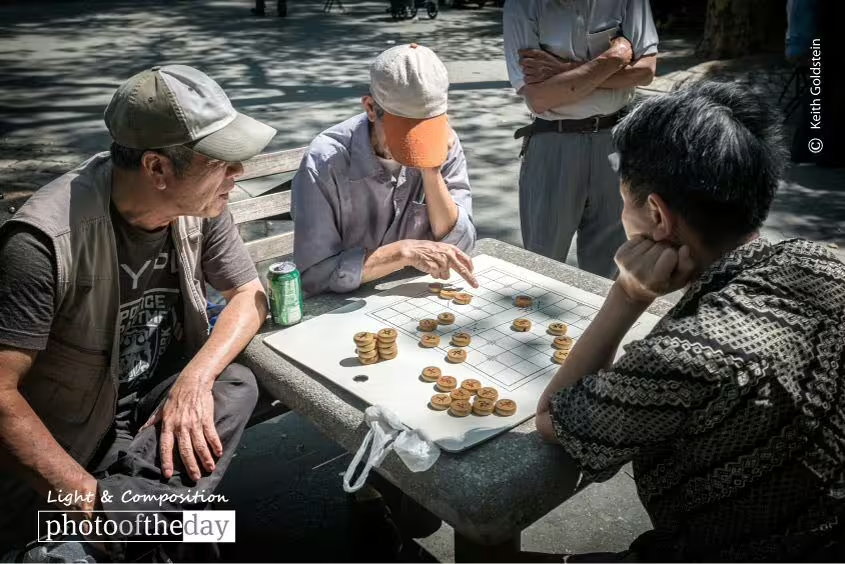
Men Playing Chinese Chess by Keith Goldstein
In the heart of Columbus Park, Keith Goldstein captures a timeless moment of connection amidst the bustling energy of New York City’s Chinatown. Utilizing a wide 19mm focal length, the photographer frames an intimate game of Chinese chess between friends, set against the backdrop of a neighborhood that preserves the traditions of a bygone era. The image succeeds through its authentic street-level perspective, balancing the candid intensity of the players with the rich, textured atmosphere of the park. This photograph is award-worthy for its ability to transform a fleeting social interaction into a poignant narrative of community and cultural endurance.
Keith Goldstein
Born in Brooklyn in 1957, Keith Goldstein is a seasoned fine art and documentary photographer whose creative journey began with an early fascination for the medium during his high school years. After earning his BFA from the School of Visual Arts and an MFA from the Cranbrook Academy of Art, he spent decades refining an emotive, unencumbered approach to capturing the world. With an extensive exhibition history dating back to 1980, his work has appeared in numerous international publications and media outlets, reflecting a career dedicated to exploring the human experience through a lens.
Resonance Score Breakdown
Transparency Note: The resonance score (12.4/20) is calculated based on social engagement metrics collected before the award announcement.
Expert Photography Reviews · 8
The Geography of Belonging
Public space is rarely neutral. We often mistake a park for a simple patch of green, but it is actually a contested map of social claims. When people gather to occupy a corner, a bench, or a table, they are performing an act of territorial assertion.
Read the reflection →The Weight of the Move
There is a silence that belongs only to men who have known each other for a lifetime. It is not a lack of words, but a surplus of understanding.
Read the reflection →Reviews & Comments
Share your thoughts about this award-winning photograph. Your reviews contribute to the community engagement score.

The tension here is palpable. It’s a wide, cinematic master shot that refuses to cut away. Goldstein’s 19mm lens pulls the viewer right onto the bench, making the chess match feel like a high-stakes standoff. I’ve spent hours in parks like this, and the way the light hits those weathered faces makes my chest ache with nostalgia. It’s a perfect frame; the editor would never dream of trimming a single pixel from this scene.
The 19mm lens forces a brutal proximity. It’s a claustrophobic geometry. The board acts as a fulcrum, anchoring the players’ hands in a rigid, triangular tension. While the background dissolves into urban noise, the foreground’s spatial weight holds the frame together. It’s tight, almost suffocating, yet the composition doesn’t collapse. I’ve grown weary of street photography’s sentimentality, but this structure is undeniable. It’s a precise, architectural lock. The frame finally earns its keep.
In Columbus Park, the air thickens with the weight of unspoken moves. We watch these men, their focus a bridge between generations. Goldstein didn’t just snap a frame; he sat in the silence of their concentration until the game became a conversation. I feel a sudden, sharp ache for the quiet rituals we’re losing to the city’s roar. It’s a beautiful, human tether to the past. This is a photograph that asks to be returned to.
You got right in there with them. Most people would’ve kept their distance, but you chose the 19mm, forcing us to sit at that table. I can almost hear the tiles clicking. It’s not just a game; it’s the weight of their focus that hits me. You waited for that exact silence between moves. And that’s the truth of it. You didn’t just take a picture of Chinatown; you felt the quiet pulse of their friendship.
The ochre light filtering through the park’s canopy possesses the dusty, melancholic weight of a Morandi still life, grounding these players in a palette of sun-bleached terracotta and muted jade. It’s a chromatic intimacy that truly moves me; one feels the humid, urban heat radiating from the pavement, a tactile warmth that doesn’t merely frame the game but breathes through it, turning a simple afternoon in Chinatown into a shimmering, suspended meditation on time.
The board sits between them. A bridge of wood and intent. I’ve watched these games for hours in the park. The noise of the city doesn’t reach this table. It’s quiet here. The players lean in. The surrounding pavement is vast, gray, and still. Nothing here is accidental. The empty corner is not empty. It holds the weight of their focus. I feel a sudden, sharp ache for this stillness. It’s rare. It’s enough.
Most street photography is noise, but this frame earns its place in the archive. Using a 19mm lens, Goldstein forces us into the players’ personal space without disrupting their focus. It’s the tension in their hunched shoulders that makes me lean in, feeling that quiet, dusty heat of a New York afternoon. Many photographers capture a scene; few capture the gravity of a game. Thirty years from now, this will still feel like a living, breathing community.
Getting that close with a 19mm lens isn’t just about gear; it’s about becoming part of the furniture. Goldstein clearly didn’t just wander through Columbus Park once. He’s earned his seat at that table. I’ve spent enough afternoons shivering in the rain to know when someone’s actually put in the hours. It’s a rare, quiet intimacy. I find myself wanting to pull up a chair and watch the game myself. A job well done.