Masks by Ryszard Wierzbicki
Captured in the vast expanse of the Ngorongoro crater in September 2011, this evocative image documents a poignant cultural moment. The photographer encountered a group of young Maasai boys along a roadside, meticulously applying traditional face paint in preparation for their upcoming initiation ceremony. By choosing a telephoto perspective, the photographer captured the raw anticipation and solemnity of this rite of passage without intruding on the scene. The image is award-worthy for its respectful, intimate portrayal of cultural heritage, balancing the stark, natural beauty of the Tanzanian landscape with the profound, transformative human experience of the subjects.
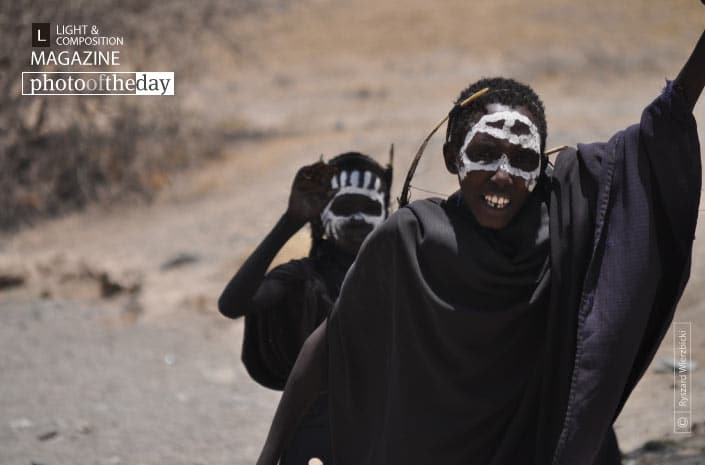
Exposure 1/2000sec @ f/6.7 | ISO 400 | Focal Length 175mm
Ryszard Wierzbicki
Born in Poland in 1963, Ryszard Wierzbicki relocated to the United Kingdom in 2006, where he established himself as a dedicated travel photographer. His work is defined by a deep commitment to cultural observation, with a particular focus on poignant portraits of children and the elderly. Through his extensive travels, especially across South-East Asia, he captures the human spirit within diverse traditions, consistently demonstrating a keen eye for the quiet, authentic moments that define global cultures.
Resonance Score Breakdown
Transparency Note: The resonance score (13.0/20) is calculated based on social engagement metrics collected before the award announcement.
Expert Photography Reviews · 8
The Weight of Becoming
We are born with faces that belong to our fathers. Then comes the time when we must choose a face of our own. It is a quiet violence, this shedding of the old skin to reveal something that has been waiting underneath.
Read the reflection →The Weight of Becoming
I spent this morning cleaning out my old desk drawers, the kind of task you put off for years. I found a stack of birthday cards from when I was ten, and a dried-up ribbon from a dance recital I barely remember.
Read the reflection →Reviews & Comments
Share your thoughts about this award-winning photograph. Your reviews contribute to the community engagement score.
Most travel photography is just tourism masquerading as art, but this hits differently. By using the 175mm focal length, Wierzbicki avoided the voyeuristic trap of getting too close. The white pigment against their dark skin creates a tension that feels ancient. I’ve seen thousands of portraits, yet the solemnity in these boys’ eyes still stops me cold. It’s the restraint that makes this endure; it’s not just a ritual, it’s a quiet, heavy transition into manhood.
The ochre pigment smeared across these faces possesses the dusty, sun-scorched warmth of a Morandi still life, grounding the boys in the crater’s dry, pale earth. It’s a chromatic ritual that I find utterly haunting; the way the white clay cuts through the heat-hazed atmosphere creates a tension, a fragile vibration against the landscape’s muted, tawny palette. One feels the weight of their transition, suspended in a light that’s both ancient and unforgivingly, beautifully present.
A telephoto lens often serves as a coward’s shield, yet here it feels like a necessary restraint. One senses Wierzbicki didn’t just stumble upon these boys; he likely sat in the dust until he became part of the landscape. It’s a quiet, disciplined observation. I’ve spent enough hours waiting for a shift in the light to know when someone’s actually earned their seat. It’s a rare, honest bit of patience. I find it quite moving.
The crater floor stretches. It’s vast. The boys sit in the dust, paint on skin. They’ve carved out a quiet circle amidst the heat. I’m struck by the distance. It’s not just geography; it’s the space between their focus and the world. Nothing here is accidental. The empty corner is not empty. It’s the weight of the transition. They’re waiting. I find myself holding my breath, watching them inhabit the silence before the change.
At 175mm and f/6.7, the focal plane is razor-thin, isolating the boys’ faces from the crater’s chaotic bokeh. You can see the diffraction of light across the white pigment, revealing a texture the naked eye would surely miss. It’s a clinical capture, yet I’m genuinely moved by the way the lens resolves the solemnity in their eyes. It’s rare to see such optical precision serve a moment of such profound, fragile human transition. Truly beautiful.
The dust of Ngorongoro settles in the throat, doesn’t it? I’ve spent enough time in the bush to know that silence isn’t empty; it’s heavy with what’s coming. These boys aren’t just painting skin; they’re waiting for the light to change their lives. Wierzbicki didn’t rush them. He stood back, letting the telephoto lens breathe. I feel a strange, quiet ache looking at them. They’re standing on the threshold of everything, and the earth is listening.
The frame’s geometry is compromised by the loose arrangement of the subjects. While the telephoto compression flattens the depth, the lack of a clear fulcrum leaves the eye wandering aimlessly across the crater floor. It’s a missed opportunity for structural discipline. The boys’ positioning doesn’t anchor the composition; it merely drifts. I’ve seen enough aimless travel snapshots to know that sentimentality isn’t a substitute for form. The negative space here is simply empty, not intentional.
The white pigment on these boys’ faces doesn’t merely decorate; it carves them out of the Tanzanian void. I’m struck by how the shadows beneath their eyes hold more history than the landscape itself. It’s a brutal, necessary erasure of the self before the initiation. Wierzbicki understands that light here is an intruder. He lets the darkness swallow the edges, forcing us to confront the heavy, silent weight of a soul becoming something else entirely.