Lost in the Crowd by Liton Chowdhury
Captured on the shores of Bokkhali, West Bengal, this poignant street photograph highlights the simple, universal joy of childhood. The photographer observed three brothers deeply engrossed in play, finding in their interaction a profound reflection of the ordinary, resilient spirit of the local population. By framing these children against the backdrop of their environment, the image transforms a fleeting moment of camaraderie into a timeless narrative of innocence. The work is award-worthy for its authentic emotional resonance and its ability to elevate a candid, everyday scene into a powerful commentary on the human experience within the crowd.
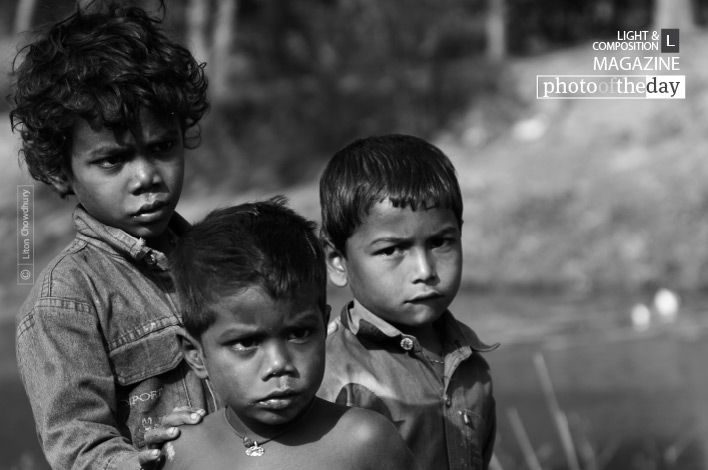
Liton Chowdhury
Based in Kolkata, India, Liton Chowdhury balances a professional career in software with a dedicated passion for photography. His creative journey began with the desire to document his daughter's childhood, a pursuit that transformed her into his most frequent and cherished subject. Over time, his lens has expanded to capture the vibrant, candid essence of street life, blending technical precision with a deep appreciation for the human stories unfolding in his home country.
Resonance Score Breakdown
Transparency Note: The resonance score (13.1/20) is calculated based on social engagement metrics collected before the award announcement.
Expert Photography Reviews · 4
The Quiet Between Us
I was standing in the grocery store line this morning, surrounded by people who were all staring intently at their phones. It felt like we were all in the same room, yet miles apart, each of us tucked away in a private, digital bubble.
Read the reflection →The Geometry of Belonging
In the study of fluid dynamics, there is a phenomenon where individual particles, when caught in a sufficiently dense stream, cease to move as distinct entities.
Read the reflection →Reviews & Comments
Share your thoughts about this award-winning photograph. Your reviews contribute to the community engagement score.
The frame’s geometry is compromised. While the subjects occupy the foreground, the horizon line bisects the composition with a jarring lack of intent. It’s a messy distribution of mass. The negative space doesn’t breathe; it merely dissipates. I’ve seen this chaos before, and it’s exhausting. The visual architecture fails to anchor the eye, leaving the narrative adrift. It’s technically competent, sure, but the spatial tension is absent. It doesn’t hold. I’m left wanting actual rigor.
The salt air of Bokkhali clings to these boys. They aren’t just playing; they’re anchored in the vast, indifferent tide. I’ve spent enough dawns waiting for the light to settle to recognize that stillness. It’s not about the crowd, but the silence between them. Watching their small, focused forms against that endless horizon, I feel a sudden, sharp ache for my own lost childhood. He didn’t rush them. He simply waited until the earth allowed them to exist.
It’s a charming scene, but one wonders if the photographer simply happened upon these boys while passing through. The composition is tidy, yet it lacks the grit of a long vigil. I’ve spent enough hours shivering in the salt air to know that true resonance requires more than a casual shutter click. It’s a pleasant enough snapshot, but I’m left wanting the weight of a photographer who’s actually stayed long enough to get sand in their boots.
At f/5.7, the Canon 1000D’s sensor captures the Bokkhali sand with surprising textural fidelity. The focal plane is razor-thin, isolating the brothers’ expressions from the chaotic diffraction of the shoreline. I’m genuinely moved by how the lens resolves the grit against their skin; it’s a tactile intimacy the naked eye usually misses. While the chromatic aberration is visible in the harsh coastal light, it doesn’t diminish the raw, optical truth of their fleeting, sun-drenched connection.