Looking On by Keith Goldstein
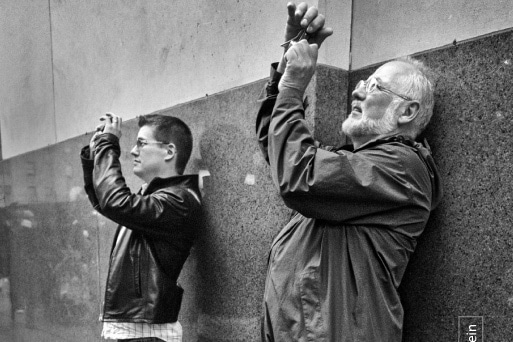
In this ongoing documentary project at the One World Trade Center site, the photographer captures the raw human experience of visitors observing the construction. By intentionally excluding the tower itself—focusing instead on reflections in sunglasses, camera screens, and windows—the work highlights the diverse emotions of those witnessing the site. The image is a poignant study of contemplation, awe, and grief, rendered with a street photographer’s keen eye for detail. Its award-worthy quality lies in this subtle, indirect approach to a monumental subject, successfully shifting the focus from the architecture to the profound, varied expressions of the human spirit.
Keith Goldstein
Born in Brooklyn in 1957, Keith Goldstein is a seasoned fine art and editorial photographer whose creative journey began with an early fascination for the medium during his youth. After earning his BFA from the School of Visual Arts and an MFA from the Cranbrook Academy of Art, he developed a deeply emotive, unencumbered style of documentation. With a career spanning over four decades, Goldstein has exhibited internationally and contributed to numerous prestigious publications, consistently using his camera as a tool to explore his personal connection to the world.
Resonance Score Breakdown
Transparency Note: The resonance score (12.7/20) is calculated based on social engagement metrics collected before the award announcement.
Expert Photography Reviews · 3
The Weight of What We See
I remember standing on a subway platform in Brooklyn, watching a woman across the tracks. She was staring at a blank concrete wall, her brow furrowed, her lips moving as if she were reciting a list of things she couldn't afford to forget.
Read the reflection →The Mirror of Elsewhere
We often mistake the act of looking for the act of seeing. We believe that if we turn our eyes toward a mountain, or a monument, or the vast, churning machinery of a city, we are somehow absorbing it.
Read the reflection →Reviews & Comments
Share your thoughts about this award-winning photograph. Your reviews contribute to the community engagement score.
1/2000sec at f/5, ISO 6400 on an 18.3mm lens. The shutter speed is overkill for a static subject, but it freezes the micro-vibrations of the crowd perfectly. ISO 6400 introduces noise that mimics grain, which I’ve always found irritating, yet here it adds a necessary grit to the glass reflections. Goldstein’s technical choices are aggressive. They don’t just capture the moment; they force it into focus. It’s a cold, precise execution. I respect the discipline.
Before the eye identifies the reflection, a sudden stillness settles in the chest. It’s the weight of absence. By omitting the tower, Goldstein forces us to inhabit the spectators’ internal architecture instead. I find my own breath hitching as I trace the ghost of steel in those dark lenses. When I return to this a year later, the grief feels less like a public event and more like a private, quiet ache I’ve carried all along.
It’s easy to snap a skyscraper; it’s quite another to wait until the reflection in a stranger’s sunglasses tells the story instead. Goldstein clearly spent hours pacing that concrete, enduring the biting wind of Lower Manhattan to catch a flicker of genuine grief. I’ve stood in that same cold, and it’s a miserable, necessary penance. He didn’t just find this moment; he earned it by refusing to look at the obvious. A rare, quiet victory.