Living on the Edge by Abhiroop Ghosh
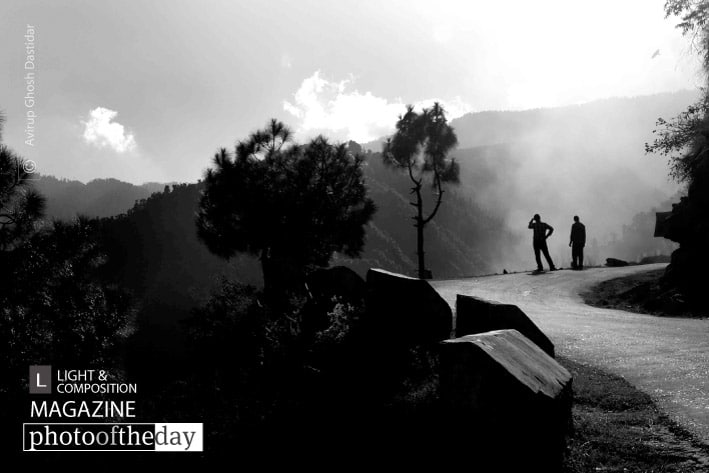
Captured from a moving vehicle, this evocative image portrays a man standing precariously near a mountain gorge in Himachal Pradesh. The photographer was struck by the subject's posture and the surrounding atmosphere, which initially suggested the aftermath of an accident. By acting on instinct, the photographer successfully preserved a fleeting moment of human vulnerability against the dramatic, winding backdrop of the mountains. The image is award-worthy for its raw, spontaneous narrative quality and the photographer's ability to transform a brief, passing encounter into a profound visual story about the human condition.
Abhiroop Ghosh
Based in Kolkata, India, Abhiroop Ghosh Dastidar balances a career in journalism with a dedicated pursuit of freelance photography. Over the past three years, he has cultivated a strong focus on street photography, viewing the medium as an instinctive tool to document the impulses and diverse cross-sections of daily life. His work is defined by a commitment to storytelling, aiming to capture the authentic, unscripted moments that reveal the deeper narrative of the human experience.
Resonance Score Breakdown
Transparency Note: The resonance score (13.2/20) is calculated based on social engagement metrics collected before the award announcement.
Expert Photography Reviews · 6
The Architecture of Breath
We spend our lives building walls against the void, stacking stones and certainties to keep the abyss at a polite distance. Yet, there is a secret gravity to the precipice—a pull that whispers of how thin the veil between being and vanishing truly is.
Read the reflection →The Weight of the Precipice
We often speak of balance as if it were a static achievement, a place where one finally comes to rest.
Read the reflection →Reviews & Comments
Share your thoughts about this award-winning photograph. Your reviews contribute to the community engagement score.
The mountains don’t care for our haste, yet here, the shutter caught a man suspended between earth and abyss. It’s a haunting, fleeting grace. I feel a chill in my chest looking at his solitude against that jagged Himachal gorge. He wasn’t posing; he was simply existing in the thin, cold air. The light is harsh, unforgiving, yet it reveals the vulnerability we all carry when we’re truly alone. It’s a quiet, terrifying beauty.
Captured from a moving vehicle, one suspects. It’s a snapshot of a fleeting impulse, not a deliberate study. While the composition holds a certain grim tension, I find myself wishing the photographer had stopped the car, climbed out, and spent an hour in that biting wind. It’s a decent grab, but it lacks the weight of a place truly earned. I’ve spent enough days shivering on those slopes to know that luck isn’t craft.
The gorge doesn’t just drop; it swallows. Ghosh captures a man teetering on the precipice of existence, where the light fails to reach the jagged floor below. It’s a terrifying void. I’ve stared at these Himachal shadows for an hour, and they don’t offer comfort—they demand an accounting of our own fragility. When the shutter clicked, the darkness wasn’t merely an absence; it was the heavy, silent weight of a life hanging by a thread.
Stripped of chromatic warmth, the monochrome palette here evokes the stark, chalky stillness of a Morandi study, where the absence of pigment forces one to confront the crushing weight of the gorge’s grey, slate-like depths. It’s haunting how the silvered light clings to the man’s silhouette, turning his isolation into a tactile, shivering vibration. I’m genuinely unsettled by the way these tones bleed into the void; it’s a beautiful, terrifying surrender to the mountain’s indifferent, monochromatic breath.
The frame’s geometry is precarious, mirroring the subject’s instability. The mountain gorge creates a jagged diagonal that slices the picture plane, forcing the eye toward the precipice. It’s a brutal, necessary tension. I’m genuinely unsettled by how the negative space swallows the figure whole. The composition doesn’t offer comfort; it demands a reckoning with the void. It’s a rare instance where the chaotic spontaneity of the capture actually respects the discipline of the frame.
Most entries in this category rely on staged drama, but this shot’s raw, kinetic blur feels honest. It’s the precarious tilt of the man’s frame against the jagged Himachal gorge that hooks me; I actually held my breath the first time I saw it. It’s not perfect, but it’s real. In thirty years, we won’t care about the Nikon D3000’s limitations. We’ll only care that someone captured this fleeting, terrifying vulnerability before it vanished.