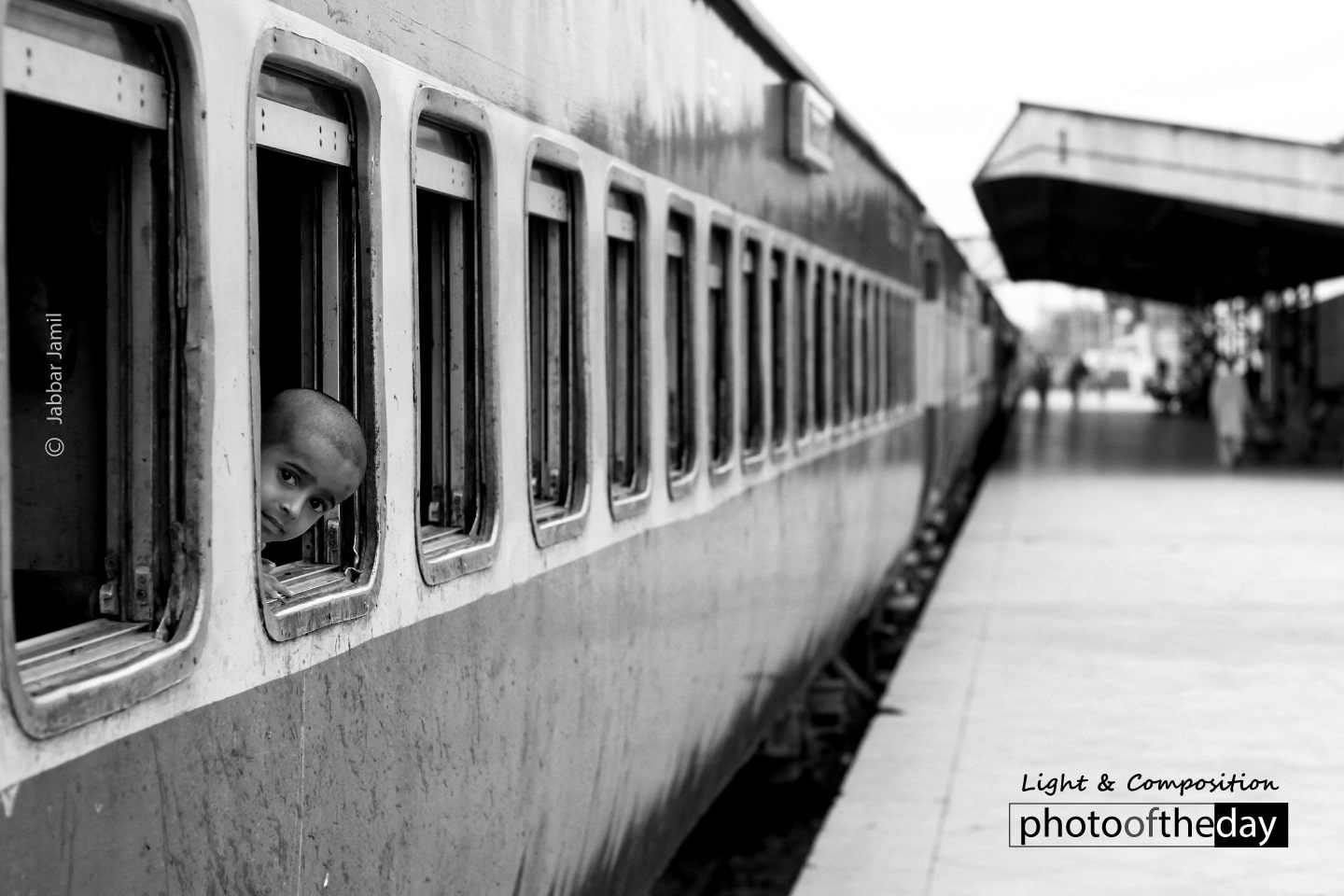
Little Traveler by Jabbar Jamil
In the fleeting moments before a train departed from a station in Sialkot, the photographer envisioned a compelling composition. The scene was transformed by the sudden appearance of a young traveler who remained perfectly still, as if inviting the camera to capture his presence. By patiently waiting for the right frame, the photographer successfully documented this quiet, serendipitous encounter. The image is award-worthy for its ability to turn a transient, everyday moment into a poignant narrative, showcasing the photographer’s keen eye for human connection and his dedication to capturing authentic, unposed street life amidst the bustle of transit.
Jabbar Jamil
Based in Sialkot, Pakistan, Jabbar Jamil is a dedicated street photographer who views his craft as a vital bridge to the outside world. He utilizes photography as both a creative outlet and a therapeutic practice, often venturing beyond his comfort zone to document the raw, unfiltered realities of urban life. Through his lens, Jamil seeks to forge human connections, finding profound meaning in the scenes he encounters regardless of their aesthetic polish.
Resonance Score Breakdown
Transparency Note: The resonance score (9.5/20) is calculated based on social engagement metrics collected before the award announcement.
Expert Photography Reviews · 7
The Weight of Small Shoes
We are all passengers in the architecture of transit, waiting for the iron pulse of the tracks to pull us toward a horizon we have not yet named.
Read the reflection →The Weight of Waiting
There is a particular stillness that arrives just before a departure, a heavy, suspended quality like the air before a summer thunderstorm in the fjords. It is a moment where time seems to thicken, turning the simple act of standing into a profound statement of existence.
Read the reflection →Reviews & Comments
Share your thoughts about this award-winning photograph. Your reviews contribute to the community engagement score.
The stillness of this boy amidst the Sialkot station’s blur echoes the quietude Cartier-Bresson sought in his decisive moments, yet the framing feels more akin to the stark, observational rigor of early Kertész. It’s a delicate balance of motion and pause. I’ve spent decades cataloging such transit scenes, but the way the boy’s gaze anchors the chaotic geometry of the platform genuinely caught my breath. It’s a rare, haunting intersection of history and modern street life.
You waited. I can feel it in the way the boy holds his stillness against the chaos of that Sialkot station. It’s not just a frame; it’s a quiet breath in a loud place. When I look at his eyes, I feel a sudden, sharp ache for the transience of childhood. You didn’t force the moment. You let him exist, and because of that, the camera caught something real. That’s a rare, honest gift.
Sialkot’s station isn’t just a backdrop; it’s a rhythmic sequence of steel and shadow. The boy stands at a threshold where the platform’s datum meets the train’s heavy mass, his stillness anchoring the chaotic fenestration behind him. I’m struck by how the light rakes across the platform, defining the void between traveler and structure. It’s a rare, honest capture of transit—not as a blur, but as a space where we finally pause to exist.
The boy’s stillness feels staged, doesn’t it? I find myself unsettled by how he’s positioned as a prop for the photographer’s aesthetic convenience. Why does the frame prioritize the train’s geometry over the child’s agency? It’s a beautiful composition, yet it leaves me cold. Does he know he’s being consumed as a symbol of transit? I’m tired of seeing poverty framed as a serendipitous encounter. We’re looking at a life, not just a visual narrative.
The boy’s posture is a study in stillness, but the timing is off. He’s caught in a transition, his weight shifting just enough to blur the intent. I’ve spent my life watching bodies hit their apex, and this isn’t it. It’s a millisecond too late; the tension has already bled out of his stance. It’s a nice shot, sure, but it doesn’t hold that singular, breathless snap of a body perfectly aligned with its own gravity.
It’s refreshing to see a frame where the light isn’t being swallowed by the water column. In Sialkot, the air is clear, unlike the murky, backscatter-filled depths I’m used to. There’s no refractive index distortion here, just a crisp, human moment. I’ve spent so long fighting the ocean’s blue-green filter that seeing this boy’s natural skin tones feels like a miracle. It’s a quiet, sharp encounter that doesn’t need a strobe to find its soul.
Most street photography is just a frantic grab, but here, the stillness is earned. One suspects Jamil didn’t just stumble upon this boy; he likely spent hours inhaling station soot, waiting for the chaos to align. It’s a quiet, disciplined frame. I’ve spent enough miserable mornings in transit hubs to know that stillness doesn’t happen by accident. It’s a rare, honest moment. I find myself genuinely envious of the patience required to capture that gaze.