Life in a Cage by Anjan Patra
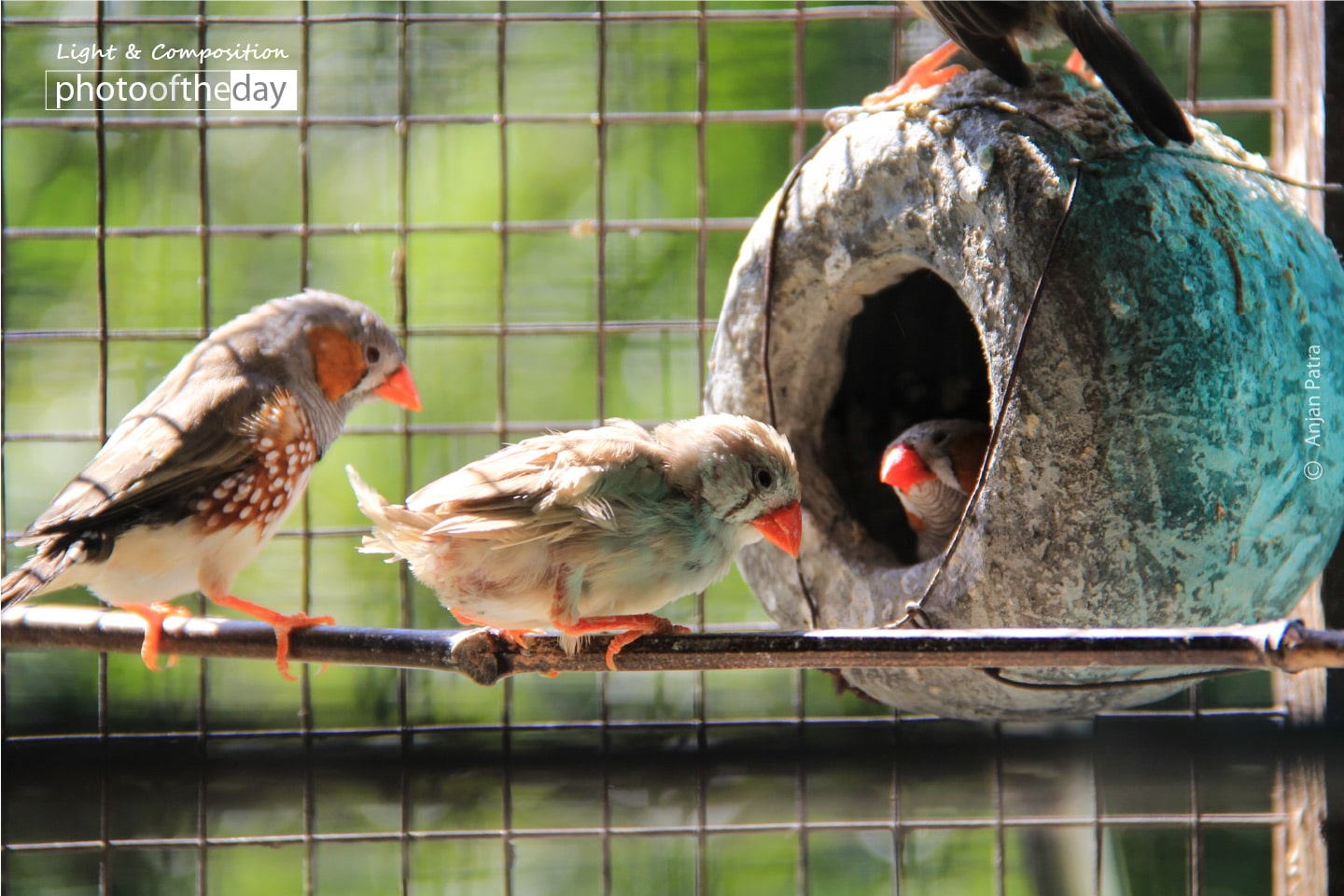
Captured during a visit to a bird park in Manali, India, this poignant image highlights the silent struggle of captive wildlife. The photographer observed a group of birds, noting their vibrant colors contrasted against their inability to fly, their wings stretching in vain against the confines of their enclosure. By focusing on the birds' expressive interactions and their palpable longing for freedom, the photographer captures a deeply emotional narrative. This photograph is award-worthy for its ability to transform a simple roadside observation into a powerful, evocative commentary on the nature of confinement and the universal desire for liberty.
Anjan Patra
Based in New Delhi, India, Anjan Patra transitioned from a professional career in architecture to pursue his deep-seated passion for photography. Over the past seven years, he has traveled extensively to document diverse cultures and human stories, eventually establishing himself within the Indian wedding photography industry. His work is defined by a creative eye that seeks to unveil hidden narratives, blending his architectural precision with a sensitive, storytelling approach to the world around him.
Resonance Score Breakdown
Transparency Note: The resonance score (11.8/20) is calculated based on social engagement metrics collected before the award announcement.
Expert Photography Reviews · 5
The Architecture of Restraint
Epictetus famously remarked that no man is free who is not master of himself, yet he also understood that the body is often subject to the whims of fortune and the walls of the world.
Read the reflection →The Architecture of Exclusion
We often mistake the built environment for a neutral backdrop, forgetting that every wall, fence, and boundary is a political statement. In urban sociology, we look for the 'right to the city'—the idea that inhabitants should have a hand in shaping the spaces they occupy.
Read the reflection →Reviews & Comments
Share your thoughts about this award-winning photograph. Your reviews contribute to the community engagement score.
Vibrant feathers pressed against wire mesh make my stomach turn. Is this beauty, or just a curated misery? Patra captures the birds’ longing, but does he consider his own role in their spectacle? By framing them as aesthetic objects, he risks turning their trauma into a tourist souvenir. Why do we find their confinement so photogenic? I can’t shake the feeling that we’re just consuming their captivity, disguised as a moral lesson. It’s uncomfortable.
You caught the exact moment those wings hit the wire. It’s a heavy sight. I’ve spent enough time in places where freedom is just a memory to know that ache when I see it. You didn’t just snap a bird in a cage; you felt the frustration of that reach. And that’s what matters. It’s raw, and it’s uncomfortable. Honestly, looking at those vibrant feathers trapped behind cold metal makes my own chest tighten. Well done.
f/5.6 at 200mm, 1/250s, ISO 400. The focal length isolates the subject, but the aperture choice is lazy. It renders the wire mesh as a distracting, out-of-focus blur rather than a sharp, oppressive barrier. I’ve seen this mistake too often. The technical execution doesn’t reinforce the narrative of confinement; it softens it. It’s frustrating. If you’re going to frame a prison, make the bars sharp enough to cut. The optics here simply don’t commit.
The cage’s rigid grid creates a harsh, unforgiving coordinate system. These intersecting verticals and horizontals trap the birds within a strict 1:1 ratio, forcing their organic curves into a suffocating geometric prison. I’m genuinely unsettled by how the wire mesh bisects their wings, turning flight into a broken vector. It’s a brutal spatial equation where the negative space of the cage consumes the subject. The math here doesn’t just define the frame; it enforces the confinement.
Most wildlife photography is just pretty plumage, but this hits differently. Of the thousands of submissions I’ve reviewed, few capture the specific, hollow ache of a wing pressed against wire. It’s the way the bird’s eye avoids the lens that haunts me; it feels like a private shame I’m intruding upon. In thirty years, we’ll still be looking at this, wondering why we ever thought it was acceptable to keep such vibrant life behind bars.