Kids on the Wooden Bridge by Jose Juniel Rivera-Negron
Captured during a crisp, cool day of hiking, this documentary photograph freezes a moment of genuine tension on a wooden boardwalk. As the photographer navigated the trails, he encountered a group of children observing crocodiles beneath the bridge. The image centers on a young girl whose expression of palpable fear and intense focus reveals the raw, unfiltered reaction to the wildlife below. By isolating this fleeting moment of vulnerability against the backdrop of the woods, the photographer highlights the intersection of childhood curiosity and natural danger, earning recognition for his ability to document an authentic human experience.
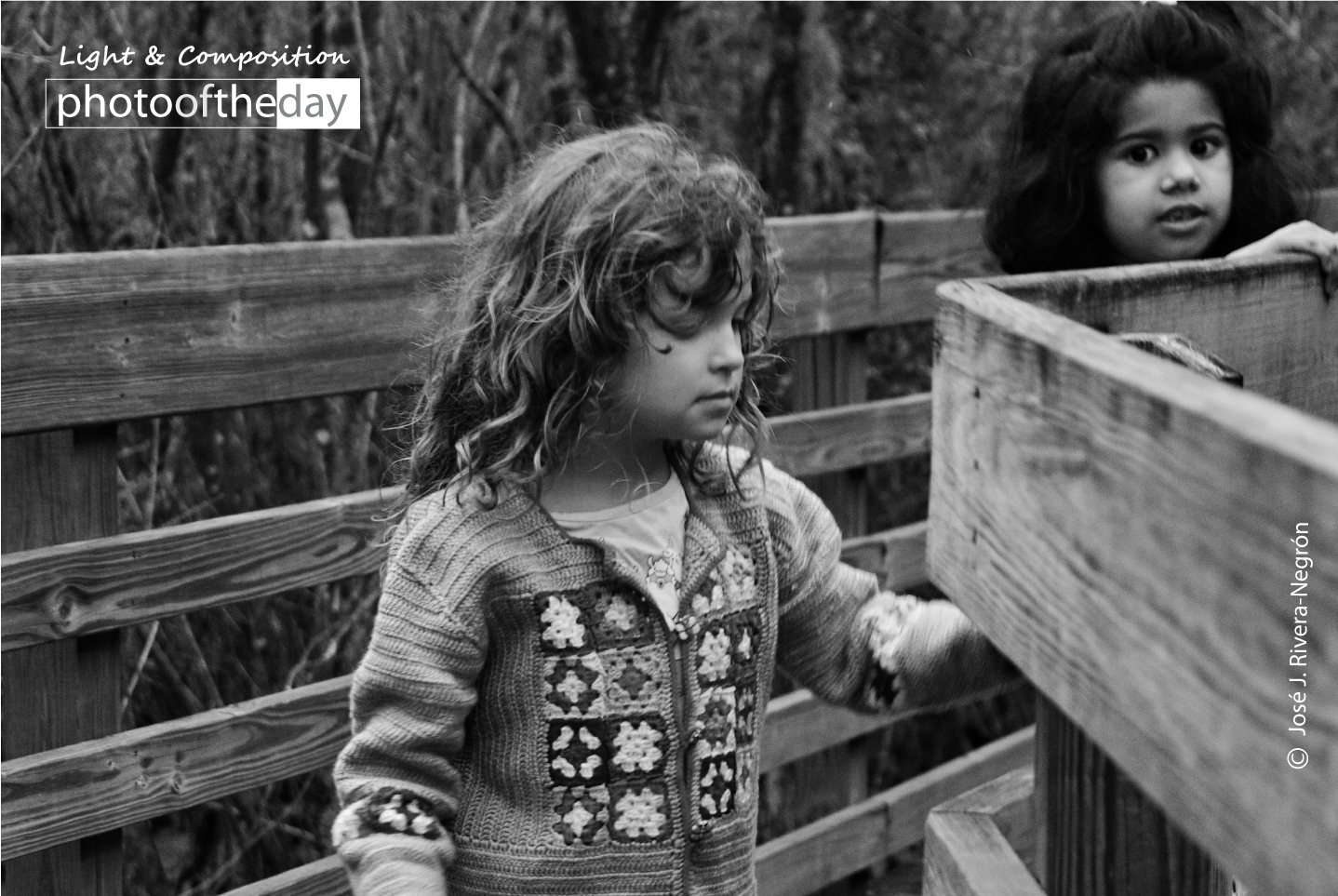
Exposure 1/400sec @ f/6.3 | ISO 400 | Focal Length 250mm
Jose Juniel Rivera-Negron
Born on the tropical island of Puerto Rico, Jose Juniel Rivera-Negron eventually relocated to the United States, where he overcame significant personal adversity to pursue his passion for the arts. Now based in Tampa, Florida, he views photography as a profound medium for storytelling and a testament to the possibility of transformation at any stage of life. His work is driven by a desire to document the realities of the human condition, reflecting his journey toward personal growth and his commitment to sharing inspiring narratives with a global audience.
Resonance Score Breakdown
Transparency Note: The resonance score (9.0/20) is calculated based on social engagement metrics collected before the award announcement.
Expert Photography Reviews · 6
The Edge of the Known
There is a specific, sharp-edged silence that descends when a child realizes the world is not merely a playground, but a place with teeth.
Read the reflection →The Weight of the Unknown
To whoever is watching the water, I have been thinking about the way we learn to be afraid.
Read the reflection →Reviews & Comments
Share your thoughts about this award-winning photograph. Your reviews contribute to the community engagement score.
Why does the girl’s terror become our entertainment? Rivera-Negron isolates her vulnerability, yet he doesn’t ask if she consented to this exposure. It’s a voyeuristic distance that makes me deeply uncomfortable. Does the crocodile’s presence justify turning a child’s genuine fear into a documentary trophy? He captures the tension, but he ignores the power imbalance inherent in the lens. We’re watching her panic from safety. Is that really an authentic experience, or just a stolen one?
The boardwalk acts as a datum, a man-made line cutting through the chaotic, organic void of the swamp. Rivera-Negron’s choice of a 250mm lens compresses the depth, flattening the timber planks into a stage for this human encounter. I’m struck by how the light rakes across the wood, emphasizing the texture against the children’s stillness. It’s a fragile threshold; the structure doesn’t just hold them, it defines their vulnerability against the wild, unseen depths below.
The bridge’s diagonal geometry dictates the frame, forcing the eye toward the girl’s rigid posture. It’s a tight, claustrophobic architecture. The wooden planks create a rhythmic grid that anchors the chaos of the children’s focus. I’m genuinely unsettled by how the negative space above the railing isolates her fear. The composition doesn’t just hold; it traps the viewer in that singular, sharp moment of apprehension. It’s a rare instance where the structure perfectly mirrors the subject’s internal state.
The wood grain stretches. It’s a long, silent path. The girl’s eyes fix on the water. She doesn’t move. I’ve felt that same stillness, that sudden weight of the wild beneath my feet. The frame holds her breath. It’s not just about the crocodiles. It’s the space around her fear. Nothing here is accidental. The empty corner is not empty. It’s the pause before the world breaks. I find myself holding my breath, too.
The tension here is electric. It’s a tight close-up, a telephoto compression that flattens the world until only that girl’s wide-eyed terror remains. I’ve seen this look on set before; it’s the moment an actor stops performing and starts breathing. The 250mm lens isolates her perfectly, cutting out the noise of the woods. It’s a brutal, honest frame. I felt my own pulse quicken looking at her. The editor keeps this shot every single time.
Watching these children peer down at the crocodiles, I’m struck by the contrast between their dry-land safety and the lethal, murky world beneath that bridge. Down there, light doesn’t penetrate the tannins of a Florida swamp; it’s a realm of total optical occlusion. I’ve spent my life fighting the water’s theft of color, but here, the danger is purely biological. It’s a visceral, chilling reminder of why we stay behind the lens, isn’t it?