Keys for the Sunshine by Sena Sasani
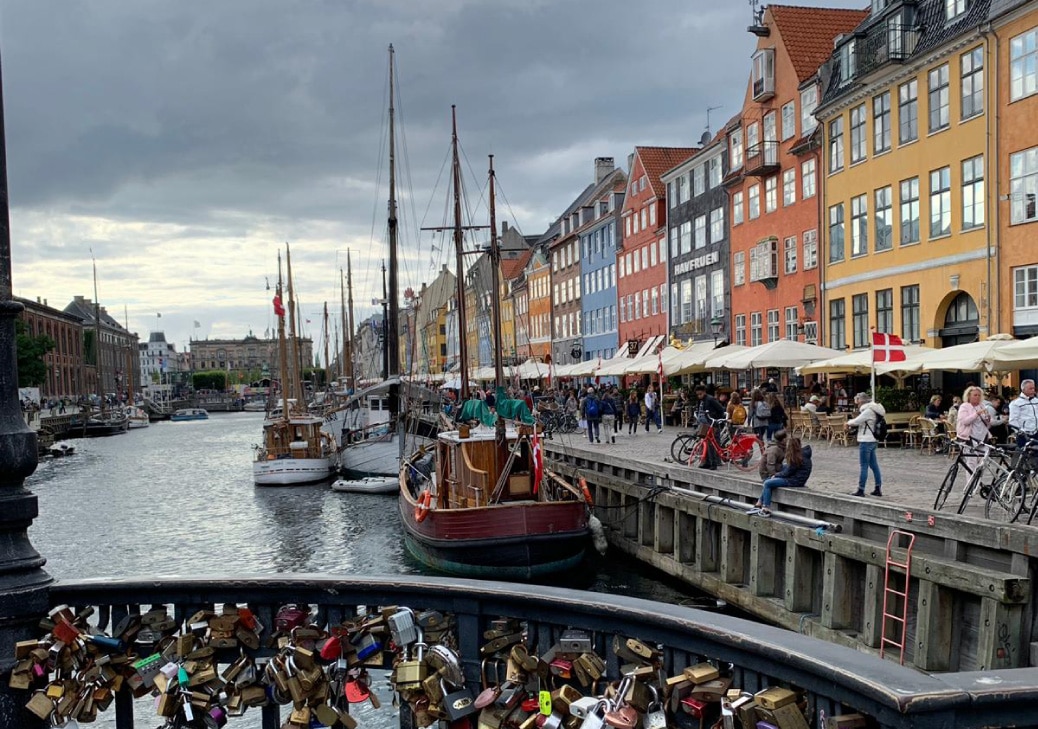
During a summer holiday in Denmark, the photographer discovered a striking row of colorful buildings that demanded attention despite the fatigue of a long day of exploration. Captivated by the architecture, the photographer captured nearly fifty frames to ensure the essence of the scene was preserved. The resulting image serves as a poignant reflection on the duality of human emotion, evoking a sense of optimism intertwined with melancholy. This photograph is award-worthy for its ability to transform a simple travel observation into a deeply personal, atmospheric narrative that resonates with the viewer's own experiences of discovery and contemplation.
Sena Sasani
Born in Ankara, Turkey, Sena Sasani is a nineteen-year-old law student who balances her academic pursuits with a passionate commitment to photography. When not studying, she travels extensively, documenting historical architecture, wildlife, and natural landscapes across the globe. As a co-administrator of the photography collective @sbx.photography, she actively curates and shares her visual work with an international audience, demonstrating a keen eye for the beauty found in her worldly travels.
Resonance Score Breakdown
Transparency Note: The resonance score (12.1/20) is calculated based on social engagement metrics collected before the award announcement.
Expert Photography Reviews · 7
The Architecture of Longing
Can a structure hold a memory, or are we merely projecting our own ghosts onto the walls we pass? We walk through cities built by hands long gone, tracing lines of stone and color as if they were maps to our own internal states.
Read the reflection →The Weight of Color
We carry the summer inside us like a stone. It is a heavy, warm thing, kept against the cold that inevitably returns. In the north, we learn early that light is a visitor, not a resident.
Read the reflection →Reviews & Comments
Share your thoughts about this award-winning photograph. Your reviews contribute to the community engagement score.
Copenhagen’s rhythm is defined by the tension between solid and void, yet here, the fenestration feels almost like a stage set. The light hits these facades with a flat, northern clarity that flattens the depth I crave. It’s a pretty sequence, sure, but it’s missing the threshold—the transition from street to interior. I’ve walked these canals, and honestly, I miss the wind. It’s a charming lie, but it doesn’t quite breathe for me.
1/120sec at f/1.8, ISO 40, 4mm. A smartphone sensor pushed to its limit. The f/1.8 aperture on a 4mm lens provides a depth of field that’s essentially infinite, yet the sensor’s noise reduction has smeared the brickwork into a digital watercolor. It’s technically lazy. I’ve spent years analyzing optics, and seeing this level of computational interference makes my teeth ache. You didn’t capture architecture; you captured a software approximation of it. The math simply doesn’t hold up.
Before the eye identifies the Copenhagen facades, a sudden stillness settles in the chest. It’s the color—that saturated, defiant yellow—that triggers a physiological shift, a quickening pulse against the fatigue of the frame. I’ve returned to this twice now; the melancholy hasn’t faded, it’s deepened. It feels like a half-remembered summer evening where you’re finally alone. It’s not just architecture; it’s the quiet, aching weight of being somewhere beautiful while feeling entirely untethered.
Those ochre facades, reminiscent of a Morandi still life, possess a muted, sun-bleached melancholy that I find utterly devastating. It’s the way the light clings to the brickwork, a buttery, pale lemon hue that doesn’t merely sit upon the surface but breathes through the architecture. One feels the weight of the Nordic summer fading into shadow, and frankly, it’s enough to make me weep for the fleeting, fragile warmth that’s captured here in such exquisite, aching stillness.
The iPhone X’s 4mm sensor struggles against the diffraction limit here, yet the f/1.8 aperture renders the Copenhagen facades with surprising micro-contrast. You can see the light scattering across those painted surfaces, revealing textures the naked eye would miss in the haze of a summer afternoon. It’s technically constrained, but there’s a genuine, aching warmth in how the lens resolves that light. I’m honestly moved by how such a small sensor captures the melancholy of a fading day.
We walk past these Copenhagen facades and we don’t just see paint; we hear the echoes of the people who live behind them. Sena Sasani didn’t just look at the architecture; she listened to the quiet hum of a summer evening. It’s a portrait of a city’s soul, caught in the light. I feel a sudden, sharp ache of nostalgia looking at those colors. It’s a photograph that asks to be returned to, again and again.
Fifty frames to capture a row of houses? It’s a tedious pursuit of resolution that misses the point. I’m far more interested in what Sasani chose not to resolve. By flattening Copenhagen’s architecture into a smear of saturated color, she’s closer to Richter’s blurred paintings than standard travelogue. I actually felt a jolt of relief seeing the iPhone’s digital artifacts dissolve into this hazy, melancholic impression. Why chase clarity when the blur feels so much more honest?