Innocent Looks by Hirak Ghosh
Captured in the rural landscape of Canning, West Bengal, this image documents a poignant moment of childhood spontaneity. During his first major outdoor shoot alongside respected senior mentors, the photographer observed a group of children lost in play, an interaction that served as a nostalgic mirror to his own youth. The photograph is award-worthy for its raw, unposed authenticity and the delicate balance between the subject's innocence and the photographer's keen observational eye, effectively freezing a fleeting, universal moment of joy within a traditional village setting.
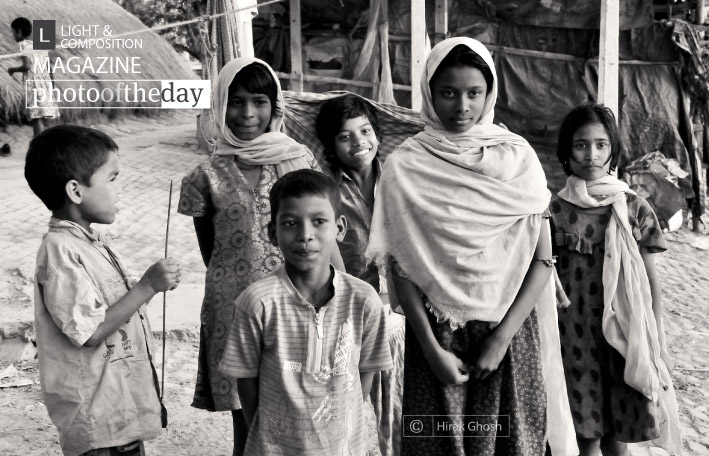
Hirak Ghosh
Hailing from a small village in West Bengal, India, Hirak Ghosh is a dedicated student who views photography as his true life passion. He frequently travels to remote villages to document the daily lives and activities of local residents, finding deep inspiration in the human experience. His work reflects a sincere commitment to storytelling, capturing the quiet beauty of rural India through a lens of curiosity and profound respect for his subjects.
Resonance Score Breakdown
Transparency Note: The resonance score (14.1/20) is calculated based on social engagement metrics collected before the award announcement.
Expert Photography Reviews · 6
The Unmapped Geography of Play
In the quiet corners of a house, one often finds the remnants of a world built entirely from imagination. A stack of books becomes a fortress; a discarded piece of fabric transforms into a royal cloak.
Read the reflection →The Unmapped Geography of Play
We begin as cartographers of the immediate, mapping our world in the dust of a backyard or the hollow of a tree. There is a specific, untethered gravity to childhood, where the hours do not tick forward but circle like birds around a nest.
Read the reflection →Reviews & Comments
Share your thoughts about this award-winning photograph. Your reviews contribute to the community engagement score.
Innocence isn’t found in the light, but in the encroaching dark of Canning. Ghosh’s frame doesn’t merely capture play; it anchors it against a void that threatens to swallow the children whole. I’ve stared at these faces, and it’s the heavy, unyielding shadows beneath their feet that haunt me. They aren’t just standing in a village; they’re existing on the precipice of time. It’s a brutal, beautiful reminder that we are all just fading silhouettes.
The frame’s architecture is compromised by a lack of geometric anchor. While the subjects occupy the center, the surrounding negative space doesn’t resolve into a coherent narrative of depth. It’s a loose arrangement that fails to leverage the 45mm focal length for structural impact. I’m frustrated by the wasted potential of the background blur. The composition lacks the necessary tension to hold the eye, leaving the visual weight adrift in a sea of unmanaged tonality.
It’s easy to snap a shutter when children are playing; it’s quite another to be invited into their orbit. One suspects Ghosh didn’t just stumble upon this scene, but sat in the dust until he was as unremarkable as the village walls. I’ve spent enough afternoons waiting for the world to forget I’m there to recognize the effort. It’s a quiet, honest piece of work. He didn’t chase the moment; he let it happen.
Most street photography from 2011 feels dated, but this holds up. Of the thousands of candid portraits I’ve reviewed, few capture such unforced eye contact. The child’s gaze isn’t just looking at a lens; it’s questioning the observer. I’ve seen countless rural portraits, but the way the light catches the dust around their feet makes me ache for a childhood I never had. It’s the raw, unpolished honesty that ensures this will still matter in thirty years.
The light in Canning doesn’t rush; it settles over these children like a soft, dusty veil. I’ve spent enough hours waiting for the sun to soften to recognize that stillness. He stood there, patient, letting the scene unfold until the joy became honest. It’s a quiet, fleeting grace. Looking at their faces, I’m suddenly back in my own childhood, feeling that same unfiltered sun on my skin. It’s a beautiful, breathless moment of pure, unhurried life.
Stripped of pigment, one finds the silvered greys of Canning possess a haunting, Morandi-esque restraint, where the light doesn’t merely illuminate but clings to the children’s skin like damp linen. It’s a monochromatic symphony of charcoal and pearl that I find utterly devastating; the absence of colour forces the eye to trace the tactile weight of the dust, revealing an emotional resonance that’s far more profound than any vibrant, saturated palette could ever hope to achieve.