Indian Spices by Karan Zadoo
Captured within the intimate setting of a home kitchen in Delhi, this evocative photograph celebrates the vibrant essence of Indian cuisine. By focusing on the raw, colorful textures of traditional masalas, the photographer highlights the soul of Indian cooking—a culinary tradition defined by the intricate and extensive use of aromatic spices. The composition utilizes a shallow depth of field to draw the viewer into the rich, granular details of the ingredients. This image is award-worthy for its ability to transform everyday kitchen staples into a compelling visual narrative, showcasing how light and perspective can elevate humble subjects into a profound cultural statement.
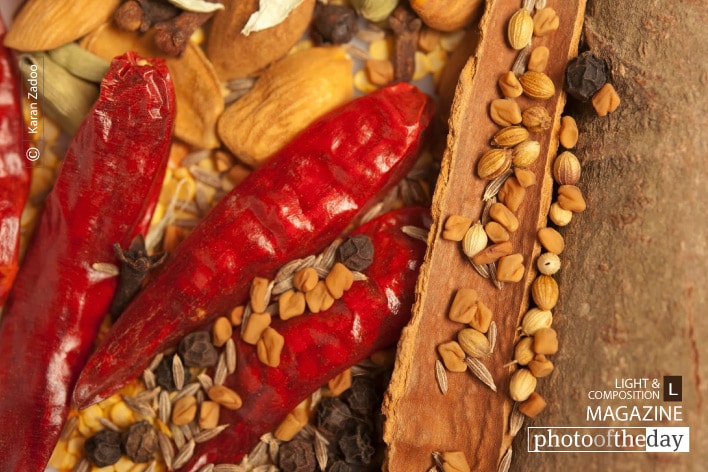
Exposure 1/200sec @ f/5.6 | ISO 100 | Focal Length 60mm
Karan Zadoo
Born in Srinagar and raised in Delhi, Karan Zadoo transitioned from a career in advertising to professional photography after discovering a profound connection to nature and travel in the Himalayas. He is a dedicated observer of the human condition and the vibrant landscapes of India, specializing in food, travel, and documentary portraiture. Driven by a philosophy of constant evolution, Zadoo utilizes his technical expertise to capture the untold stories of people and places, striving to document the authentic spirit of his subjects through his lens.
Resonance Score Breakdown
Transparency Note: The resonance score (12.8/20) is calculated based on social engagement metrics collected before the award announcement.
Expert Photography Reviews · 5
The Weight of Dust
There is a history in the things we grind down. To crush a seed is to release a memory of the earth, a scent that travels further than the hand that held it. In the north, we rely on salt and dried fish, flavors that endure the long frost.
Read the reflection →The Alchemy of Dust
In the ancient world, the value of a thing was often measured by the distance it had traveled to reach a table.
Read the reflection →Reviews & Comments
Share your thoughts about this award-winning photograph. Your reviews contribute to the community engagement score.
The frame’s geometry is compromised by an erratic distribution of granular mass. While the shallow depth of field isolates the central spice mounds, the peripheral negative space lacks the necessary tension to anchor the composition. It’s a chaotic arrangement that fails to resolve into a coherent visual architecture. I’ve grown weary of such undisciplined textures. The picture plane doesn’t hold; it merely spills. It’s a missed opportunity for structural rigor in an otherwise vibrant field.
Before the eye identifies the turmeric or chili, something in the chest tightens. It’s a sensory anticipation, a phantom heat rising from the granular textures. I’ve spent years looking at food, yet this composition triggers a primal, almost hungry restlessness. When I return to it, the shallow focus feels like a fading memory of a kitchen I’ve never visited. It’s not just spice; it’s the visceral, dusty warmth of a Delhi afternoon caught in my throat.
Granular piles of turmeric and chili don’t merely exist here; they occupy a space of heavy, unyielding silence. Zadoo’s shallow focus forces us to confront the abyss lurking between these grains. I’ve always found that darkness is where the soul of a spice truly resides, hidden from the vulgarity of full exposure. It’s unsettling, really. When I look at these shadows, I don’t see a kitchen. I see the weight of a history that refuses to be fully illuminated.
At f/5.6, the 60mm lens resolves the granular topography of these masalas with startling precision. The focal plane is razor-thin, isolating the crystalline structure of the spices against a soft, creamy bokeh that’s a function of the aperture’s geometry. I’m genuinely moved by how the light catches those jagged edges; it’s a microscopic landscape I’ve never truly seen until now. It’s not just food; it’s the physics of texture rendered with absolute, uncompromising clarity.
Most food photography is just glossy marketing, but this captures the grit of a Delhi kitchen. I’ve seen thousands of spice shots, yet Zadoo’s choice to let the granular textures bleed into the shadows makes the heat feel tactile. It’s the raw, unpolished chaos that wins me over; it feels like a memory rather than a setup. Thirty years from now, people won’t care about the gear. They’ll just want to smell that vibrant, dusty air.