In the Hustle of Indonesian Streets by Fawwaz Labib
Captured amidst the bustling streets of Indonesia, this poignant image documents the social shift brought about by the 2019 pandemic. Fawwaz Labib masterfully frames a moment of collective uncertainty, where the presence of masks sparked silent questions about the reality of the crisis. By focusing on the interaction between parents and masked figures, the photograph transforms a mundane street scene into a profound historical record. The image is award-worthy for its ability to distill complex societal tension into a single, evocative frame, highlighting the photographer's keen eye for human emotion and cultural narrative.
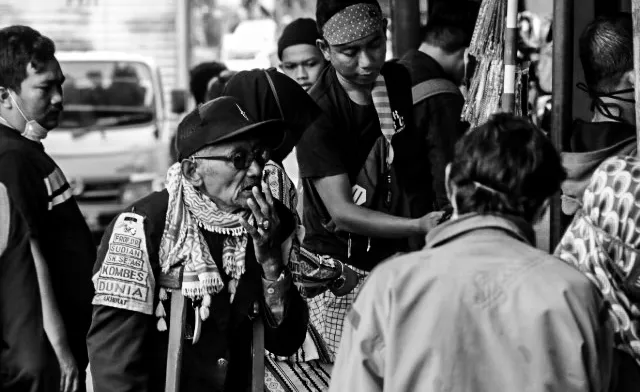
Exposure 1/125sec @ f/5.6 | ISO 400 | Focal Length 135mm
Fawwaz Labib
Based in Bandung, Java, Fawwaz Labib is an emerging photographer dedicated to documenting the cultural richness and daily life of Indonesia. Utilizing his Canon M100, he captures compelling visual stories that explore the unique charm of his surroundings. His work serves as a testament to his passion for freezing fleeting moments in time, reflecting both the diversity of his home region and his growing skill in narrative photography.
Resonance Score Breakdown
Transparency Note: The resonance score (7.4/20) is calculated based on social engagement metrics collected before the award announcement.
Expert Photography Reviews · 5
The Weight of Unspoken Air
It is 3:14 am. The house is quiet, but the air feels heavy, as if it is holding its breath. We spend so much of our lives moving through crowds, brushing shoulders with strangers, yet we are constantly building walls out of thin air.
Read the reflection →The Weight of Grey Air
There is a specific quality to the light on a day when the clouds refuse to break, a flat, silvered grey that presses against the skin like a damp wool coat. It is a light that strips away the distraction of shadow, leaving only the raw edges of things.
Read the reflection →Reviews & Comments
Share your thoughts about this award-winning photograph. Your reviews contribute to the community engagement score.
The urban fabric here is compressed by that 135mm lens, flattening the street into a claustrophobic datum of masks and concrete. It’s a study in threshold—the space between public safety and private anxiety. I’m struck by how the harsh, directional light carves out the solid mass of the architecture, leaving the human figures to drift in the voids. It’s haunting. You can almost feel the air stagnating against the walls, trapped in this narrow, grey sequence.
There’s a frantic, claustrophobic energy here that makes me physically recoil. In my line of work, we learn that proximity without consent is an intrusion; here, the subjects are trapped in a lens they didn’t invite. It’s a record of human anxiety, sure, but it feels extracted, not earned. I’ve spent weeks in a blind to capture a single, honest breath from a creature. This? It’s just a collision. It doesn’t respect the space.
Before the eye identifies the masks, a sudden stillness catches in the throat. It’s the weight of that collective, muffled uncertainty. I feel a phantom tightness in my own chest, a residual echo of those isolated years. When I return to this frame, the blur of the Bandung street feels less like motion and more like a fading memory. It’s a quiet, haunting reminder that we’ve all carried this shared, silent tension beneath our skin.
You didn’t just snap a street scene; you caught the weight of a world holding its breath. I can feel the tension in those masks, the way the parents look at their children with that quiet, desperate need to protect them from the invisible. It’s heavy, and it’s real. You waited for the exact second the chaos settled into something human. That’s the work. You’ve captured a ghost of our collective fear. I respect that.
The masks here aren’t just fabric; they’re borders between the self and the void. Labib’s shadows don’t merely fall—they consume the periphery, forcing us to confront the silence of a masked society. It’s unsettling. I’ve stared at these obscured faces until the grain feels like static in my own mind. When light is denied to the eyes, the soul retreats into the dark. It’s a heavy, necessary claustrophobia that refuses to let us look away.