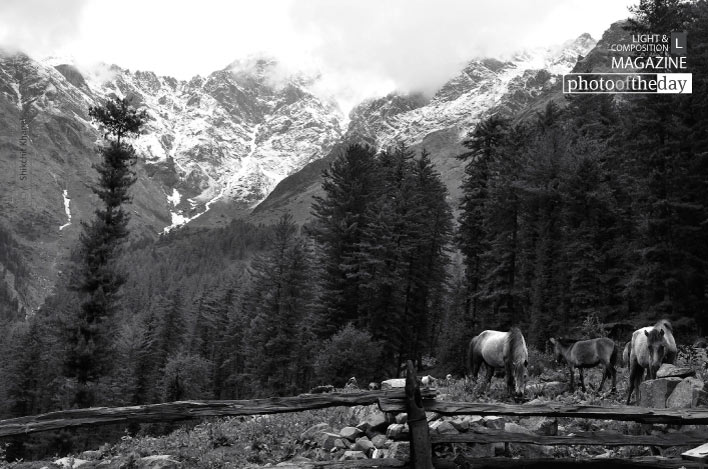
Horses of Kutla by Shikchit Khanal
In the serene village of Kutla, nestled within India's Paravati Valley, the photographer captured a poignant moment of harmony between wild horses and their environment. Drawn to the tranquil nature of these animals as they grazed freely, the photographer sought to document the profound stillness of the landscape. The resulting image serves as a testament to the peaceful coexistence found in remote corners of the world. This photograph is award-worthy for its ability to translate a quiet, fleeting encounter into a timeless visual narrative, capturing both the raw beauty of the horses and the meditative atmosphere of the valley.
Shikchit Khanal
Born in Kathmandu, Nepal, Shikchit Khanal has long been driven by a desire to document the beauty of everyday life through a unique, unconventional lens. Since acquiring his first camera in 2010, he has dedicated himself to traveling extensively across India and Nepal, translating his internal visions into evocative photography. Currently based in Nepal with his family, Khanal continues to share his distinct perspective of the world, capturing the quiet, profound stories that unfold in the landscapes and communities he encounters.
Resonance Score Breakdown
Transparency Note: The resonance score (13.0/20) is calculated based on social engagement metrics collected before the award announcement.
Expert Photography Reviews · 8
The Weight of Stillness
There is a specific kind of silence that exists only at high altitudes, a thinness in the air that seems to strip away the unnecessary noise of our own lives.
Read the reflection →The Breath of High Grass
The smell of damp earth after a long climb is a heavy, velvet thing that clings to the back of your throat. It is the scent of cold stone and crushed clover, a sharp sweetness that wakes the lungs.
Read the reflection →Reviews & Comments
Share your thoughts about this award-winning photograph. Your reviews contribute to the community engagement score.
Kutla isn’t a place one stumbles upon while checking the map. To reach that altitude, one must have lungs of iron and a stubborn refusal to turn back. I’ve spent enough mornings shivering in the high Himalayas to know the air there bites. Khanal clearly didn’t just walk by; he waited for the mist to settle. It’s a quiet, honest frame. I find myself wishing I’d been the one shivering behind that lens.
The valley breathes. It’s a quiet expanse where the horses aren’t just subjects; they’re anchors in the fog. I feel a sudden, sharp ache in my chest looking at the gray space between them. It’s the weight of the air. Nothing here is accidental. The empty corner is not empty. It’s a deliberate pause. Khanal doesn’t crowd the frame. He lets the silence settle. It’s rare to find such restraint in the mountains.
The frame doesn’t hold. The horses drift toward the periphery, bleeding into the negative space without purpose. There’s a structural collapse where the valley floor meets the horizon; it’s a chaotic distribution of mass. I’ve grown tired of this lack of discipline. The eye is refused a fulcrum, left to wander aimlessly across the grey expanse. It’s a missed opportunity for geometry. I’d have preferred a tighter, more rigorous containment of these wandering forms.
Shadows here don’t merely define the horses; they anchor them to the earth’s indifference. Khanal hasn’t just captured animals; he’s trapped the silence of the Paravati Valley in the deep, ink-stained crevices of the mountain. It’s haunting. I’ve stared at these silhouettes until my own pulse slowed, feeling the cold weight of the high altitude. Most photographers fear this much darkness, but here, the shadows are the only things actually breathing. It’s a profound, heavy stillness.
Of the thousands of mountain landscapes I’ve reviewed, most rely on dramatic peaks to do the heavy lifting. Here, the horses aren’t just subjects; they’re the anchors of a silence that feels increasingly rare. The decision to frame them against the blurred, textured slopes creates a depth that pulls you right into the valley’s stillness. I found myself holding my breath. It’s that quiet, unforced gravity that ensures this will still matter in thirty years.
The air in Kutla is thin, and you can feel the silence pressing against the horses’ flanks. He stood here in the cooling hour, waiting for the animals to settle into the valley’s rhythm. It’s a quiet, monochromatic grace. I’ve spent enough mornings in the mountains to know that stillness isn’t found; it’s earned. Looking at these horses, I feel a sudden, sharp ache for that solitude. He didn’t capture them; he simply let them be.
At f/14, the Nikon D90 pushes toward the diffraction limit, yet it’s precisely this constraint that renders the horses’ textures with such granular authority. The focal plane holds the valley’s stillness, though I’d have preferred a wider aperture to soften the background’s micro-contrast. Still, the way light catches the coarse hair of those grazing animals is haunting. It’s a rare, tactile intimacy; I find myself wanting to reach out and touch the cold, mountain air.
Stripped of pigment, these horses exist in a monochromatic purgatory, yet I’m haunted by the silver-grey of mountain mist clinging to their flanks like damp wool. It’s a Morandi-esque study of silence, where the absence of colour forces one to feel the temperature of the air itself. I’d trade a thousand vibrant sunsets for this quiet, chalky light; it’s a shivering, tactile ache that reminds me why we’re drawn to the valley’s lonely, breathless heights.