Holocaust Memorial by Cláudia Vieira
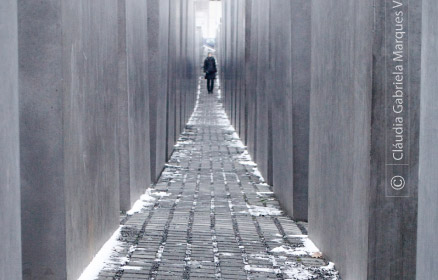
Cláudia Vieira captures the solemn grandeur of Berlin’s Memorial to the Murdered Jews of Europe, designed by Peter Eisenman. By positioning herself within the undulating concrete labyrinth, the photographer utilizes the unique interplay of Berlin’s winter light to accentuate the structure’s immersive, subterranean nature. The composition emphasizes the stark, rhythmic geometry of the memorial, transforming a site of profound historical weight into a compelling architectural study. This image is award-worthy for its ability to balance technical precision with a haunting, atmospheric perspective that invites the viewer to experience the memorial’s somber, shifting landscape.
Cláudia Vieira
Cláudia Gabriela Marques Vieira is the Director of FuturePresent, a creative media studio based in Berlin, Germany. With over a decade of expertise in media design and consultancy, she brings a unique, research-driven perspective to her photography, which spans art, nature, and portraiture. Having served as a university lecturer in interactive media, Vieira now focuses on expanding her photographic profile, frequently traveling to capture the natural world and sharing her vision through the FuturePresent Photographic Community.
Resonance Score Breakdown
Transparency Note: The resonance score (13.2/20) is calculated based on social engagement metrics collected before the award announcement.
Expert Photography Reviews · 4
The Weight of Stone
The air in a place of deep silence has a specific texture; it feels like cold wool pressed against the back of the throat.
Read the reflection →The Architecture of Memory
History is rarely a straight line. We prefer to imagine it as a path we walk, moving steadily from the past into the future, but it is more often a labyrinth of our own making.
Read the reflection →Reviews & Comments
Share your thoughts about this award-winning photograph. Your reviews contribute to the community engagement score.
Most architectural shots of Eisenman’s memorial fall into the trap of sterile geometry. Vieira avoids this by letting the winter light bleed into the shadows, turning concrete into something almost fluid. It’s the claustrophobia that gets me; I felt my breath hitch looking at those narrowing gaps. Of the hundreds of submissions I’ve seen from this site, this one actually captures the crushing weight of the history buried beneath the stone. It’ll endure because it feels heavy.
The light here isn’t just falling; it’s mourning. Cláudia stood in the cooling hour, waiting for that flat, winter grey to soften the concrete’s harsh edges. It’s a quiet, heavy stillness. Looking at these shadows, I feel a sudden, sharp ache in my chest—the weight of history pressing against the lens. She didn’t rush the shutter. She let the labyrinth speak first, capturing the exact moment the stone finally stopped holding its breath.
Eisenman’s concrete monoliths don’t just occupy space; they consume it. Vieira understands that the true subject isn’t the stone, but the encroaching void between the slabs. It’s a claustrophobic dance where light is merely a thin, desperate intruder. I’ve walked these corridors, and the cold, sharp shadows here don’t just frame the architecture—they suffocate it. It’s an honest, brutal confrontation with history. When the light dies in these gaps, it’s where the real thinking begins.
The concrete monoliths create a rigorous, rhythmic cadence that anchors the frame. It’s a masterclass in spatial tension. The vertical lines slice the picture plane, forcing the eye into a claustrophobic, subterranean descent. I’m genuinely unsettled by how the light bleeds into the negative space, refusing to offer relief. The composition holds because it doesn’t apologize for its own rigidity. It’s a cold, calculated geometry that finally justifies the weight of the subject matter.