Holding onto the Values by Afnan Naser Chowdhury
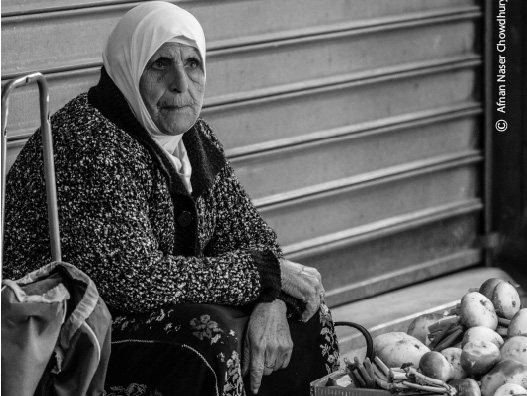
Captured within the bustling street markets of Jerusalem’s Old City, this poignant image serves as a testament to the resilience and enduring spirit of the Palestinian people. The photographer masterfully utilizes a shallow depth of field to isolate a subject against the textured, historic backdrop, emphasizing the dignity found in daily labor despite immense hardship. By focusing on the intersection of age and unwavering dedication, the photograph transcends simple street documentation. It stands as an award-worthy piece because it successfully bridges the gap between technical precision and deep human empathy, inviting viewers to reflect on their own perspectives through the lens of another's profound reality.
Afnan Naser Chowdhury
Based in Virginia, Afnan Naser Chowdhury discovered his passion for photography while pursuing his Bachelor’s degree at North South University. With a lifelong appreciation for nature and painting, he brings a refined aesthetic sensibility to his work, often blending technical curiosity with a deep interest in human stories. Currently residing in the United States, he continues to develop his craft, seeking to connect with fellow artists and audiences through his evocative street photography and commitment to capturing the essence of the human experience.
Resonance Score Breakdown
Transparency Note: The resonance score (11.1/20) is calculated based on social engagement metrics collected before the award announcement.
Expert Photography Reviews · 6
The Weight of History
I remember sitting in a small cafe in Istanbul, watching an old man polish the same brass tray he had been tending to for forty years. His hands were mapped with veins and scars, moving with a rhythm that felt like a heartbeat.
Read the reflection →The Architecture of Persistence
We often mistake stillness for an absence of motion, forgetting that the deepest roots are those that hold the earth together while the wind tries to undo the trees.
Read the reflection →Reviews & Comments
Share your thoughts about this award-winning photograph. Your reviews contribute to the community engagement score.
The darkness here doesn’t merely frame; it interrogates. Chowdhury’s choice to let the edges of the Old City dissolve into a heavy, suffocating blackness forces us to confront the subject’s isolation. It’s a brutal, necessary erasure. I’ve stared at the way the light clings to those weathered hands, and honestly, it makes my chest ache. When light is this sparse, it isn’t decoration—it’s a desperate, final argument against the encroaching void of history.
The shallow depth of field isolates the subject, but does it also strip away the context of his struggle? I find myself unsettled by the romanticization of this man’s labor. Why do we crave this specific aesthetic of hardship to validate Palestinian resilience? It’s a beautiful blur, yet I wonder if the focus on his weathered face obscures the systemic reality of the Old City. Are we looking at a person, or just a symbol?
You waited for that light to hit his face, and it’s the only thing that matters here. I’ve walked those markets, and it’s easy to get lost in the noise. But you didn’t. You found the quiet in his eyes. Because you stayed still, I can feel the weight of his hands and the history he’s carrying. It’s not just a portrait; it’s a conversation. You really saw him. That’s rare, and I respect it.
The shallow depth of field here echoes the selective focus of early pictorialists, yet it’s applied with a modern, clinical precision. Chowdhury’s 35mm framing forces a confrontation with the subject’s hands that feels reminiscent of August Sander’s typological rigor. I’ve spent decades cataloging the Old City’s light, but the way he isolates the texture of labor against that blurred, historic stone genuinely caught my breath. It’s a rare, quiet dialogue between tradition and the fleeting present.
The stone arches of the Old City create a heavy, rhythmic datum that usually dictates the space, yet here, the shallow depth of field dissolves that structural weight into a soft, blurred abstraction. It’s a clever choice, though I miss the tension between the solid masonry and the human form. Still, seeing that sliver of light catch the subject’s weathered hands—it’s genuinely moving. It makes me feel the grit of those walls without needing to see them.
We look at this face and we understand something about the weight of history. In the bustling markets of Jerusalem, Afnan Naser Chowdhury didn’t just snap a shutter; he waited for the silence between the chaos. The man’s eyes hold a quiet, stubborn grace that stops me in my tracks. It’s a portrait of endurance, where the blurred stones behind him feel like a fading memory. I’m moved by how he listened before he looked.