Himalayan Boy by Ryszard Wierzbicki
Captured during an early morning trek through the Annapurna Circuit in Nepal, this poignant image features a young boy resting in a cradle within a local Himalayan village. The photographer utilized a telephoto lens to isolate the subject, capturing a fleeting, intimate moment of stillness before the day's journey began. The photograph is award-worthy for its authentic portrayal of childhood in a remote landscape, demonstrating a keen eye for candid storytelling and a deep respect for the cultural nuances of the region. The soft, natural light enhances the raw emotion and quiet dignity of the scene.
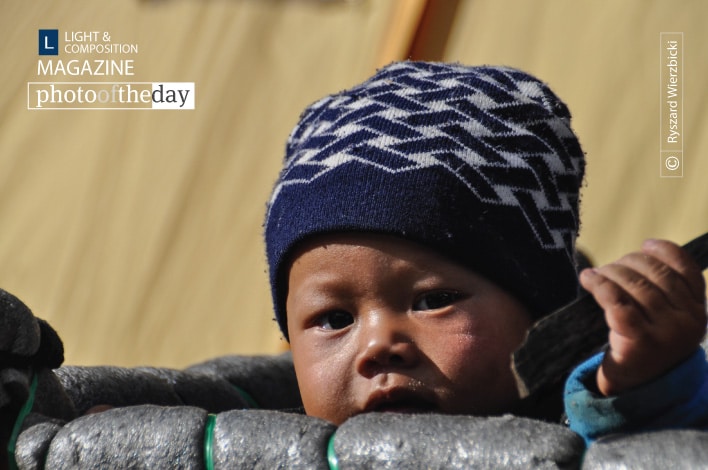
Exposure 1/1500sec @ f/6.3 | ISO 400 | Focal Length 150mm
Ryszard Wierzbicki
Born in 1963 and originally from Poland, Ryszard Wierzbicki transitioned from a career in social sciences and marketing to a life of exploration after emigrating to the United Kingdom in 2006. His photography is deeply informed by his extensive travels across South-East Asia and his commitment to humanitarian work with orphanages. By trading corporate life for a life of adventure, he has dedicated himself to documenting the world through travel, scuba diving, and photography, while fostering community through his dedicated travel and photography forums.
Resonance Score Breakdown
Transparency Note: The resonance score (11.9/20) is calculated based on social engagement metrics collected before the award announcement.
Expert Photography Reviews · 7
The Weight of Unwritten Days
Does a soul possess a history before it has learned to name the world? We often assume that childhood is merely a waiting room, a quiet threshold where one prepares to eventually step into the noise of adulthood.
Read the reflection →The Weight of Stillness
The smell of woodsmoke always pulls me back to a place I have never been. It is a sharp, pine-heavy scent that clings to wool, thick and grounding, like the feeling of a heavy blanket pulled up to the chin on a morning when the air outside is brittle enough to snap.
Read the reflection →Reviews & Comments
Share your thoughts about this award-winning photograph. Your reviews contribute to the community engagement score.
The shutter snaps, and the world stops. It’s a quiet, breathless frame. The boy in the cradle isn’t just resting; he’s waiting for a scene that hasn’t started yet. I love the compression here. That 150mm lens pulls the background into a soft, painterly blur, isolating his stillness against the mountain air. It’s the shot the editor keeps because it holds the weight of the entire trek. A perfect, frozen cut. I’d watch this boy for hours.
A telephoto lens at 150mm suggests a photographer keeping their distance, perhaps to avoid disturbing the stillness. It’s a clean shot, though one wonders if the shutter was clicked on the first pass. I’ve spent enough mornings in the Annapurna cold to know that true intimacy requires lingering until the subject forgets you’re there. It’s a decent capture, but I find myself wishing the photographer had put the camera down and simply sat with the boy.
In the high, thin air of Manang, we find a boy cradled in stillness. He isn’t performing for the lens; he’s simply existing in the morning light. I’ve spent years looking for this kind of quiet, and it moves me deeply. Wierzbicki didn’t just point a camera; he listened to the silence of the mountains first. It’s a rare, honest portrait that asks us to return, again and again, to that small, steady gaze.
1/1500sec at f/6.3, 150mm, ISO 400. The shutter speed is overkill for a stationary subject, but it’s a safe hedge against the D5000’s sensor noise. At 150mm, f/6.3 provides just enough separation to pull the boy from the background clutter. It’s a calculated, clinical choice. I’ve spent years looking at these files, and honestly, the crispness of the boy’s eyes actually caught me off guard. It’s technically sound. The gear didn’t get in the way.
At 150mm and f/6.3, the focal plane is razor-thin, isolating the boy’s gaze from the chaotic textures of the cradle. The Nikon’s sensor resolves the fine, dusty fibers of his wool garment with startling clarity. I’m genuinely moved by how the lens handles the soft, high-altitude light; it’s rendered with such delicate micro-contrast. It doesn’t just capture a face; it resolves the very stillness of the morning air. It’s a beautiful, precise optical achievement.
Before the eye identifies the cradle, something in the chest tightens. It’s the stillness of the boy’s gaze that triggers a sudden, sharp empathy. I feel a phantom chill from that Himalayan morning, a quietness that settles deep in the lungs. When I return to this, I’m not looking at a child in Nepal; I’m remembering the vulnerability of my own beginnings. It’s a haunting, fragile activation that follows me into the dark.
The ochre of the boy’s woollen wrap, a shade reminiscent of Morandi’s dustiest earth pigments, anchors the frame against the cool, thin shadows of the Manang morning. It’s a quiet, aching harmony that makes my chest tighten with a sudden, sharp longing for that high-altitude stillness. One finds here a chromatic restraint that Vermeer would have envied, where the light doesn’t merely illuminate, but instead cradles the child in a soft, atmospheric embrace of muted, glacial grey.