Hill Top Farm by John Tudor
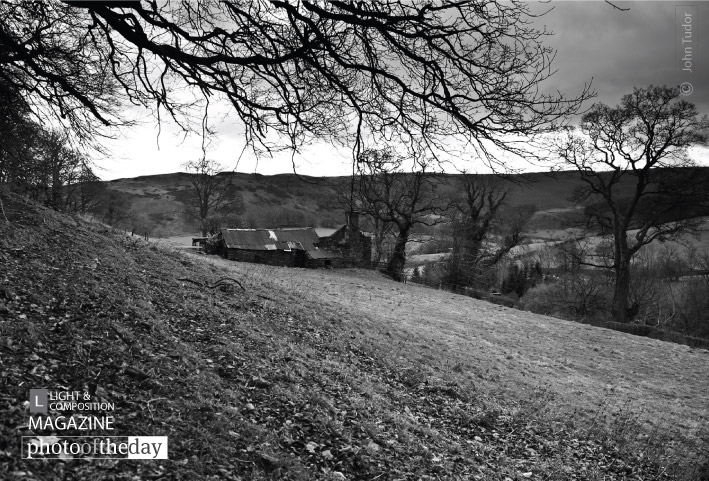
Perched above Rhewl near Llantysilio, this evocative photograph captures the weathered remains of a remote farmstead. Once a bustling home for a family of eight, the ruin now stands as a somber testament to the harsh realities of rural life in North Wales. The photographer masterfully utilizes the soft, diffused light to emphasize the textures of the crumbling stone and the desolate beauty of the landscape. This image is award-worthy for its poignant historical narrative and the photographer’s ability to transform a site of decay into a compelling visual tribute to the resilience of those who once called this challenging terrain home.
John Tudor
Based in North Wales, John Tudor is a dedicated freelance photographer specializing in professional imagery for websites and brochures. His photographic journey began in the late 1980s with 35mm film, eventually evolving into a professional career following formal studies in digital photography and Photoshop. A member of the Welshot Imaging Photographic Academy, Tudor utilizes professional full-frame Canon equipment to document the landscapes and heritage of his region with technical precision and a keen eye for historical narrative.
Resonance Score Breakdown
Transparency Note: The resonance score (9.9/20) is calculated based on social engagement metrics collected before the award announcement.
Expert Photography Reviews · 7
The Weight of Grey
There is a particular weight to the light on a day when the clouds refuse to break, pressing down on the landscape like a heavy wool blanket.
Read the reflection →The Ghost of a Hearth
It is 3:15 am, and the house is settling. The wood groans under the weight of the night, a sound like old bones shifting in sleep. I am thinking about the things we leave behind when we decide we can no longer survive in a place.
Read the reflection →Reviews & Comments
Share your thoughts about this award-winning photograph. Your reviews contribute to the community engagement score.

The dry-stone walls, fractured and lichen-spotted, hold the silence of the Welsh hills better than any human voice could. I’m struck by how the light clings to those jagged edges, revealing the erosion of a life once lived here. It’s not just a ruin; it’s a ghost of domesticity. Without the people, the architecture becomes the portrait itself, telling a story of abandonment that makes my heart ache for the hearths that have long gone cold.
It’s a familiar Welsh melancholy, echoing Bill Brandt’s stark, high-contrast landscapes, yet Tudor’s soft, diffused light pulls the stone into a gentler, more tactile realm. I’ve spent decades tracing these ruins, but the way the 24mm lens stretches the foreground here feels refreshingly unforced. It doesn’t just document decay; it breathes life into the silence. Honestly, I found myself leaning in, half-expecting to hear the wind rattle those empty frames. It’s a quiet, haunting triumph.
There’s a haunting silence in these stones. I’ve spent my life chasing the human element, and while this farmstead is empty, it feels crowded with ghosts. You can almost hear the children who once filled these rooms. It’s a lonely, beautiful frame, but I find myself aching for a face in the doorway. Without a person to ground it, the history feels distant. Still, the light on that crumbling wall is truly heartbreaking.
Llangollen’s ruins don’t move, but the light does. Tudor caught the atmosphere, sure, but where’s the pulse? Street photography demands a heartbeat. I’m looking for the tension of a life lived, not just a pile of stones. It’s quiet, almost too quiet. I’d kill for a stray sheep or a sudden shift in that Welsh mist to break the stillness. One tenth of a second later and the mood shifts. It’s technically sound, but it’s missing the ghost.
Before the eye identifies the stone, something in the chest tightens. It’s the silence of the Welsh hills, heavy and cold. I feel a sudden, sharp ache for the warmth that once leaked through those gaps. When I return to this a year later, the decay doesn’t feel like history; it feels like a personal loss. Tudor’s light pulls the breath right out of me. It’s a haunting, hollow space I can’t quite leave behind.
1/80sec at f/4, 24mm. A wide aperture choice for a landscape. It’s a gamble that doesn’t pay off. The foreground stones lack the necessary bite, and the background softness feels like a missed focus rather than a deliberate choice. I’ve spent years staring at these sensor readouts, and frankly, it’s frustrating to see such a compelling ruin rendered with this much optical laziness. You’ve traded sharpness for a shallow depth that the scene simply didn’t demand.
It’s strange to look at this Welsh hillside and not search for the telltale blue-green shift of the deep. Here, light doesn’t vanish into the abyss; it clings to the stone. I’m struck by how crisp the textures remain without the interference of backscatter or the refractive distortion of a dome port. It’s a dry, honest clarity I rarely see. I’d trade my strobe rig for this stillness, where the atmosphere doesn’t steal the color.