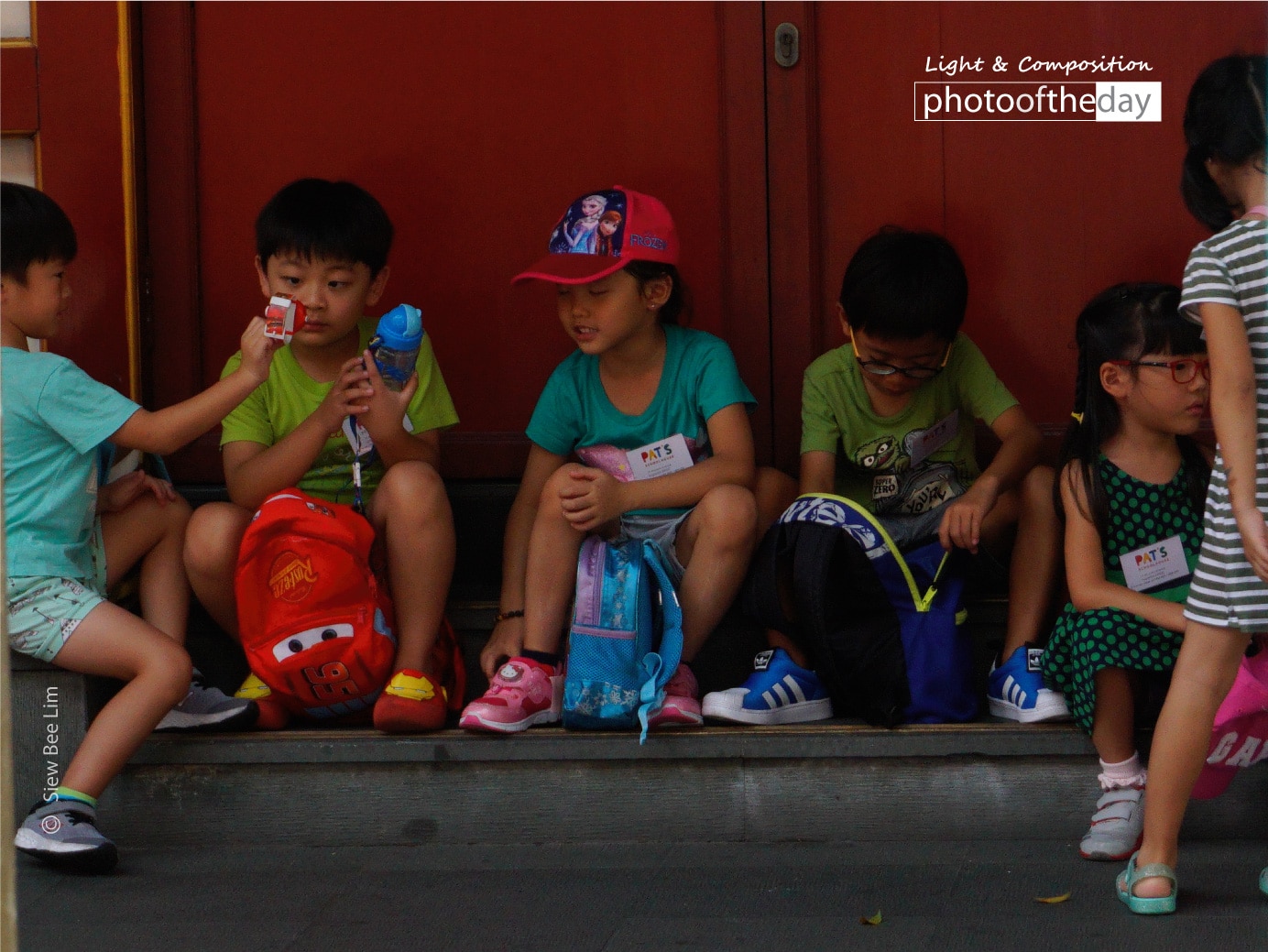
Having a Rest by Siew Bee Lim
Captured in the vibrant atmosphere of Singapore’s Chinatown during the Lunar New Year, this poignant image documents a quiet moment of repose for a local playgroup resting outside a temple. The photographer, drawn to the candid innocence of children, expertly utilized the natural light and cultural backdrop to frame this fleeting scene. The photograph is award-worthy for its authentic documentary quality, capturing a slice of life that balances cultural tradition with the universal, gentle stillness of childhood, demonstrating a keen eye for human connection amidst the bustling festivities.
Siew Bee Lim
Born in 1965 in Singapore, Siew Bee Lim is a dedicated photographer who rediscovered her passion for the craft later in life. Though she initially explored photography as a young programmer, she has returned to the medium with a renewed commitment to formal learning and artistic growth. Drawing inspiration from her lifelong appreciation for literature and Chinese painting, she now focuses on documentary photography, seeking to capture the authentic, candid moments of daily life with a fresh and evolving perspective.
Resonance Score Breakdown
Transparency Note: The resonance score (11.7/20) is calculated based on social engagement metrics collected before the award announcement.
Expert Photography Reviews · 7
The Pause Between Heartbeats
I often find myself lingering near the old stone steps of the public library, watching the way the city rushes past in a blur of commuters and delivery bicycles.
Read the reflection →The Architecture of Repose
In the high heat of summer, certain species of alpine marmots will retreat into the deep, cool shade of rock crevices, abandoning the frantic labor of foraging to simply exist in the stillness of the stone.
Read the reflection →Reviews & Comments
Share your thoughts about this award-winning photograph. Your reviews contribute to the community engagement score.
The shutter snaps, and the world stops spinning. It’s a quiet cut in the middle of a chaotic festival. The children are slumped in that heavy, honest exhaustion only kids possess. I’ve seen a thousand street scenes, but this one hits me right in the chest. The framing holds the stillness perfectly against the temple’s backdrop. It’s the shot the editor keeps because it’s the only one that breathes. They’ve caught the exact moment time surrendered.
In the shadow of the temple, the world’s noise fades. We see these children, limbs tangled in the exhaustion of play, and we’re reminded that stillness is a language all its own. Siew Bee Lim didn’t just point a lens; she waited for the silence between the festivities. It’s a tender, honest pause. Looking at their small, heavy eyelids, I feel a sudden, sharp ache for the uncomplicated peace of my own childhood. It’s truly beautiful.
Most documentary work from this year’s Lunar New Year coverage felt cluttered, desperate to capture the chaos. Siew Bee Lim chose the opposite. By focusing on the children’s stillness against the temple’s rigid geometry, she found a quiet gravity that’s rare. It’s the way their small, slumped shoulders contrast with the ornate architecture that gets me—it feels like a genuine exhale. Thirty years from now, this won’t just be a festival photo; it’ll be a memory of childhood.
It’s easy to snap a shutter when the festivities are in full swing. One wonders how many hours Siew Bee Lim spent loitering in the humidity before the crowd thinned enough to isolate these children. It’s a quiet, honest frame. I’ve spent enough afternoons waiting for a scene to settle to know that this stillness wasn’t accidental. It’s a rare, earned bit of peace in a chaotic city. I find myself quite envious of that patience.
Before the eye identifies the children, something in the chest softens. It’s the stillness that hits first, a quiet pocket carved out of the Lunar New Year’s frantic pulse. I feel a sudden, sharp ache for the weight of my own childhood limbs, heavy with exhaustion. When I return to this, I don’t see a temple; I see the universal surrender of a body that’s finally stopped running. It’s a beautiful, fleeting truce with the world.
The frame resolves into a precise 3:2 grid, anchored by the children’s rhythmic, staggered alignment. Their bodies form a series of repeating triangles that break the rigid verticality of the temple pillars. I’m genuinely struck by how the negative space in the lower quadrant balances the dense, ornate textures above. It’s a beautifully solved spatial equation; the geometry doesn’t just contain the stillness, it creates it. Everything here is perfectly weighted, turning a fleeting moment into a stable, mathematical constant.
Chinatown’s chaos, yet these kids are anchored in stillness. It’s a rare, quiet pocket. I love the way the temple architecture frames their exhaustion; it’s a perfect contrast to the Lunar New Year frenzy. Did she nail the timing? Yes. One tenth of a second later and the energy would’ve shifted, the composition collapsed. She caught them before the spell broke. It’s honest, it’s raw, and it’s exactly why we keep chasing the light.
beautiful